Showing posts with label reader questions. Show all posts

July 03, 2023

Reader Question: Will MAF ever make me faster?!

Despite the fact that I no longer "train" (or run regularly, for that matter!) I still get asked a particular question pretty frequently. As a running coach, it makes sense that I get questions about running ;)  And running is one of my favorite things to talk/write about!


This question has to do with heart rate training--specifically, MAF training. In short: 'MAF' is a heart rate training method that was developed by Dr. Phil Maffetone; and coincidentally, his method involves a heart rate called Maximum Aerobic Function (i.e. MAF heart rate). From here on out, when I write MAF, I'm referring to the Maximum Aerobic Function heart rate. Heart rate is given in bpm (beats per minute).

(If you want the full, more-information version, here is a post I wrote about the MAF method of training and my thoughts on it.)

Please don't take this as gospel, because it's been a while since I read the MAF book, but the gist is this: a typical person's MAF heart rate is a simple number that is calculated by subtracting their age from 180. (Let's say you are 40 years old--your MAF heart rate would be 140, because 180 bpm - 40 (age)=140 bpm.) 

To train using the MAF method, you do all of your running at or under your MAF heart rate. In the example above, the 40-year old woman goes for a four-mile run several days a week--and each time she runs, she must keep her heart rate at or below 140 beats per minute. Always. No matter the situation.

Let me tell you, it feels VERY SLOW. But we'll get to that in a minute.


According to Dr. Maffetone, if you always run at that MAF heart rate, you will naturally get faster while maintaining the same heart rate. Your muscles and cardiovascular system are getting more efficient each time you run at your MAF rate, and therefore, it takes less effort to do the same amount of work (your running pace).

So, here is the big question/problem that people ask me about frequently: Running at the MAF heart rate is SO SLOW--I have to walk a lot of the time, especially when going uphill, and it feels like I'll never get faster. Does it really work? Will I get faster if I only ever run at my MAF heart rate?

First, let me be clear that I have not done the MAF method 100% for more than a couple of weeks. (I use the MAF formula frequently, but I'll get to that later.) I hadn't really studied the method until a friend told me about it, and the whole idea made so much sense to me. I loved it!

Until I tried to run at MAF pace and was soooo slow that I was very embarrassed. (Wisdom I wish I knew then: Don't ever be embarrassed at what pace you run. Seriously, that's dumb.)

I didn't do MAF training for long because I just didn't have the patience to see it through. I wanted to run FAST, dammit! So I ignored it for a few years. I read a book called Hansons Marathon Method in 2013 to train for the Chicago Marathon. It involved a LOT of running, but it really stressed that most of the running should be SLOW and easy. I didn't even know the meaning of "easy"--all of the runs I thought I was doing at an easy pace were not, in fact, easy. They were pretty much "garbage miles"--too slow for speed work, too fast for cardio efficiency.

(I hope I'm writing this in order--but this is the end result, regardless...) I wanted to train with the Hansons Marathon Method, and decided to use my MAF heart rate as the rate I would use for my easy runs. And finally, I read a book called '80/20 Running' by Matt Fitzgerald--he says to spend 80% of the TIME spent running per week at an easy pace, and 20% of the TIME can be spent doing work that raises your heart rate into a particular zone. (It's key to note that it's *time* and not *distance*.)

I sort of combined the methods to train for Chicago: the training plan in the Hansons Marathon Method Book (you can find my review of the whole method here); the 80/20 rule; and using my MAF heart rate to be the heart rate I spent 80% of my time running.

I took this picture after the hardest training run I've ever done: 3 x 2 miles at race pace (for me, that was 7:55/mile at the time). 


Training for a marathon is more of an extreme example for this particular question about MAF training. I used the method mostly during my training for a 10K (spending 80% of my time at MAF heart rate and 20% of the time doing HARD speed work).

I came in second female overall at a 5K that I decided to use as speed work.

I had results. Really good results, in fact.

I wish I could answer the question that I'm asked so frequently--about whether following MAF exactly as it should be will yield the best results--but I can say that the MAF training heart rate number was perfect for my own training.

The pace I had to run at that number felt way too slow (and yes, I had to walk quite a bit to lower it) in the beginning. At that time, I'd been trying to follow the MAF program as written; however, I got impatient and decided to combine it with the 80/20 Method. Then I could get my "fix" of fast running once in a while.

Using the combination of the MAF easy runs (80% of the time) and very hard speed work (which I'll describe), took my 10K pace from about 11:00/mile to 7:55/mile in about six months. I trained SO HARD and definitely got the results I wanted. (Unfortunately, I was burnt out after going after such a lofty goal.) I hit my 10K goal, which was thrilling.

I absolutely think that the MAF method on it's own probably works--thousands of people rave about it. And actually, if you want to read a book about a famous runner who followed this sort of heart rate training and felt SO SLOW at first, check out Rich Roll's memoir called 'Finding Ultra' (the link is to my favorite running books, so you can find it there). 

So, for the official answer to my question...

Yes, I believe that the MAF method works if you do it like you are supposed to. I didn't do it for long (only a couple of weeks) but I could understand how it starts to feel easier at the same heart rate.

Also, when I first started training with MAF heart rate, I felt super slow. But I forced myself to trust the process (I think my pace was 13-something a mile--when I was used to calling my "easy" runs 9- or 10- something per mile, haha!). I remember my MAF heart rate being 146 bpm, and I always kept my pace below that number when I was doing "easy runs".

Per my own permission, I spent 20% of my running time each week doing speed work--intervals and/or tempo runs. And I went hog wild with them, making each of those workouts really count. Seriously, I gave them my ALL. I think that was important--what's the point of half-assed speed work?

I think the combination of the two methods is a great way to train, regardless of the distance. I wrote out several places that use the method; you can check out my free training plans on this page. The plans can even be used for walking--I've discovered I have to walk VERY fast to get my heart rate up to MAF; and holy smokes, it's a tough workout. 

You could actually use this method for any sort of cardio exercise you like to do, now that I think about it. The whole point is to make your body more efficient at the workload you give it; and it does this by being trained, over and over, at that particular exertion (your MAF heart rate). Eventually, you'll have to work really hard to get it up there!

(If I remember correctly, I think my "easy runs", using MAF heart rate during 10K training, went from 13:00 minutes+ per mile to just under 10:00 per mile. At the same heart rate of 146 bpm! I wish I could tell whether it was the MAF method, the 80/20 Method, or a combination of the two that did it, but I'll never know for sure.)


After all is said and done, it wouldn't hurt to TRY doing the MAF Method exactly as intended--see what happens. (And definitely email me and let me know.) If you really don't see good results after the time that Dr. Maffetone suggests, you can always decide to try a different method (or try adding speed work, like I did). But there certainly isn't anything wrong with giving it a try.

I think the hardest part about it is all mental--making yourself run/walk/bike/etc. much slower than you want or that you're used to is mentally challenging! I'm sure that once you start to see results, it will be encouraging, though. 

(Oh, this is a random question that deserves a spot here as well: Dr. Maffetone says that you don't have to change your MAF heart rate every year on your birthday. He says that as long as it's working for you and your health hasn't changed, you don't need to change it. I found 146 bpm worked so well for me when 10K training that I used that number for a couple of years.)

This post isn't nearly as clear as I hoped it would be, but I wanted to try to write this info in one place for anyone who may be wondering the same question. Give MAF a try, and let us know how it works out for you! Or, make it your own and work the MAF method into your own training like I did.


March 25, 2023

Post-Race Blues (a reader question)

I was looking for something to post today and I re-discovered a folder in my email called "Blog Post Ideas"--they are ideas that were submitted by readers. At the time I made it, I had every intention of writing about each of them--and then, being me, I completely forgot the folder was even there.

So, I started looking through them today, and there was one from 2019(!) about "post-race blues" and how to get motived to start running again after a big race is over. Since I was just writing yesterday about how I just don't feel motivated to run right now, I thought it might be a helpful post (for myself, even).

In 2016, I ran a personal best 10K and I felt on top of the world. I had trained SO HARD for that time. The previous fall, I was running an 11:00 minute mile for a 10K and my goal (for April) was to run a 7:55 minute mile pace. Sounded completely impossible.

But I trained my ass off, even losing 40 pounds in the process. And on race day, I did it! I was so happy and relieved that all of my training had paid off.


And you know what? That was the last time I felt *truly* excited about racing. After that, I didn't care about my speed or distance, or even running races ever again. I had reached that big goal and I didn't really have another desire to reach new distances or speeds. I wanted to keep running, but more for exercise/hobby/fun than anything.

I wish I could say that it has changed over time, but it honestly hasn't. I go through phases where I really enjoy running and other times, phases where I want to quit for good (right now, I have no desire to run). The point is, though, I had the post-race blues after that 10K for a long time. I actually went into a pretty deep depression for nearly a year--at which time I went to a psychiatrist and was diagnosed with bipolar.

I felt like I just didn't have anything to look forward to after crushing my goal. I'd worked so hard that I never wanted to try to better my time once again. I've only run a few races since then and I haven't truly *raced* any of them. In 2018, I gained a lot of weight back because I just couldn't find that drive I used to have--not just racing, but in diet as well. 

I replied to the reader who had sent me the question--I said that I'm not "credible" to give advice about getting motivation back to keep running because I hadn't yet gotten there myself. I said that once I figured it out, I would be sure to write about it.

And here we are, almost four years later... do I have the right advice? Unfortunately, no.

This is where I am hoping some other people can jump in and give their own advice for getting back to running after the "post-race blues". I'm in a bit of a pickle (totally my fault) right now because I have a 10K race in two weeks and I'm not even close to ready for it. I don't know whether to go try to run it and do my best or just go and cheer Nathan on while he runs it (we hadn't planned to stick together through the race itself--he's much faster than I).


Basically, I want to WANT to run. There were times where I was excited to train because I could see myself improving. There were times that I switched up training methods to keep things interesting. I coached cross country and hoped that would motivate me; I've read running books and I've listened to running podcasts to no avail. I just can't get back that full-force drive I used to push me to train. Or if I wasn't training for a race, I ran anyway.

In my heyday, if someone would have asked, I would have suggested:

*Pick a new race to train for.
*Set new goals for either distance or speed (not both at the same time)
*Check out some running motivation (I wrote a whole post about my running motivators here)
*Try a different training method (if you're used to training by speed, then try heart rate training; if you're used to training by distance, try running shorter distances but faster; etc.)
*Pick a running plan that is different than anything you've done before; there is something about the fresh, new start that is a pick-me-up
*Take a short break from running and try another sport--or maybe even set your sights on a triathlon.
*Make it fun with friends by signing up for a race like a Ragnar Relay (that's the race that I did with a team in the film 'From Fat to Finish Line').
*Get together with a friend and train for another race together--even if you don't have plans to run a personal best.
*Sometimes just looking through past race photos helps!

As you can see, I have ideas. They just haven't panned out for me--either due to excuses, laziness, lack of interest, or inability due to injury or something like that. 

So, Friends, I ask you now... what would your advice be? I want to know for myself as much as for the reader who asked the question! (A million years ago) Thanks :)

June 30, 2022

Candidly Katie #31


Again, this post is the formerly-called "Reader Q&A". I just thought Candidly Katie had a certain ring to it that sounded nice :)  On these posts, I'll respond to readers' questions (if I have any)--either fun ones or more serious ones, or whatever you come up with. I feel like I write SO much about myself (I've been blogging on Runs for Cookies since 2011) that I tend to forget what I've written and what I haven't.

Anyway, if you have any questions for me, please email them to me! Just send an email to: katie (at) runsforcookies (dot) com. I'll keep your name anonymous :)  Here goes! A few questions for this segment...

With your running certification I think you could help answer some questions for us beginners  :)  One question I have is:  Once I am able to run a mile without stopping, how quickly would you anticipate I would be able to run 2 miles or 3 miles?

Katie: I hate to answer this with such a vague "that depends" answer, but honestly--it does! However, I'll answer from my own experience as well as working with the kids on the cross country team.

When it comes to running, you'll find that the farther you go, the easier it is to go farther next time. Before thinking about that hurts your brain, think of it this way: If you go out and struggle through 1/4 mile (let's say that's the farthest you can run now), and I asked you to run 1/2 mile the next day, that feels like a HUGE increase.

However, if you are currently able to run 24.75 miles, and then next time, I ask you to run 25 miles, it's still a difference of 1/4 mile. That quarter-mile is going to be MUCH easier than running it when you're used to running 1/4. Does that make sense?

When I first started running, I couldn't run very far at all--not even the length of my street, which is probably 0.1 mile. My brother told me to go slower--as slow as molasses--and he bet I'd be able to double or even triple my distance. Well, he was right! I ran over a mile when I tried that.

To finally answer your question: Each time you run, it gets a little easier. The hardest part is the uncharted territory of that run. A mind trick I used to play when I had a long run (let's say my long run was 10 miles) was that I had to run 8 miles with a one mile warm-up and a one-mile cool down. I'd run eight miles before, so it didn't feel new to me. And calling those extra miles a warm-up and cool down made it seem much less scary.

Here is a picture of Jessica and I after we ran our first 20-miler--we were so proud! (Well, it was actually 16 miles with a 2-mile warm-up and 2-mile cool down, haha.)


If I had to guess: let's say you just ran your first mile and now you're training for two. If you're running regularly (3-5 times a week), I would say that you'd be able to run two miles after a couple of weeks. Depending on your training plan, that probably won't be the best way to increase mileage, but if that is the overall goal, you could just run a little farther each time and hit two miles then three miles relatively quickly.

Here is a post that I wrote about starting to run and running faster. Hopefully that helps!


I'm trying to drink water, which I really don't like. I'm wondering if you drink bottled or tap water and if you ever use those little flavor packets. And also, we recently bought a big seedless watermelon. It was so sweet and full of water. Is that something you do?

Katie: Hahaha, always with the water! I never used to struggle with it, but for the last few years, it's been really hard for me to get in much water.

I always drink tap water (I don't even filter it; I just drink it straight from the tap) and I'm very fanatical about using a reusable water bottle. It drives me CRAZY to see people drinking water from disposable bottles (not trying to start a debate; it's just something I'm kind of passionate about.)

I wouldn't say that I *love* water, but it's definitely my go-to drink. I don't like to waste calories on other drinks. To get in as much water as possible, I fill up a 1 Liter bottle and chug it as quickly as I can (usually within about 3-4 minutes). I impressed Luke and Riley one day by drinking the entire bottle without stopping for air, haha!

As far as watermelon, I don't count that as water--although it does have a ton of water and certainly would help hydrate you. In my own mind, I only count water as water (no tea, coffee, juice, etc.). I chew a ton of ice every day (I'm not anemic, I just like to chew ice), but I don't count that toward my water intake, either. I aim for 4 Liters of pure water a day (about a gallon).

I don't use the flavor packets or anything, either. I don't necessarily think there is anything wrong with them, but when I drink water, I tend to chug it rather than sip it; so the flavor packets don't really do anything for me. But I say hey--get your water in however it's easiest for you! 


I have about 50 pounds to lose, I am chipping away at it very slowly, losing about 0.5-1 pound per week. But I still dread getting on the scale! I have a hard time feeling good when I lose so little each week, and I can hardly feel the difference myself in the 10 pounds I've already lost.

This is usually the point in the past when I've given up, go into "eff-it!" mode and stop tracking. But I really, really want to stick with it this time! Any thoughts on a pep talk around the scale? Or what you're thinking at the beginning of long weight loss journey when you're making progress but before you really see any results?

Katie: Well, this is great timing. I just lost 50 pounds! And it took me a long time--a full year. 

Here is the way I look at and hopefully it'll help: I know that I want to lose the weight--it's a fact. I know it's going to take me a while to lose the weight (in this case, it was 50 pounds). That's a fact as well. I *also* know just how hard it is to keep the weight off after losing it and that there is NEVER going to be a finish line. You'll always be working at either losing it or maintaining it.

When the scale barely budged for me (or if I had a gain) I kept in mind that I'm not in a race to the finish line--because there isn't one--but I'm just doing what I need to do forever. If the scale says I lost five pounds or only half a pound, it isn't going to change the way I eat that day. (Or it shouldn't, anyway.)

Losing a large amount of weight is SUPER overwhelming and it feels almost hopeless in the beginning. But if you stop thinking of it as a weight loss journey and more of just everyday life, the number won't matter so much. If you're doing what you know you should be doing for your body (eating right, exercising, etc.) then it shouldn't matter what the scale says. It WILL go down eventually; the "eff it" moments are the defining moments where you'll either continue to lose weight or you'll give up and you DEFINITELY won't lose the weight.

Another option would be to stop looking at the scale for a while. Maybe only once a month? I prefer to weigh every day; it helps me to see how different foods affect me. However, I don't let it trigger me to quit if the scale doesn't show what I hope. I'm very reasonable and level-headed when it comes to the scale. If it says I gained a pound but I know I didn't eat an extra 3,500 calories, then I don't even give it a second thought. It's not unusual for my weight to fluctuate up to 4-5 pounds in a single DAY. 

My very favorite way to track my weight loss when I was losing 125 pounds was this: I had a pair of jeans that was one size smaller than the current size I was wearing. Every week, I'd try on the too-small pair and see how close they were to buttoning and/or zipping, and then once I could get them buttoned and zipped, I'd buy a pair that was one size smaller and keep going. It was always so exciting to get to move down a size! (I went from a 24W to a 2 at my smallest; I'm about a 6 now.)


I realize this answer is all over the place; it's just so hard to explain the workings of my mind. Basically, if you keep doing all the right things, the scale will continue to move downward. A year from now, you could be 50 pounds lighter if you keep going! Maybe it'll take two years, but does that really matter? A year from now you'll at least be halfway to your goal. And I promise that a year from now, you'll wish that you'd started today!

This is a one-year comparison (losing just less than a pound a week):


Okay, hopefully my answers weren't too scatterbrained today! Those were good questions :)  And now a question for all of you...

How do you drink your water? Tap, bottled, filtered, etc? Do you use your own refillable bottle or disposable? A straw or no straw? Flavor or no flavor? So many choices for such a simple thing!

June 23, 2022

Candidly Katie #30 (formerly 'Reader Questions')


I had planned to post pictures of Noah's bedroom makeover today, but his comforter hasn't arrived yet. It's *supposed* to be here tomorrow, so if it is, I'll take some quick pictures and post all about the makeover. I know I'm turning it into a big deal, but it was a really fun project to work on and Noah was SO happy with it!

So, I will get those posted on Saturday (hopefully!) because I don't want to skip my Friday Night Photos again. My camera roll has quite a few pictures, if I remember correctly. Instead, I thought it would be fun to do another installment of reader questions, or as I'm not going to rename it "Candidly Katie".

I feel so vain calling it that, but that's essentially what it is! And it has a better ring to it. Actually, knowing what I know now, I would have for sure made my blog name 'Candidly Katie' instead of 'Runs for Cookies'. I even bought the domain!

These posts are where I answer readers' questions--anything from my favorite way to spend a Saturday to which way the toilet paper should hang on the roll (haha!) to dealing with anxiety. So, if you have a silly or serious question, please feel free to email it to me!

Just write it to: katie (at) runsforcookies (dot) com and I'll save it for a future "Candidly Katie" post. 

So here goes...

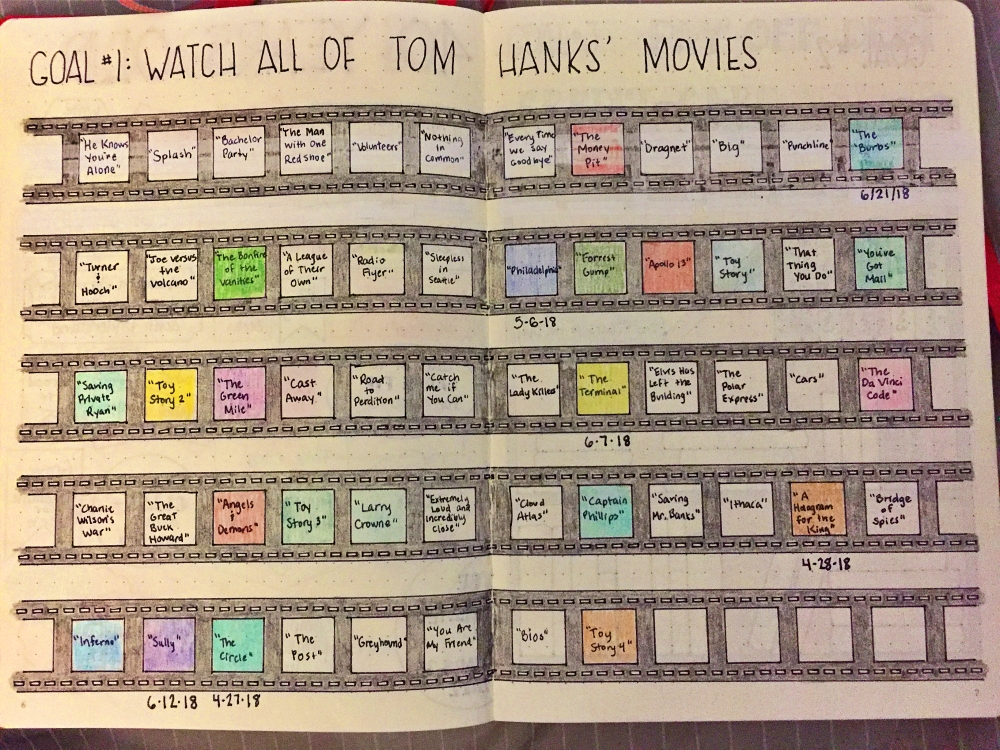
Q. Did you ever watch all of the Tom Hanks movies?  I recall a long time ago you mentioned that on your blog.

Katie: It's true, I did make a goal to watch all of Tom's movies (can we be on a first-name basis? I think so!). I'd made a goal that I called 40x40--a list of items to accomplish by the time I turned 40. I was doing fairly well with the list until the pandemic hit and ruined quite a bit of the plans. It actually would have been a perfect time to watch all of his movies! However, I did not.

I probably watched half of them in total. I hadn't thought about the fact that several of the movies weren't streaming or if they were, they were expensive. So, I hate to say I gave up on that goal, but in all honesty, that's what I did.

My rule was that I had to watch them all--even the ones I already saw. The ones colored in are the ones I saw after I made the goal to watch all of them.


Q. How did you get into wood working?  (you are so good at taking things apart and building things!)

Katie: This happened when I was making over my entire house from top to bottom. It's kind of funny--when I was working on the baseboards (the boards against the wall at the floor), I didn't have a miter saw, which would have made it 10,000 times easier. I had a coping saw, which looks like this:


I had to hand-miter each and every piece of the corners of the floor boards! I had to do some of the window casings, too. Needless to say it took forever. Eventually, I found a miter saw on Marketplace and it was a total game changer for me. I loved that thing! I couldn't believe how much easier it was (not to mention faster). It was then that I fell in love with tools.

I also borrowed my brother's Paslode nail gun to use for attaching the trim at the floor and around the windows and all that. I was in awe of how cool it was! Each new tool I tried, my mind was blown. I couldn't believe all that you could make with a few tools. I even borrowed my dad's jigsaw to make this cool "pet feeding station". (This was one of my first projects, actually.) I bought a solid handmade bookshelf at a resale shop.

Cat food on top, dog food on bottom. Treats in the middle. The hole on top was for the cats to climb up. They didn't use it the hole, so I covered it over and put carpet on top.


After that, I started looking on Marketplace for used tools. I got an awesome deal on a Paslode for myself! Remember when I drove four hours round-trip to buy it? I also got a great deal on a jointer.

For Christmas a few years ago, my father-in-law (very generously!) bought me a Dewalt contractor table saw (the contractor just means that it's kind-of portable). A table saw can do just about everything! By making jigs, you can use the table saw in ways you never would have thought possible.

Anyway, I could talk about woodworking and tools for days (I actually have a huge post in my drafts folder about my favorite tools, but I haven't published it because who really cares?! Hahaha.) I can't remember the first thing I made, but I'm sure it was totally cringe-worthy now ;)

However, my #1 most popular post happens to be 'How to Build a Squirrel Picnic Table'. I'm pretty proud of that one :)


Q. Have you considered studying psychology?  (I think you would be excellent... you seem to be very good at observing and analyzing human behavior and figuring out what works and what doesn't work).

Katie: It's funny you asked, because psychology was my major at Easter Michigan University! I absolutely LOVE psychology--from mental health to the forensics of why we do the things we do. My ultimate dream was to be a therapist, but after two years of studying psychology, my guidance counselor told me that I really can't do anything with a psych degree; I would have to get a masters in social work in order to be a therapist. *queue shock and what-the-hell-do-I-do-now feelings*

Well, after spending two years studying the wrong courses (even though I found them fascinating!), I just couldn't imagine starting over. So, I gave up on that. I went on to study a couple of other things at the community college that didn't pan out. I couldn't figure out what I was interested in doing. Like you suggested, though, people tell me all the time that I should be a therapist. It's interesting, because I have bipolar disorder, but I am very good at thinking logically and being unbiased. I also have good analogies.

People say that I am good at giving advice; even my own therapist told me several times that I should go back to school to get my masters in social work! I'm very good at validating others' feelings (literally the most important thing I learned in therapy). It changed my life. That post, The Most Important Tool I Learned In Psychotherapy, remains one of my most popular posts. I highly recommend reading it! I just read it again myself and it reminded me just how important it is. (Also, you can read some of my analogies.)


 And there you have it! Some candid questions and answers about me. If you have a question for me, just send me an email at: katie (at) runsforcookies (dot) com. I'll keep it anonymous.

Now a question for you... What did you want to be when you "grew up"? Are you currently doing your dream job?

June 09, 2022

Reader Questions #29


I must have been half asleep yesterday morning when I wrote my blog post; looking at it now, I'm a little embarrassed for the overshare, haha. But I'm thrilled with the bra suggestions, so thank you! 

I was reading through email yesterday when I noticed a folder I'd created a couple of months ago for "Ask Katie" emails. I completely forgot about it! They are questions that readers have for me to reply to on my blog. Years ago, I used to do a Q&A once a week and it was fun to answer questions--everything from what's my favorite movie to the best way to train for a half-marathon. (That's why this is #29; I left off with #28 in 2016.)

I have a few other folders for blog post ideas, too. If I don't keep things in my inbox, I tend to forget about them; so, if you sent me something like that and haven't heard back from me, I'm not ignoring it--I promise.

I thought I'd answer some fun questions today...

Q. I want to know if you were given a free international trip, where would you go, what would you do, how would you travel there and who would you bring?  -Lauren

A. This one is tough because I have travel anxiety (along with everything-else anxiety) and the thought of flying overseas scares the bejeezus out of me! So let's just pretend that my anxiety doesn't exist ;)  The only place I've ever had a burning desire to go is to Alaska; but since that's not international, I think I'd probably pick Africa.

My parents went to Nairobi in 2004 as volunteers to work with a medical staff providing a make-shift clinic for citizens to see a doctor. If I remember correctly, I think my dad worked as a "handyman", fixing things that needed it. And my mom helped fit people for prescription glasses (that had been donated) after they saw an optometrist. She said she loved seeing the disbelief and happiness on their faces when they could see clearly for the first time.


If I didn't have anxiety, I'd love to go there and do something similar! My parents got so much out of that experience and felt great about helping people. They said people walked there from great distances to see a doctor and everybody who was seen/treated was SO grateful.

Sorry, this is a much longer answer than I'm sure you were looking for! Haha. I'd bring Jerry with me--he's my best friend and we have so much fun together. I think he'd really like working on a mission like that, too.


Q. I really enjoy Jerry’s posts; he seems like a great guy.  I have a question for both you and Jerry.  What is the most embarrassing thing that one of your kids did, that you secretly found funny?  You know, when you were totally humiliated as a parent but just couldn’t stop laughing about it?  -Kathy

A. Ohmygosh, there are so many! What a fun question. Jerry doesn't embarrass easily, but as soon as I read your question, the answer popped into my mind immediately. And Jerry agreed that this is the best answer to your question...

When Noah was in preschool, the kids had to line up just inside the entrance to the school until the teacher came and walked them all to the classroom. The parents would sit on the benches in the hallway while the kids lined up and waited for the teacher. Naturally, the kids talked to each other while they were in line.


Noah was having an animated four-year-old-boy conversation with the boy behind him. The teacher appeared and like always, she would wait until the kids were quiet and then she'd walk them down the hall. At the exact same time that it fell silent, Noah yelled to the kid he was talking to, "Shut up, you retard!" (being four years old, his speech wasn't perfect and it sounded like "wee-todd").

Now, you KNOW that I don't use that word--spending so much time with Mark before he died, it broke my heart to see how some people treated him for his intellectual disability--so I have no idea where Noah heard it.

I was mortified and I pulled Noah aside to talk to him about 1) not yelling at people like that; and 2) how it's not okay to say that word. If I'm being honest, though, I was trying hard not to laugh. It was the perfect timing of the whole thing--yelling it right as it got super quiet, and his speech ("wee-todd") made it funny. I told Jerry about it later and we got a good laugh about it. Jerry and I still bring up that moment in conversation once in a while!


Thank you, Kathy and Lauren, for the fun questions! I enjoyed answering them. If anyone else has a question for me, please ask! You can email it to me at: katie (at) runsforcookies (dot) com. Make sure you say somewhere in the email that it's okay to post on my blog; I don't want to accidentally post something that was meant just for me. Depending on how many questions I get, I'll answer them periodically when I'm not sure what to write about.


And now a question for all of YOU... what is the most unexpected and kind thing that someone has done for you?
(I know that trying to comment on my blog is a pain--sometimes *I* can't even do it--so I apologize. I have no idea how to fix it!)

May 12, 2018

A Great Marriage Despite (Bi)Polar Opposite Partners

Just a forewarning, this post may be a little (or a lot) sappy. I'm married to a pretty cool guy, and I might do some gushing here and there ;)


A reader recently submitted a question via my blog topic suggestion form, and it's a question I've actually been asked quite a few times recently. It differs from the normal topics on my blog, so I thought it would be fun to write about.

The reader asked:
"Hi! Would love to hear more about your marriage; you mentioned how you and your husband have nothing in common on one of your recent posts... my husband and I are the same way... I'd love to hear some ideas of how you find common interests and make it work, growing your relationship!"
First, some background...

Jerry and I met when I was 17 and he was 18. Here is the story of how we met. I knew from our first date that I was going to marry him, and I even wrote it in my journal that night. We were young when we got engaged--20 and 21--and were married the following year. So, we were together for four years before we got married; and this August, we will celebrate our 15-year wedding anniversary.


When we got married, it was clear that people thought we were too young. We were each others' first real relationship, and we were inexperienced with life in general. But somehow, I had no doubts whatsoever about the marriage. We got along so well, and we truly loved spending time together.


Fast forward to 2018, and we are still very happily married! We most certainly have our ups and downs like any other couple, and we've had good years and not-so-great years; but overall, I would say our marriage is very successful.

Which is odd, because we are complete opposites of each other. When I say opposites, I mean we have NOTHING in common.

As a side note, I want to share a very mind-blowing statistic that relates to us. In the United States and Canada, at least 40% of all marriages fail--those obviously aren't great odds. But in a relationship where one partner has bipolar disorder? There is a whopping 90% failure rate! (source) I wrote a post about how bipolar has affected my marriage which may help explain why we have managed to stay a part of that 10% success statistic so far.

Anyway, how do Jerry and I not only manage to stay together, but also manage to stay together happily while we have no common interests?

** Because we are opposites, we balance each other out really well. For example, Jerry is very social and outgoing, while I am very introverted and a homebody. So, if not for him, I would likely have zero social life; and if not for me, he would never spend any time at home. In ways like that, opposites really do attract.

** Jerry and I also trust each other with all of our being--I've never trusted anyone like I trust him, and I am very comfortable talking to him about anything at all. He feels the same about me. We don't have any secrets from each other, and we really enjoy talking about our feelings. It makes communication so much easier when you don't have to hold anything back! If I'm mad at him for whatever reason, I don't have to beat around the bush... I can just tell him. And if my mood is a little too crazy for him, he can tell me so.

**As far as our interests go... this is a tougher issue. My therapist actually brought this up with me recently, because she asked what we're going to do to stay happy when the kids move out of the house. We'll only have each other for entertainment most of the time, so we need to find hobbies or activities that we both enjoy doing together.

Up until I started losing weight, much of our relationship revolved around food. We enjoyed going out to eat, and even binge eating in the evenings. After the kids were in bed, we'd dig out some junk food and watch a movie (while eating the entire time). It was no wonder we both gained so much weight! In December 1999, Jerry weighed about 155 pounds; by 2009, he was up to 253 pounds (we had the same starting weight, hahaha).


** Once we started living a healthier and more active lifestyle, we weren't able to use the movies and eating as a "date night" and we had to look at other options. So, we started thinking outside our little box, and trying new things for our "dates". Jerry is typically up for anything at all (another thing that we don't have in common--I am much more reserved), so we tried anything I suggested.

Now, there are a lot of times we compromise on dates--if it's something that Jerry really wants to do, I will do it for him. And vice versa. However, we've also managed to find some things that we both really like and look forward to!

Here are some examples of dates we both enjoy:

** Going out for drinks and Keno at the local bar

** Having another couple over to play Euchre (or other games)


** Having a movie night at home--cuddling up on the couch with a snack and watching a movie

** Going through old photos and reminiscing

** Taking selfies and video selfies while being goofy


** A picnic in the park

** A long walk or bike ride (we both have to be in the mood for this, which is rare)

** Thrift shopping at Salvation Army or at garage sales

** Doing our own thing... together. (I might sit on the couch and write a blog post while he plays a game on the Xbox. It sounds lame, but we enjoy each other's company even when not doing the same activity.)

** Sitting on the back deck in the summer with a cold beer and just chatting

** Comedy clubs

** Taking "couples" quizzes or answering questions out loud (we recently had a BLAST going through this book below (Amazon affiliate link) and seeing how compatible we are--the results are that we are extremely incompatible, hahaha)


And that's about all I can come up with right now. There are things we each enjoy doing individually, so we'll do those things with a friend to spare each other having to do something we don't really like.

** Something else we do that I think helps us stay happy in our marriage is that we go on solo trips sometimes. Since we have such different interests, we'll each plan visits with friends who have the same interests we do. Then, we can get our fix of doing the things we enjoy with someone else who enjoys it as well. 

For example, I'm going to Kansas City this weekend to spend time with a few of my girlfriends, doing "girlfriend-y" things ;) In July, Jerry is going to Wisconsin to visit a friend and go to some beer festival. He's happy that I get to go have fun doing things that he's not interested in, and I'm happy that he's going to attend a beer festival with someone who is just as excited as he is about beer. We text each other pictures throughout our trips and then excitedly recap the details for each other when we get home. We love hearing the excitement in each other's voices as we share our favorite parts of the trip.

And one of the best parts is that we actually miss each other--being away from each other for a few days sort of renews the "butterflies" feeling. It gives our relationship a little "boost"! (We do go on trips together, as well; but those are difficult to plan, because we have such different interests.) 


I know going on solo trips isn't for everyone, so I'm not suggesting that all couples do it. But Jerry and I trust each other so completely that we sincerely want each other to do the things that we enjoy, even if it doesn't involve one of us. Hopefully that makes sense!

** Another thing that helps our marriage stay alive is that we express our gratitude for each other. I am SO grateful every single day that he gets up and goes to work a 12 hour shift in order to provide for our family. I never take this for granted, and I make sure to tell him this often. I don't ever want him to doubt that I am grateful for what he does for our family.


(Funny story behind this picture... Jerry told me to take a selfie of me looking all happy while he was in the ER and post it on Instagram so that my "haters" would talk about how much of a pretentious asshole I am. He was a little high on morphine, and he told me to take a video... so I took a video of him telling me all about how I should post this photo for my haters. It was hilarious! He later had no recollection of saying those things.) 

And likewise, Jerry thanks me for doing the things that I believe are "expected" of me... doing the laundry, cooking dinner, going grocery shopping, etc. He notices when I buy something at the grocery store that he didn't ask for, but that I think he would like. He gets excited that I make it a point to cook his favorite dinner on a day that is particularly stressful for him. 


Since we've been together so long, it would be easy to take everything for granted, because it's so routine. But we make sure to continue to let each other know that the little things matter and that we are grateful for each other.

  Finally, we don't compare our relationship to others. Our expectations are reasonable (I am not expecting to go on dates like they portray on The Bachelor, for example!). We don't force ourselves to do the stereotypical romance--roses, fancy candlelight dinners, etc. We consider it a "date" when we go grocery shopping together! 


We enjoy each other's company, no matter what we're doing. I think that stems from fully trusting each other, sharing our honest feelings, showing our gratitude for each other, and laughing together. The laughter is key for us! We have lots of inside jokes that nobody would understand but us, and we love the opportunity to bring them up. 


In one final, sappy, note, I think our marriage is happy because Jerry and I are best friends. A best friend is someone you can have fun with in pretty much any circumstance, even if it's just sitting on the couch and chatting. We trust each other completely, and we love spending time together. 


We may not be compatible when it comes to the direction of the toilet paper roll (it MUST go over, not under, damnit!) or have the same interests in hobbies, but we fit together like Legos. (I warned you that this post would be sappy!)

If you have any secrets to a happy marriage that you'd like to share, please do! I'd love to read them. 


March 05, 2018

"I know how to lose weight, so why am I not doing it?"

This post is a combination of Weight Loss Wednesday and Mental Health Monday. I asked on Facebook recently for ideas for blog post topics--since I've had a bit of writer's block lately, I hoped that maybe people would have some fresh ideas.

One person wrote:
"My struggle is and continues to be.....
I’ve lost weight in the past, I know what to do, so why aren’t I doing it?
That on and off switch.
Thanks for asking. As I enjoy reading your words, your thoughts!!"
I believe this is mostly mental, which is why I chose to write about it today. It's a question I've asked myself God-only-knows how many times in my life. And I wish I had one solid, concrete answer... but if I did, then everyone would be thin ;)

While I was obese, and a doctor started telling (lecturing?) me one time about the things I needed to do to lose the weight, I cut her off and told her that I know how to lose weight. If you want to know how to lose weight, ask a fat person--we know better than anyone!

We've read all the magazine articles, self-help books, healthy cooking books; we've gone to Weight Watchers and Jenny Craig; we've tried Slim Fast and Whole 30 and the BeachBody programs. We can tell you exactly how many calories are in that doughnut you're eating, or the pasta that you ordered at the restaurant; how many fat grams are in that cookie or slice of pizza. We can tell you how many miles you need to walk to burn off that piece of cake.

WE KNOW HOW TO LOSE THE WEIGHT.

So, the big question is, what stops us from actually doing it?

Jerry and I were goofing around recently and we started taking selfies of us doing all of the emoji faces... haha! I wasn't sure what other pics to use for this post, so this is what you get ;) 

I had to think hard about this question, because I spent 20 years of my life knowing how to lose weight but not actually doing it. Until one day, I did. So, I had to ask myself what was different? Why was I able to do it this time? I came up with three things that I think made the difference.

One

I've written it over and over and over, and I'll never stop saying it: I didn't make changes that I wasn't willing to live with forever. THAT is the big "secret" that helped me to actually lose the weight.


Before you stop reading (most people shut out the rest of what I have to say at this point, because that's not a "real" answer that they are looking for), let me explain the best I can.

To lose weight, we have to make sacrifices. That is a fact. If you don't change a single thing, you obviously aren't going to lose the weight. So, whether we are successful and can stick with it depends on the sacrifices we CHOOSE to make.

If we know what we need to do to lose the weight, we need to ask ourselves if those are things we're willing to do forever (key word is "willing"). If we only choose sacrifices that we're willing to make, then there really isn't a question of whether or not we can do it. We don't have to change everything! We just have to pick and choose the changes that we are willing to make.

Here is a post that explains more about how to do that.

Two

We have to stop making the same old excuses:

"I have a birthday party tomorrow, so I'll wait and start after that."
"This weekend is busy for me, so I'm going to start on Monday."
"I am going to start tomorrow, so I need to eat all of these cookies and get them out of the house."
"I'm going to have my favorite meal one last time before I start my diet."
"The holidays are coming up, so I'm going to wait until after that. I always have so many parties and festivities going on, so I can't stick to a diet during the holidays."

And so on. We've all said them (or similar things) over and over again.


But here's the kicker: If we are TRULY willing to make the sacrifices that we came up with in my first point, then there is absolutely no reason to start later than literally RIGHT NOW. At this very moment. Because there are always going to be birthdays, anniversaries, junk food at home and work, and invitations to go out to dinner--these things won't stop!


Our surroundings, our relationships, our jobs, holidays, special occasions... those things don't change just because we go on a "diet". We are going to have to deal with those things forever, regardless of what we're eating.

So, if we choose to make the changes that we can live with, then why not start right this minute? We don't need "one last" anything, because if it's something we're not willing to give up, then we are going to have it again--no need to treat it like it's out of our lives forever.

Instead, we need to make a plan--starting right this minute. Which leads to...

Three

We need a "life plan" if we're going to stick with the changes we make. We need to plan for the tough situations and know what we're going to do in them. For example, in the previous excuse of, "I have a birthday party tomorrow, so I'll just wait until after that to start," we need to plan for it in a way that will make us happy.

What is it about the birthday party that we feel will throw us "off our diet"? We want to eat all the food, which probably isn't healthy, and a piece of birthday cake? No problem! We just plan for it ahead of time. In my personal scenario, I would plan to eat only the foods that I desire (for example, I might choose to eat a heaping scoop of pasta salad because I love it, but then I would forgo the fried chicken, because I can really take it or leave it--it's not something that I care about.

I would eat all of the things that I want to eat, that sound good to me, and I would skip the things that don't matter so much. I know (from experience) that the first 4-5 bites of a particular food taste the best; after that, it kind of goes downhill, so when it stops tasting as good, I stop eating it. What's the point of continuing to eat it if it doesn't taste as good?


And I always save room for dessert. If I'm full from a meal, then I will have my dessert later (even asking to take a piece of cake home instead of eating it at the party).
(Note: When I was counting Points or calories, my dilemma at a party was that I didn't want to have to try to estimate the calories in everything, and it was just too much work. So I would either eat nothing at all or say "Screw it!" and eat everything. 
Eventually, my solution for that became to just pick a number and count it as that--say, 500 calories for my plate of food, regardless of what was on it. I didn't try to figure it all out; I just ate what I wanted, and counted it as 500 calories.  
Then, when I wrote it in my food journal, I didn't feel like I "screwed up" the entire day or week. When I felt like I blew it with a meal, then I would let that ruin the rest of the day or week. So, by counting it (even if I was off count by 1,000 calories!) I didn't let it ruin my attitude.)
As far as drinks go... one of the sacrifices I was willing to make from the very beginning of my weight loss was pop. I used to drink tons of Dr. Pepper, but I felt I could live without it. I certainly wasn't willing to give up my desserts, but Dr. Pepper was a sacrifice that I was cool with. If you are a pop person, and you don't want to give it up, then plan on having it--but not a whole two-liter. Having one glass of pop at a birthday party isn't the end of the world.

Alcohol is a tough one for me, as you know if you've been reading lately. I had a glass of wine just about every single day when I was losing weight. I measured it out and counted the calories in it. These days, I haven't been so good at stopping with a small glass of wine. And as I get older, it has affected me in a lot of negative ways, so I am choosing not to drink alcohol (I'm not ready to declare "forever" yet... but I'd like to keep it to very, very rarely).

It's not easy for me, though! Just like weight loss, I have to make sacrifices. Of course I want to drink like everybody else at a party, or share a bottle of wine with Jerry or a girlfriend. But I remind myself of the consequences--how bad it will make me feel later, in particular. And when I weigh that in my mind, being 100% honest with myself, I (usually) choose not to have any.


In another example: "I better eat all these cookies now so that I can start my diet tomorrow". I can't tell you how many times I've said this. And you want me to spoil the ending? It won't be the last time you have cookies in your house!

Eating all of the cookies right now isn't going to keep us from being around cookies forever. All it does is give us an excuse to eat all the cookies--it makes us feel like we're doing the "right" thing because now we can start losing weight tomorrow.

In this situation, I've learned that I can have cookies every single day if I want to. I am not willing to give up cookies from my life. So, I leave the cookies in the cupboard, and when I really, truly, honestly want a cookie, I'll eat one (or two--or until they just don't taste as good).

I discovered that there have been so many times where I thought I wanted things (junk food) just because it was "bad"... but way deep down, it didn't even sound good to me at the time. So what's the point of eating it if it doesn't even sound good? Why not save it for when it really does sound good?

I think that listening to our gut feeling (figuratively, not literally--ha) is very important when it comes to food choices. When I'm really struggling, I usually ask myself, "Do I REALLY want this? (Yes! Of course I do!) No, do I really, honest-to-God, want this? Does it really sound that good?" and sometimes the answer is yes; sometimes the answer is no. But I try to listen to that little voice way down in my gut.

Before I eat, I serve myself a small portion of food, even if I'm ravenous. I can always go back for seconds if I want. I eat slowly if I can, and then if I'm ready to get seconds, I'll take a moment to ask myself if I really am still hungry. I have found that my gut feeling (I guess we could call it intuition, although I hate the phrase "intuitional eating"), is the best answer. My head might tell me I want more, but deep down, I know that I don't actually want more.


Okay, that was a very long-winded answer to a simple question:

"I know how to lose weight, so why am I not doing it?"

I think it's because we tend to make things more complicated than they need to be. If we don't give up the things we enjoy, and we learn to listen to our gut feelings about what we REALLY want, it will probably help us to actually "do it".

I think we all know the infinite ways to lose weight, and many of us have tried dozens of them--but by making it complicated, it becomes overwhelming--and of course we would rather choose simple than overwhelming.

So, I guess the nutshell three word answer is: Keep it simple!


Here are some other posts that may be helpful (going into more detail) regarding this topic:

Lose Weight Eating Only the Foods You Love
Changing the Habits That Keep Us From Losing the Weight
Is It Worth the Points/Calories?
My Best Advice For Those With Weight Loss Goals
What I Wish I Knew When I Started Losing Weight
Get It Over With! (Stop Procrastinating and Just Do It)
What Made This Time Different


(I have to say, I do a way better job at making emoji faces than Jerry does!)


August 08, 2017

Lose Weight Eating Only the Foods You Love

I've been doing a ton of updating on my blog recently (reorganizing everything) and I've come across some old posts that I'd forgotten about. This one from December 2011 in particular struck me--I thought, "Wow, that's a good post--why have I not shared that more?". I started it by answering the frequently asked question, "How many calories did you eat to lose the weight?"; but it explained so well the point I always try to make when giving advice to someone who asks about how I lost the weight: you don't have to eat foods you hate in order to lose weight.

The biggest change I made when I was successful at finally dropping the excess 100+ pounds in 2009-2010 was that I didn't force myself to eat salads, yogurt, and grilled fish every day. I chose to eat the foods I love and just eat smaller portions. When I first started, I had no idea if it was going to work in the grand scheme of things; but now I know.

So, I thought I'd revive this old post from 2011 :) Hopefully it's useful!


Something that a lot of people ask me is how many calories I ate while I was losing weight. I don't like answering this concretely, because what worked for me may be (and probably will be) different from other people. So please keep that in mind!

I decreased the calories a little as I lost, but it ROUGHLY breaks down to this: when I first started, I was eating probably about 1800 calories per day (I was counting Weight Watchers Points, not calories, so I can't say for sure). Then I cut back a little at a time, and when I reached a "normal" BMI, I was probably eating 1400-1600 per day.

On days that I ran, I would usually eat more--if I ran 6 miles, for example, I would eat about half of the calories I burned on top of my daily calories. So burning 600 calories would allow me to eat 300 + my daily calorie intake. (In Weight Watchers terms, this equated to eating all of the Activity Points I earned, on top of my daily Points target.)

SparkPeople suggested that I eat 1200-1550 calories per day, and I tried that; but I was starving and bitchy, and it led to binges. So I experimented for a while with different amounts until I found an amount that allowed me to be satisfied and not feel like I was totally deprived, but still allowed me to lose weight. You just have to experiment to see what is right for you. I was not willing to live on 1200 calories per day forever, so I didn't do it then. That's not much food, and doesn't allow for any indulgences; nobody wants to live that way!

A mistake that I think a lot of people make is to try eating 1200 calories a day, realize that it totally sucks, and then they quit. Instead of quitting, try eating 1600 calories a day and see if you lose weight; or 1800, or 1500...etc. I learned that the all-or-nothing mentality is what made me fail so many times in the past. I followed the plan 100% or not at all--and I would always fail. Once I started to make my own "rules", I learned what I could live with and be happy with.

I feel the same way about Weight Watchers Points. A lot of people think that they shouldn't eat their weekly points or their activity points, in hopes of losing weight faster. But usually what happens is they feel so deprived that they quit instead of just using their extra points (I did that many times in the past!). I would suggest using all the Points you're allowed and see how it works; at least then you won't feel like you're starving. Even if Weight Watchers recommends that you eat 29 points per day, there is nothing wrong with trying 35 points a day at first and see if you lose weight. You can adjust as needed.

If there is one thing that I learned while losing weight this time around, it's that there isn't a single plan out there that works for everybody. We have to pick and choose from our plan what we are willing to do--not just what we can do to lose the weight, but what we are willing to do forever.

There is no way that I am willing to commit to working out for an hour six days a week for the rest of my life--so I chose a number that worked for me. I committed to 30 minutes, three days per week (occasionally I do more, when I'm training for a race, but I've only committed to three days). Three is do-able for me. Six is not. We don't have to answer to anybody but ourselves.

As far as calories go, and what I ate to lose weight... I didn't eat anything that I didn't want to. There are so many different foods out there to choose from that there is no reason that you should force yourself to eat celery sticks and broiled fish (unless you really enjoy those foods, of course!). Even people who have dietary restrictions for medical reasons can choose the foods they love that fit into their guidelines.

For example, I don't like salad; but I do like roasted cauliflower. So I ate what I enjoyed (the cauliflower) and skipped the salad. I was still getting healthy vegetables; but it was food I liked, and not what I felt I "should" be eating.

Something else that I did as part of my daily routine (and still do) is to eat a dessert every single day. Not just fruit, or sugar-free Jello or something like that. I picked an indulgent dessert for about 300 calories, and I set aside those calories at the beginning of the day to make room for them. I ate fairly healthy all day long, trying to get a good variety of foods--only things I enjoyed--and then at night, I would indulge in my dessert that I had planned out ahead of time.


That dessert gave me something to look forward to all day while staying on track. That dessert made it so much easier to say 'no' to tempting foods during the day when I knew I was going to have an awesome treat that night. We don't have to eat only health foods to lose weight. We can work some junk food into our diets. Chances are, if you're anything like the obese me, you're eating a lot of junk food now as it is; so planning on one dessert would actually be cutting back. It was cutting back for me, anyway! ;)

Finally, in order to be successful while counting calories, it's important to be honest with ourselves. I highly recommend measuring or weighing out portions (I prefer to weigh). I can't stress this enough. It's so easy to guesstimate the amount of oatmeal or cereal or something we're going to eat; but when we take the time to measure/weigh it out, we are getting the exact amount that we are counting the calories for. As much of a pain in the ass as it sounds, I actually weighed out, on a food scale, everything that I ate.

Some people, however, aren't willing to weigh/measure food--and that's fine! Remember, I said we should only make changes that we're willing to make. Just try to make your best guess and be honest with yourself. You might lose weight a little slower than if you weighed/measured your food, but you'll still be making a conscious effort to eat less calories, and the weight will come off.

Losing weight is a ton of work. If someone expects it to be easy, they're going to have a much harder time. It takes a lot of time and dedication to weigh out portions, plan meals, and keep track of calories. Most people are so disappointed to hear that THIS is how I lost the weight--by putting in a lot of work! But if you're willing to do the work, then you'll definitely see the results.

For the past year, I've been experimenting with "intuitive eating" or "mindful eating" or "normal eating" in order to not have to count calories forever. It's been extremely difficult, but I'm learning a lot about myself and why I eat. I still believe that counting calories is the best way to lose weight at first--for at least 6 months to a year--to get used to smaller portions, having accountability, having structure, getting into a routine, etc.

Ultimately, I would love to be able to eat intuitively and maintain my goal weight though! However, I've accepted that this may not happen, and I'm okay with that.

I hope this is helpful for anyone who is thinking about counting calories. The most important things to remember are: 1) Only eat foods you truly like; 2) You don't have to follow someone else's guidelines--make up your own plan that works for you; and 3) You'll probably have to do some experimenting to see what works and what you can stick with for the long haul--but don't quit!


Featured Posts

Blog Archive