Showing posts with label 80/20. Show all posts

July 03, 2023

Reader Question: Will MAF ever make me faster?!

Despite the fact that I no longer "train" (or run regularly, for that matter!) I still get asked a particular question pretty frequently. As a running coach, it makes sense that I get questions about running ;)  And running is one of my favorite things to talk/write about!

This question has to do with heart rate training--specifically, MAF training. In short: 'MAF' is a heart rate training method that was developed by Dr. Phil Maffetone; and coincidentally, his method involves a heart rate called Maximum Aerobic Function (i.e. MAF heart rate). From here on out, when I write MAF, I'm referring to the Maximum Aerobic Function heart rate. Heart rate is given in bpm (beats per minute).

(If you want the full, more-information version, here is a post I wrote about the MAF method of training and my thoughts on it.)

Please don't take this as gospel, because it's been a while since I read the MAF book, but the gist is this: a typical person's MAF heart rate is a simple number that is calculated by subtracting their age from 180. (Let's say you are 40 years old--your MAF heart rate would be 140, because 180 bpm - 40 (age)=140 bpm.) 

To train using the MAF method, you do all of your running at or under your MAF heart rate. In the example above, the 40-year old woman goes for a four-mile run several days a week--and each time she runs, she must keep her heart rate at or below 140 beats per minute. Always. No matter the situation.

Let me tell you, it feels VERY SLOW. But we'll get to that in a minute.


According to Dr. Maffetone, if you always run at that MAF heart rate, you will naturally get faster while maintaining the same heart rate. Your muscles and cardiovascular system are getting more efficient each time you run at your MAF rate, and therefore, it takes less effort to do the same amount of work (your running pace).

So, here is the big question/problem that people ask me about frequently: Running at the MAF heart rate is SO SLOW--I have to walk a lot of the time, especially when going uphill, and it feels like I'll never get faster. Does it really work? Will I get faster if I only ever run at my MAF heart rate?

First, let me be clear that I have not done the MAF method 100% for more than a couple of weeks. (I use the MAF formula frequently, but I'll get to that later.) I hadn't really studied the method until a friend told me about it, and the whole idea made so much sense to me. I loved it!

Until I tried to run at MAF pace and was soooo slow that I was very embarrassed. (Wisdom I wish I knew then: Don't ever be embarrassed at what pace you run. Seriously, that's dumb.)

I didn't do MAF training for long because I just didn't have the patience to see it through. I wanted to run FAST, dammit! So I ignored it for a few years. I read a book called Hansons Marathon Method in 2013 to train for the Chicago Marathon. It involved a LOT of running, but it really stressed that most of the running should be SLOW and easy. I didn't even know the meaning of "easy"--all of the runs I thought I was doing at an easy pace were not, in fact, easy. They were pretty much "garbage miles"--too slow for speed work, too fast for cardio efficiency.

(I hope I'm writing this in order--but this is the end result, regardless...) I wanted to train with the Hansons Marathon Method, and decided to use my MAF heart rate as the rate I would use for my easy runs. And finally, I read a book called '80/20 Running' by Matt Fitzgerald--he says to spend 80% of the TIME spent running per week at an easy pace, and 20% of the TIME can be spent doing work that raises your heart rate into a particular zone. (It's key to note that it's *time* and not *distance*.)

I sort of combined the methods to train for Chicago: the training plan in the Hansons Marathon Method Book (you can find my review of the whole method here); the 80/20 rule; and using my MAF heart rate to be the heart rate I spent 80% of my time running.

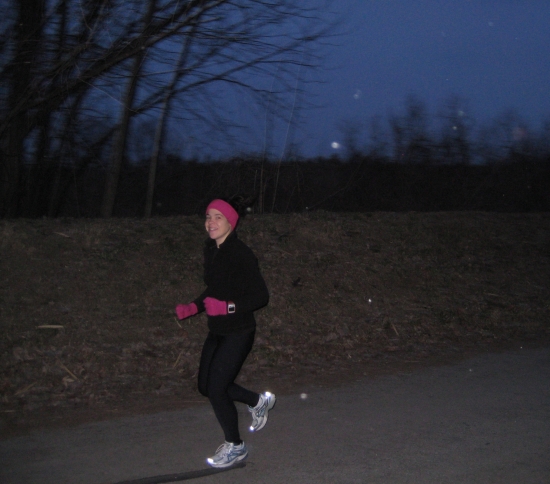
I took this picture after the hardest training run I've ever done: 3 x 2 miles at race pace (for me, that was 7:55/mile at the time). 


Training for a marathon is more of an extreme example for this particular question about MAF training. I used the method mostly during my training for a 10K (spending 80% of my time at MAF heart rate and 20% of the time doing HARD speed work).

I came in second female overall at a 5K that I decided to use as speed work.

I had results. Really good results, in fact.

I wish I could answer the question that I'm asked so frequently--about whether following MAF exactly as it should be will yield the best results--but I can say that the MAF training heart rate number was perfect for my own training.

The pace I had to run at that number felt way too slow (and yes, I had to walk quite a bit to lower it) in the beginning. At that time, I'd been trying to follow the MAF program as written; however, I got impatient and decided to combine it with the 80/20 Method. Then I could get my "fix" of fast running once in a while.

Using the combination of the MAF easy runs (80% of the time) and very hard speed work (which I'll describe), took my 10K pace from about 11:00/mile to 7:55/mile in about six months. I trained SO HARD and definitely got the results I wanted. (Unfortunately, I was burnt out after going after such a lofty goal.) I hit my 10K goal, which was thrilling.

I absolutely think that the MAF method on it's own probably works--thousands of people rave about it. And actually, if you want to read a book about a famous runner who followed this sort of heart rate training and felt SO SLOW at first, check out Rich Roll's memoir called 'Finding Ultra' (the link is to my favorite running books, so you can find it there). 

So, for the official answer to my question...

Yes, I believe that the MAF method works if you do it like you are supposed to. I didn't do it for long (only a couple of weeks) but I could understand how it starts to feel easier at the same heart rate.

Also, when I first started training with MAF heart rate, I felt super slow. But I forced myself to trust the process (I think my pace was 13-something a mile--when I was used to calling my "easy" runs 9- or 10- something per mile, haha!). I remember my MAF heart rate being 146 bpm, and I always kept my pace below that number when I was doing "easy runs".

Per my own permission, I spent 20% of my running time each week doing speed work--intervals and/or tempo runs. And I went hog wild with them, making each of those workouts really count. Seriously, I gave them my ALL. I think that was important--what's the point of half-assed speed work?

I think the combination of the two methods is a great way to train, regardless of the distance. I wrote out several places that use the method; you can check out my free training plans on this page. The plans can even be used for walking--I've discovered I have to walk VERY fast to get my heart rate up to MAF; and holy smokes, it's a tough workout. 

You could actually use this method for any sort of cardio exercise you like to do, now that I think about it. The whole point is to make your body more efficient at the workload you give it; and it does this by being trained, over and over, at that particular exertion (your MAF heart rate). Eventually, you'll have to work really hard to get it up there!

(If I remember correctly, I think my "easy runs", using MAF heart rate during 10K training, went from 13:00 minutes+ per mile to just under 10:00 per mile. At the same heart rate of 146 bpm! I wish I could tell whether it was the MAF method, the 80/20 Method, or a combination of the two that did it, but I'll never know for sure.)


After all is said and done, it wouldn't hurt to TRY doing the MAF Method exactly as intended--see what happens. (And definitely email me and let me know.) If you really don't see good results after the time that Dr. Maffetone suggests, you can always decide to try a different method (or try adding speed work, like I did). But there certainly isn't anything wrong with giving it a try.

I think the hardest part about it is all mental--making yourself run/walk/bike/etc. much slower than you want or that you're used to is mentally challenging! I'm sure that once you start to see results, it will be encouraging, though. 

(Oh, this is a random question that deserves a spot here as well: Dr. Maffetone says that you don't have to change your MAF heart rate every year on your birthday. He says that as long as it's working for you and your health hasn't changed, you don't need to change it. I found 146 bpm worked so well for me when 10K training that I used that number for a couple of years.)

This post isn't nearly as clear as I hoped it would be, but I wanted to try to write this info in one place for anyone who may be wondering the same question. Give MAF a try, and let us know how it works out for you! Or, make it your own and work the MAF method into your own training like I did.


November 17, 2019

Peak! (And a recap of 3-3-3 running for week 7)

So much for writing daily in November!

My daily writing goal is like a lot of goals that I make--I miss one day and then figure I already "ruined" it, so I might as well just forget it. It's a terrible mentality! If I miss a day, I should just get right back to it.

It may not seem like an important goal (writing every day) but I find that on the days that I write a blog post, my anxiety is much lower in general. I still get very nervous about posting something vulnerable, but for even when I write personal posts like that, I feel good about writing in general. I enjoy writing!

So, I'm not going to quit trying to hit this 30 day challenge. I just have to keep starting over, haha. One of my "40 Goals by 40 Years Old" goals is to complete a 30 day challenge. And I decided that I want writing a blog post every day for 30 days to be that challenge.

Lately, I've had more time to myself, but I've been distracted. I had NO free time for about four months; now that the craziness of summer and fall is over, however, I find myself with some time to do things I enjoy. One of those is an app I downloaded on my phone called Peak.

Peak is very similar to Lumosity, which you know I love. I've been playing Lumosity for a long time now, though, and had gotten the top score on most of the games. I was starting to get bored with a lot of them. I really like mind games like the ones on Lumosity, so I looked in the app store for another one that is similar.

And that is how I discovered Peak. I have to say, I think I like it even more than Lumosity! (I liked it so much that I even paid for the subscription.) There are a few games in Lumosity that are still favorites, and unfortunately don't have equivalents in Peak, but Peak has a larger variety of games and it has goals to work toward.

There are badges to earn (it's like they knew exactly how to suck me in!):


So, I've been playing the games on Peak (probably way too much) instead of writing on my blog. It feels good to do something enjoyable and stress free, though!

I have several random things to write about (a bullet-style post would probably be best, because everything is so random) but I think I'll save that for tomorrow. Since tomorrow starts Week 8 of my 3-3-3 running plan, I want to recap Week 7.

I've still been running on the treadmill. We actually got quite a bit of snow here on Monday--enough to warrant a snow day for the kids on Tuesday!--and the roads in the neighborhoods are still icy in patches.

Also, at the suggestion of several of you Friends, I started watching the TV show Jack Ryan while I'm on the treadmill. (My rule is that I can't watch it unless I'm on the treadmill; otherwise, I'd binge watch it on the couch, haha.)

Running on the treadmill means that my Garmin's stats are incorrect (I feel like I've complained about this at least 10,000 times on my blog and I guarantee you at least 10,000 more). The timer is incorrect on my treadmill, but I feel like the speed is accurate.

So, I use the distance on the treadmill and the timer and heart rate monitor on my Garmin to get my stats. To do that, I have to adjust the distance on Garmin Connect. (Which I didn't start doing until only a couple of weeks ago.)

Anyway, this week went... fine. Nothing super notable.


Monday (Week 7, Day 1)

I felt great the first mile. I noticed that when the show I'm watching has an exciting action scene, it's easy to keep my heart rate low. When the show gets boring or people are just talking, my heart rate tends to increase (I think this is because I pay attention to my breathing and running form rather than just letting it happen; I wish I could turn off my brain to stop this, but I just try my best to stay interested in the show).

I kept track of my mile splits for this run: 13:30, 13:33, and 13:25.


Wednesday (Week 7, Day 2)

The first 1.75 miles were great. I barely had to touch the speed on the treadmill and my heart rate stayed steady under my MAF rate.

Mile 1: 13:03 (4.6 mph at 0% incline for the entire mile)

Mile 2: Lowered to 4.5 mph for about 0.75 miles and then 4.4 mph to keep heart rate down.

Mile 3: Varied between 4.2 mph and 4.5 mph, 0% to -0.5% incline. It was hard to keep my heart rate under MAF. It's also hard to "run" at a speed under about 4.4 mph, and feels like a shuffle. At 4.2 mph, I can't lower the speed any more and maintain a "run", so I lower the incline in order to lower my heart rate. I've never had to lower it beyond -1%, though.


Friday (Week 7, Day 3)

For this run, I decided to try out the foot pod again. I had forgotten that I could mess with the calibration factor percentage, so I figured I could work with different numbers until the Garmin's speed read the same as the treadmill in real time.

The factor that it was set at (from when I was running at about 7.0 mph on a regular basis) was 92%. (I have no idea what the percentage means--just that you start with 100% and depending on your stride length and all that, it may vary from the the baseline of 100%).

First, I reset the calibration factor from 92% to 100%. Then I ran the first mile on the treadmill at an even 4.6 mph the entire time, just to see what the result was. That gave me a 13:24 mile (a 4.48 mph speed), so it was slightly off.

For the second mile, I went to work adjusting the calibration factor up and down until the speed on the Garmin read the same as on the treadmill. It ended up being a 115% calibration factor! I have found that the faster I run, the lower the calibration percentage ends up being and vice versa.

I'm going to test out the foot pod on the high school track to see how accurate that calibration factor  is, and then I'll also know if the treadmill is accurate.

For the third mile, the Garmin and the treadmill read the same speed, even as I adjusted the treadmill's speed up and down a little to keep my heart rate at MAF. The average ended up being 4.5 mph (13:20/mile).

Since I'm about halfway done with my 3-3-3 running plan, I was hoping to look for some sort of pattern with my pace--to see if the MAF training is having any effect. (Ideally, my speed will get faster while maintaining my heart rate at the MAF training level. MAF stands for maximum aerobic function. I wrote more about it on this post.)

This data below isn't great for comparison, unfortunately, because of the Garmin being inaccurate with the treadmill and some my earlier runs were outside (with Joey). But here is what it looks like anyway:


Yes, that looks like way too much data, even for me. But I wanted to see some sort of pattern, so I'm looking at all of it. The yellow highlighted lines are the outdoor runs, so I know those are the most accurate as far as distance and pace (but they are also a month old).

From looking at all of this, I can't see that I'm really able to go faster yet at the same heart rate. I will make sure to do at least one outdoor run this week to compare, though.

I did find something that I think is very interesting, though: When I run outside, my stride is a little longer than on the treadmill. Also, my pace is a little faster (for most of them). The pace is likely faster due to the longer strides but near-identical cadence.

I do notice when I'm on the treadmill and my heart rate starts to get too high, I'll shorten my stride a bit to take it a little easier and hopefully bring my heart rate down. If I don't change the speed on the treadmill but I shorten my stride, I'm still going to be going the same speed. And maybe this is why my speed has to be a little slower on the treadmill than it is outside. (If I had to increase steps, then I my heart rate would climb).

Okay, I realize this is all super nerdy and confusing and I'm definitely "thinking out loud" (thinking while typing) so it may not even make sense. I haven't even looked at the data until now, actually.

But the whole thing that I've learned from this so far (7 weeks in) is that I don't have enough consistent data to make any conclusions about anything. Even Dr. Phil Maffetone, who developed the MAF heart rate method, says that you should wait three months before looking at results.

You know what the most amazing thing of all is, though?

I've run three days a week for seven weeks now! This 3-3-3 running plan is really working out well for me--with each run, I feel a little more excited about getting back into it.

I'm starting to get impatient with the slow running, though. I love not feeling like I'm going to die when I run, but sometimes it's hard to run SO SLOW. I'm going to stick it out for the full three months, and then I am going to add a little bit of speed work (80% easy at MAF pace, and 20% hard).

It's so crazy to think that I'm looking forward to doing speed work again, hahaha.

Anyway, I have to go make dinner. I'll do my bullet-style post tomorrow to catch-up!


October 09, 2019

Born To Run (a super simple book review) and a giveaway!

Born to Run paperback

So, for YEARS I've been saying that I was going to read Born to Run by Christopher McDougall. I bought the paperback copy so long ago I don't even remember buying it. I took it on airplanes with me, I tried reading it when I was between other books, but I just couldn't get into it!

As a runner, I felt it was a rite of passage to read that book. It's been on my list forever, and when I was able to borrow it from the library and read it on my Kindle instead of the paperback, it seemed much less daunting.

And it was! Once I got about 50 pages in, I could definitely understand the appeal. I happen to forget books as soon as I read them, so this isn't really going to be a real review. I'll just write the gist of my thoughts on it and include some parts that I highlighted. (I love that on the Kindle, you can highlight things and have them all emailed to you!)

Let me first apologize if I don't have everything EXACTLY perfect on this post. I finished the book about a month ago, so the details are a little fuzzy. I wrote this based on my notes and on what I found most interesting in the book.

In a very small nutshell, the book is about a running tribe called the Tarahumara that is so remote in Mexico, they seem non-existent. Very exclusive, and despite the fact that they are literally some of the fastest long-distance runners in the world, they are very humble and don't travel around, running races. They just run for fun amongst their community.

The author of the book, Christopher McDougall, spent some time trying to track down anybody he could to learn about this mysterious tribe. Once he finds them, he learns all sorts of running tips and techniques from them. He meets an eccentric man named Caballo who lives among the Tarahumara who comes up with a plan to have a real race in the tribe's home turf. He invites some of the best runners in the world, including Scott Jurek--and he accepted!

While I thought the race preparation was very interesting, I was mostly interested in how the Tarahumara run, which is what I'll focus on here (because that's mostly what I have highlighted).

Here is what McDougall was told about running the Tarahumara way:
"Think Easy, Light, Smooth, and Fast. You start with easy, because if that's all you get, that's not so bad. Then work on light. Make it effortless, like you don't give a shit how high the hill is or how far you've got to go. When you've practiced so long that you forget you're practicing, you work on making it smooooooth. You won't have to worry about the last one--you get those three, and you'll be fast."
The Tarahumara seem to run with no effort at all, and I'm talking dozens and dozens of miles at a time. They have races that seem to go on forever--FOR FUN.
"...the only way to truly conquer something, as every great philosopher and geneticist will tell you, is to love it." 
Since the Tarahumara love running so much, they've got it conquered. Without sponsors or coaches or even running shoes, they are some of the best runners in the world.

When this book was first published, it started the big "barefoot running" trend. I was never on board with it (then again, I'd never read the book). I can totally see why people started running barefoot! The Tarahumara run barefoot or close to it (flat-soled sandals that are strapped on).

Something that I found very interesting was about easy and hard runs. I'm always preaching about the importance of easy runs, and Ken Mierke (developer of Evolution Running, a method of staying injury free) says of this,
"Nearly all runners do their slow runs too fast, and their fast runs too slow. So they're just training their bodies to burn sugar which is the last thing a distance runner wants. You've got enough fat stored to run to California, so the more you train your body to burn fat instead of sugar the longer your limited sugar tank is going to last."
Perhaps that is why when I switched to running VERY easy 80% of the time, I dropped to my lowest weight almost effortlessly and my body fat was as low as it's ever been. I was eating a lot of calories, but I was running very slowly 80% of the time and VERY hard 20% of the time.

Another interesting note about the Tarahumara is about their diet, both for running and health: Eat like a poor person (eat less). Also, the more generic, "Eat better". In this case, eating better is referring to building our diets around fruit and vegetables instead of red meat and processed carbs (nothing new).

The Tarahumara tend to eat pinto beans, squash, chili peppers, wild greens, pinole (a sweetened flour made from ground dried corn mixed with flour made from mesquite beans, sugar, and spices--this seemed to be very popular throughout the book, something that was eaten daily), and LOTS of chia seeds. I admit, I ordered some more chia bars from Amazon after I read this, haha.

I don't want to spoil the race itself in the book (the entire book is leading up toward this unofficial race full of elite runners and the Tarahumara.

Finally, about the barefoot running...

I always thought it seemed so dumb. A passing fad (which it kind of was). However, I did take something from it in this book that I think makes a lot of sense.

Running shoes these days have a LOT of support. However, our bodies weren't made to have all that support under our feet, so our feet have adapted to require it. The benefit to running barefoot is that it strengthens all of the little muscles, tendons, ligaments, and bones that make up our feet.

When all of those things are tough, as they are meant to be, we don't need all the support from running shoes. We may want to protect our feet from things like rocks and debris, but the added arch support is only there because we've adapted to it.

I did learn all about this when I went to the Runner's World headquarters and listened to Golden Harper, founder of Altra running shoes (I wrote an interview with him here). And I believed everything he was saying about the shape of our feet and having less support is actually a good thing (in context).

However, when I got the shoes (a cushioned, but flat running show, without arch support--basically barefoot only with padding), I switched to them immediately. I did not, as recommended, *gradually* make the switch as recommended.

I wound up injured, and I wondered if it was the shoes. I believe, after reading Born to Run, that my feet weren't strong enough to just switch to running without any support. The solution to this? Run barefoot every once in a while for a very short distance (a quarter mile or so) until your feet get adjusted to it. Each time you run that way, you're strengthening your feet to use less support from shoes--which will in turn make you a better runner with less injuries.

I decided to try it out a couple of times. The first time, I was running (in shoes) on the treadmill and my knee started hurting after two miles. I have no idea why! Remembering the book, I kicked off my shoes to run just a short distance (0.25 miles) and my knee pain went away!

I had to put my shoes back on to finish the run (running without the shoes was tiring on my feet and the book recommended only doing it for shorts periods of time as you adjust), but it was interesting to see how much my gait had changed when I took off my shoes. I was landing on the balls of my feet, which I don't do in shoes.

And I have to say, the following day, I was SO SORE. Just that short, easy run without shoes definitely used muscles that I wasn't used to. So, I'm hoping that doing that once in a while will strengthen my feet.

I've even had my cross country kids take off their shoes and socks after practice and do about 0.12 miles (across the field and back) with their bare feet. I tell them to run naturally, and not sprint. Just run however it feels comfortable. They said they love the feeling of the grass on their feet, and taking off their shoes feels great after running 3-4 miles in them.

I'm hoping that by doing it now and early, while they are young, they won't need so much support in running shoes when they are older. I hope that their bare feet will be nice and strong to help prevent injury. And besides, running barefoot is actually pretty fun! ;)

So, now that I've finally finished Born to Run, I can say that I actually recommend it. It took me a long time to read far enough into it to really get invested, but once I did, I found so much of it fascinating. It's a funny read, and reading it on the Kindle made it go by so much faster than the paperback! (Read how much I love my Kindle Paperwhite on this post. I can't say enough good things about it!)


Since I love my Kindle so much, I still have this paperback copy of Born to Run that isn't going anywhere. It's not brand new (like I said, I started it 8 million times) but I'd love to give it to someone who would like to read it!

So, if you live in the U.S. and are interested in reading Born to Run, just fill out the Google form below. You don't have to jump through hoops by posting on social media and all that jazz (although it would make me feel good if you followed me on Facebook or something; even though I rarely post there! "Fans" have been dropping like flies, hahaha).

Just fill out your name and email address--it will be for my eyes only--and I will select a winner via random.org on Monday, October 14th at 1:00 pm ET. I will email you if you're selected :) And let's pay nicely, kids--one entry per person. I hope you enjoy the book! I really did like it a lot once I got into it.

(Ugh, apparently I didn't change a setting when I posted this, and the form wasn't working. It should be working okay now!)

October 04, 2019

Week One Recap of 3-3-3 Running

I was hoping to get a post up every day in October, but I spent ALL DAY working on a post yesterday and just didn't get it finished before cross country practice. I'm hoping to finish it up this weekend and get it posted. It's probably the longest post I've ever written!

In case you missed it, I'll explain what the 3-3-3 running is (it's kind of a dumb name for the simplest training plan ever, basically). My friend Thomas, the runner who paced me to my 10K PR, was having problems with his legs shortly after that race. The pain was so bad that he wasn't able to run. After lots of doctor's appointments, testing, and physical therapy, he was diagnosed with psoriatic arthritis.

The whole process took about a year, so after getting on meds for the arthritis, he wasn't exactly in the same running shape that he was when we ran the 10K. He wanted to get back to running, so he started running for 3 miles, 3 days a week--and after 3 months, he was pretty much back to his old running schedule. (He's actually running a marathon on Sunday!)

Since I've taken so much time off of running (other than the occasional 3-miler), I'm extremely out of shape. I ran faster and farther than this in 2010, when I was still a beginner! I'm basically starting from scratch. After talking whining to Thomas about it, he told me to get off my ass and start running--3 miles, 3 days a week, for 3 months. Thus, the 3-3-3 training plan.

I was going to start it last Monday (September 23rd) but my knee started hurting on the treadmill. Out of nowhere! When I mentioned it to Thomas, he asked when was the last time I changed out my running shoes. Um, I'd say probably since before I quit running in 2017, hahaha. It didn't occur to me, but that was definitely the reason! I had a pair of Ghost 8's that I'd hoarded when they were on sale, and they were still brand new, so I started the 3-3-3 again this past Monday.

I don't know why it's so hard to make myself get started for a run. I always want to procrastinate. But since I started counting calories on Monday (which I'm still doing), I really wanted to get started with the 3-3-3 training. So, I put on some (now too tight) workout clothes and began running on the treadmill.

As you know, I am a huge believer in a combination of two running methods: the MAF (maximum aerobic function) heart rate training developed by Dr. Phil Maffetone AND the 80/20 Method by Matt Fitzgerald. Here is quick summary of my combination (I will write a more detailed post on this soon):

The 80/20 Method is simply a percentage. You spend 80% of your TIME spent running (not distance) at an easy pace; and 20% is speed work (each week). I combine this with the MAF method by using my MAF heart rate (180 minus my age (37) so mine is 143 bpm) to keep my easy runs easy enough.

I used this method to train for my 10K, and it worked SO WELL that I became a big believer of the combination of the two.

Anyway, that's what my plan is for getting back into running: 3-3-3 with MAF heart rate for now, and after some time (maybe 6 weeks or so) I'll add in 20% of my time doing speed work.

Running on the treadmill makes running at your MAF heart rate super simple. You start at what you think is an easy pace, and then when your heart rate hits your MAF rate, you slow the speed a notch. For example, I might start mine at 4.8 mph; once my heart rate reaches 144 (the number above my MAF rate) then I'll bump the speed down to 4.7 mph. I might have to lower it again to lower my heart rate. The goal is to keep your heart rate under your MAF rate the entire time.

I wrote about my first run (Monday's) on this post. It went how I expected! Slower than the last time I worked on MAF training, but I was able to run the whole time (at a turtle's pace).

Treadmill run, Week 1 Day 1


On Wednesday, I did my second run, and it didn't go so well. I couldn't believe the difference in my heart rate at the same speeds! I had to lower the speed to 4.1 mph for most of it (I can walk faster than that). Even that raised my heart rate too much sometimes, so rather than go even slower, I lowered the incline to -1 (walking "downhill" basically).

On Day 2, you can see the trend of my pace getting slower and slower until the end (more-so than the previous run).

Treadmill run, Week 1 Day 2


If I thought Wednesday was a mess, today was the slowest run I've EVER done--even when I was a beginner! Today, I went outside to run, because the temp was great: 56℉. I was very curious to see how my outdoor running would compare to indoor running at the same heart rate. I know I've done these comparisons before, but I love this kind of stuff.

I set my watch to beep an alarm each time my heart rate got over 143.

And beep it did.

I wanted to keep running without slowing to a walk, but I was right on the edge of that difference. (Technically speaking, running is when both feet are off the ground for a fraction of a second with each stride; with walking, one foot always has contact with the ground).

This run felt like it was all over the place--I was trying to go as slowly as I possibly could without walking, and I was concentrating on my breathing to slow my heart rate. All the normal tricks I can do to lower my heart rate! But I had a very hard time with it.

I did stop twice during the run, which actually probably helped my heart rate (it got very low each time I stopped). First, I didn't realize my parents were having a garage sale and when I ran by their house, I stopped by to say hi and see what they were selling. Then, I ran into that elderly man who I've seen for YEARS out walking.

When I was running almost every morning, he was always out walking, and we'd say a polite hello. He used to say encouraging words to me when I was marathon training. Then one day, I asked to walk with him for a bit to learn more about him. He's a very nice man (I'm guessing in his late 70's?) and he literally walks 6 days a week for 3-5 miles at a time. Doesn't even matter what the weather is!

So, when I saw him, he mentioned it was good to see me out there again, and I told him I'm trying to get back into it. We chatted for a few minutes, and then I got going again. It didn't even take two minutes or so for my heart rate to be back up to my MAF rate again.

I wasn't planning to look at my mile splits during the run, but I couldn't help it--and I was shocked to see that they were in the mid-14:00's! I don't know if this was just a bad day or if I truly am THAT out of shape. That's nearly twice as slow as my pace 10K pace (in 2016).

And this is the mess that was my outdoor run today. The drops in heart rate are the points where I stopped running for a few minutes.

Outdoor run, Week 1 Day 3


I'm beyond the point of being "too proud" to write about my running pace. I don't care about being in the back of the pack (it's funner back there!); but I do want to get in shape at least enough to where I don't have to constantly slow down my speed.

Also, I'd like to run where it doesn't take me over 43 minutes to finish a 3 mile run! I love doing 10-minute miles, because it's easy to figure out exactly how long it will take. I would be very happy to get to that point. Or even 11:00/mi.

Anyway, that was the first week of 3-3-3 training. Ideally, I'd like to run on Mondays, Wednesdays, and Fridays. If I can make those my regular days, then there will be no procrastination. And I'll have the weekends off!

By the way, the calorie counting is going well. I am choosing not to weigh myself until the end of October, though. I just don't want to see a small number after the work I've been putting into it, so if I continue like I am, I'll post my results at the end of the month and then hopefully I'll do weekly weigh-ins again (and running recaps!).

I kind of miss writing about this stuff :)


Featured Posts

Blog Archive