March 11, 2019

Living Room Makeover: Before and After Photos!


If you missed it, I shared photos recently of our completed dining room transformation. You can find the makeover pictures on this post. Moving on to the living room...

I'm doing the home makeover in three different parts, one for each room, because I have SO many pictures. So, I broke it up into each room. I'm saving the kitchen for last, because it was definitely the most work.

Unfortunately, I don't have any great photos of our living room "before". I searched and searched through my photos, trying to find any at all where you could see much of the room. I'll share the ones that you can see it the best, but I apologize that it's not great.

A description of "before":
Rectangular shaped living room
One white exterior door and one brown door that leads to the master bedroom
One of the long walls is almost completely open between the living room, dining room, and kitchen
"Stomped" ceilings (a textured ceiling like popcorn)
Crown molding (that we discovered was to hide the gap between the wall and the ceiling)
Deep green walls
Two large windows
All oak-colored trim, crown molding, and baseboard molding, window sills, doors, EVERYTHING
Light multicolored Berber carpet
Large brown ceiling fan

Furnishings "before":
HUGE brown leather sectional sofa (we loved it, but it definitely needed to be replaced)
Yellow-ish accent chair
Electric fireplace/entertainment console
Three dark brown end tables
One large square coffee table
Joey's dog bed


We wanted to do everything the same order with all three rooms at the same time, for simplicity. For the living room, here is what we did:

1) Scrape off popcorn ceiling (I wrote a tutorial for How to Remove a Popcorn Ceiling here)

2) Use drywall compound to fill in the visible seams on the sealing after scraping the texture off

3) As I was doing that, I decided to remove the crown molding

4) To my surprise, I discovered WHY the crown molding was there--it covered a large gap between the wall and the ceiling. I had to "tape and mud" all along the ceiling in order to get nice sharp edges. I had never done this before, and it was a big learning experience. It's this part that I think I am most proud of from the entire project.

5) Fill in any holes in the walls, cracks, etc.

6) Remove the baseboards around the floor

7) The mess: Sand the entire ceiling. Apply more drywall compound as a "skim coat". Sand, sand, sand. There was drywall dust EVERYWHERE.

8) Clean the dust really well to avoid getting it on paint.

9) Wipe off the ceilings to remove dust.

10) Apply caulk to any gaps or cracks in the trim/molding (this made SUCH a huge difference in the final look! I wish I'd known this trick years ago)

11) Prime ceiling x2 coats

12) Paint ceiling x3 coats (I do not recommend Sherwin Williams' ceiling paint--we used so much of it, and I still am not totally happy with it)

13) Prime the walls (I used Kilz stain blocker latex primer)

14) Paint the walls with two coats of Sherwin Williams' Cashmere Finish latex in the color "Cityscape" (dark gray). Because we no longer had crown molding, I had to learn to "cut in" the paint at the ceiling. This was really fun to learn and practice! It's not perfect, but I am pretty impressed with how well it turned out.

15) Tape off the paint around the window and door casings and jambs

16) Prime the wood for the casings with Kilz oil-based primer

17) Paint two coats of Sherwin Williams' oil-based paint in "Spare White" color on the door jambs, and the window/door casings. All trim, basically.

18) Remove the standard "trailer" door from the master bedroom and replace just the door slab, and paint it "spare white".

19) Remove carpet and replace with luxury vinyl planking (we bought this one from Home Depot)

20) Replace furniture--I sold some things on Facebook Marketplace, and I found a few treasures on there to replace what we needed. I bought a very cool mid-century modern sofa and a chair that looks like it should be part of a set, but they were totally separate!

I bought a very nice quality and comfortable Sherrill sofa for $50. I bought a wool Pottery Barn rug to match the sofa and chair for $50 as well. I was going to replace the dark wood with lighter colors, like we did with the rest of the house, but I rather like it. So, we decided to go with the dark stained wood in the living room only.

I also found a Pottery Barn bench/console--I was going to use it for our shoes, but it was WAY too nice to do that--the original price on it was $599, and I paid $60 on Facebook Marketplace!

21) I hung a couple of my dad's paintings on the walls.

22) We arranged the furniture in a new way that was able to get the treadmill out of the way. The treadmill is an eyesore, and we always used to keep it in the dining room (and the dining room table was in the kitchen).

Since we got rid of the huge sectional, we cozied up the living room by pulling the far side coach inward, and then putting the treadmill behind it. You can still see the treadmill, but it's not nearly as noticeable, and it's in a great spot. We kept the three end tables and got rid of the coffee table. Joey got to keep his dog bed ;)

23) Replaced our old ceiling fan

I think that about covers it! This was the easiest room to do, believe it or not. Just wait until you see the kitchen.

Here are the "after" photos I took of the living room (it is nearly impossible to keep a husband, two kids, two cats, and a dog from messing things up! My house is never this clean.) My brother, Brian, let me borrow his "fancy" camera to use a wide-angle lens so that you can see more. So, if anything looks slightly warped, it's because of my non-existent photography skills.


I can't even describe how much I love it! It's still taking some getting used to. But the kitchen is the biggest change of all, and I'm super excited to share those pics!

Here are some photos of the process of making over the living room...


And for the grand finale... Jerry finished the floors! After that, I just had to cut, attach, and paint the baseboards along the floor. 


LIVING ROOM BEFORE (Jerry was about to do a cartwheel here, haha):


LIVING ROOM AFTER


I did start keeping a list of all of the projects and the whole process from start to finish... you can find that page here: DIY Home Makeover




March 10, 2019

Mock Max and Erma's Chicken Tortilla Soup

Mock Max and Erma's Chicken Tortilla Soup

I did not mean for this to post today. My brain is in the gutter. Sorry for the double post! This is a mock-Max & Erma's Chicken Tortilla Soup recipe that I started making ages ago. I serve it at get-togethers, because everyone always raves about it. It's super fast to throw it together, and delicious! I always get a lot of compliments when I serve it at a get-together on a cold day.

Here is a printer-friendly recipe!

Chicken Tortilla Soup

1 onion, chopped
1 can cream of chicken
1 can cream of mushroom
1 can cream of celery
1 can fiesta nacho cheese soup (or if you can't find that, you can use cheddar cheese soup)
1 quart of chicken broth
1 (15 oz) can diced tomatoes
1 cup salsa
1 small can diced green chiles
1/2 tsp. garlic powder
1 tsp. red chili powder
1 pound chicken breasts, cooked and shredded (it's way better if you take the time to shred them, instead of chop them)

Add all ingredients to a large soup pot and bring to a boil. Reduce heat and simmer one hour. Top with tortilla chips, avocado, sour cream, salsa, etc. Makes about 8 servings.


March 10, 2019

RECIPE: Basic Hummus

Basic Hummus Recipe

Everybody seems to have their own hummus recipe. This is my version. I love garlic--so this is very garlic-y. If you're not a huge fan of the garlic, just use one small clove. I like to use 3-4 big cloves.

Here is a printer-friendly version!

Basic Hummus

1-3 cloves garlic, peeled
1 can chickpeas/garbanzo beans, drained
2 Tbsp. water
1 lemon (juice and zest)
2 Tbsp. tahini (sesame seed paste)
3 Tbsp. olive oil  (seems like a lot, but it makes the hummus REALLY smooth and rich)
salt to taste
paprika to sprinkle on top

In a food processor, put in the cloves of garlic and process until they are finely chopped. Add the drained chick peas, water, lemon juice and zest, and tahini. Process on high until smooth, stopping to scrape the sides of the processor once or twice. While the processor is running, drizzle in the olive oil. Run the processor for another minute or two, until everything is combined and smooth. Sprinkle paprika over the top.

Makes 8 (1/4 cup) servings. Per serving:  110 calories, 8 grams fat, 3 grams fiber, 8 grams carbs, 3 grams protein.


March 08, 2019

TUTORIAL: How to Make Your Own Wall Chalkboard Wall Clock

How to Make Your Own Giant Chalkboard Clock

This chalkboard wall clock was a ridiculous idea that I came up with after I'd ordered a DIY clock that arrived with defective pieces. I'd been searching for months for a huge clock, and couldn't find what I was looking for. Finally, I ordered one of those DIY wall clocks from Amazon, where you put adhesive numbers on the wall and add the hardware. (Here is the link, although I'm not saying I recommend this one--like I said, the numbers were defective--but I did end up using the mechanical part of the clock, which works great.)

I received the box and was super bummed that some of the numbers were defective. I packaged it to send it back, when I had the idea that I could probably just make my own numbers to put on the wall. The ones that came with it weren't anything super special. As I pondered a color scheme, I remembered that I had almost a full container of chalkboard paint leftover from one of my kitchen cabinets.

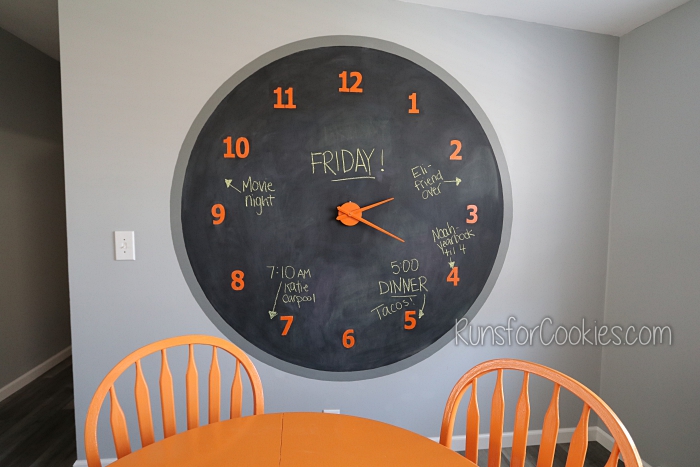
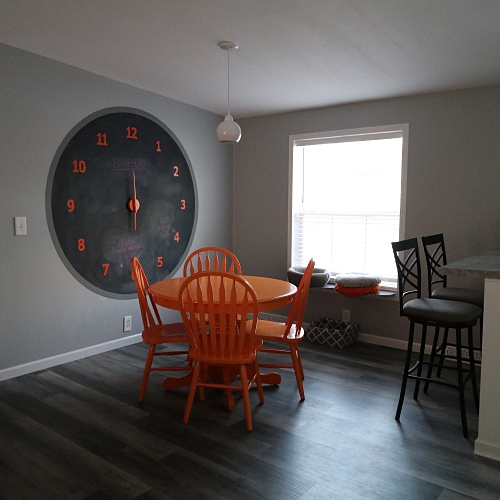
So, I introduce you to the gigantic painted-on wall clock--fully functioning, and a chalkboard to boot! I thought the chalkboard would be fun to write out the day's schedule. For my family, it has turned into our "what's for dinner and when?" clock. My kids are CONSTANTLY asking me when is dinner and what I'm making. It drives me crazy! (My family likes to add their own things on there, too, which is helpful).

How to Make Your Own Giant Chalkboard Wall Clock


Anyway, I've had some requests for a tutorial, so I will do my best. I didn't take a ton of pictures along the way, so I will do what I can with what I have. Also, this would have been much easier to follow if I had done a video tutorial. But because it was a make-up-as-you-go-along sort of thing, I wasn't thinking ahead.

I ended up making a ton of diagrams, and this has turned into the blog post that I have spent the longest amount of time working on. Haha! Hopefully, someone will use it.

Note: I started with primed and painted walls in a light gray color latex paint (Sherwin Williams' Cashmere in the color "Argos"). If your wall needs fresh paint or touching up, definitely do that beforehand.

Materials

-Wall paint for a clock border (I used Sherwin Williams' Cashmere in "Cityscape"--dark gray)
-Chalkboard paint (a very small amount--I bought a quart at Lowe's and only used 1/4 of it)
-Oil-based primer and paint for the numbers of the clock, whatever color you'd like*
-Wooden yard stick
-Protractor (the cheap plastic ones you can get for a dollar in the school supplies section)
-Drill
-Drill bit (you want it to be small, but it doesn't have to be an exact size; you want the tip of a sharp pencil to fit in there without a lot of wiggle room. I used a 3/32" bit.)
-Pencil with a sharp tip
-12 pins (like you would use for sewing--not needles, just pins with a head on them)**
-1 tiny nail
-Hammer
-Good quality paint brush (1-1.5 inches or so)
-Stencil brush (I didn't use one, but as I explain later, it would be VERY handy)
-A tiny paint brush for touch-ups (I used an old eyeshadow brush)
-Number stencils (I printed out these ones)
-The mechanical part of a clock (I bought this $20 clock from Amazon and just used the mechanical piece). I'm sure you can use any sort of mechanical piece from a clock.
-Laser Level (I highly recommend a laser level--it made spacing out the numbers so much easier! I cannot find the one that I have, but this one is very similar. I got mine at Lowe's, and I use it all the time!)


-A small flockfoam paint roller (see pic below) - This will give you a much smoother finish than other rollers or brushes when using chalkboard paint. I used a brush on our cupboard, and the finish isn't nearly as smooth. The employee at Sherwin Williams recommended this:


*I used oil-based paint for my numbers because that's what I had on hand. I am not sure how it would work with latex paint.

**Note: I marked the spots for my numbers BEFORE I painted the chalkboard paint on. This was partly due to the fact that only after I made the marks did I notice that the clock numbers I'd purchased were defective, but I also later realized that it would have been difficult to mark the number placement after painting anyway. This is where the pins come in handy. I'll explain below.

Read through all these instructions and look at the diagrams first; everything will make more sense if you take it all in as a whole instead of each step.

Marking the Circles

1) Determine where you want the very center of your clock to be, and mark it with a tiny dot on the wall. Make sure you are SURE about the placement, because this dot will be the center (literally) of all the steps from here on out.

2) Using the drill and tiny drill bit, you are going to drill four holes into the yard stick. At one end, you will drill a hole that will be for the center of your clock. Then, the other three are for a pencil guide to place your numbers, the inner edge of the border, and the outer edge of the border (respectively).

In the guide below:

The distance from the yellow hole to the green hole will be HALF the final width of your clock. So, if you want your clock to be 50 inches wide, then the yellow and green holes should be 25 inches apart. This is important, so choose wisely ;)

The space between the green hole and the pink hole is how wide your border will be. If you want your border 5 inches wide, then place the holes 5 inches apart, for example.

The purple hole is simply a guide for placing your stencils--this circle will go through the very center of your numbers--so, again, choose wisely.
(For MY clock, which is about 70 inches in diameter:
I placed the green hole at about 1", the pink hole at about 3", and the purple hole at about 10". The yellow hole is at about 35.5". My measurements weren't exact... I just eyeballed where I wanted them.)

Drill Guild for How to Make Your Own Giant Chalkboard Wall Clock


The holes that you drill should be just big enough to fit the tip of your pencil. If they are too big, the pencil line might get sloppy.

3) Using the hammer, tap the tiny nail through the hole (marked "center" in the diagram) in the yard stick into the mark on the wall where the center of the clock will be. Now, you should have a yard stick hanging from a small nail in the wall.

4) Insert the pencil tip into the green hole (green on the guide above--that is just for reference). Now, while holding the pencil tip in the hole, simply make a large circle on the wall by rotating the yard stick on the nail 360 degrees. You will have a perfect circle when you are done. This circle will be the size of the entire clock.

Again, make sure this is the size you want your clock to be.


5) Leaving the yardstick on the wall, insert the pencil into the pink hole, and repeat the last step. Use the yardstick as a guide to make a perfect circle inside of the first circle.

You should have two large circles on the wall--a large one and a smaller one just inside of it. (The space between these will become the border of the clock.)

6) Next, do the same thing with the purple hole. (This circle is a guide for where you will place your numbers).

Now you should have a center nail and three large penciled circles on the wall. You can remove the yardstick--you're done with it now.


Marking the numbers' placement

This is the most tedious, time-consuming part!

1) Next, you'll be using the laser level, pencil, and protractor. The protractor will likely have a little hole in the bottom center for alignment (see photo below), with a horizontal line on each side. Pull the nail from the clock center and use the nail to attach the protractor to the wall (through the same hole in the wall).

2) Now, you'll want to make the protractor perfectly level. Using the laser level, line up a perfectly level line from one end of the protractor to the other. The lines at the 0 degrees and 180 degrees should be level with the line of the laser. (see photo below)

(This was very hard to do with one hand and take a photo with the other... but you can see a very faint red laser line that goes right across the horizontal line on the protractor. And the little bubble of air in the level is centered, so we know the protractor is aligned correctly)


Here is what it would look like without the protractor in the way. (If it looks unlevel, it's just because of the cropping of the photo. Trust me, it is level.):


Once you have the protractor perfectly level, hold it against the wall firmly so it doesn't budge. You are done with the laser level for the moment.

4) While holding the protractor against the wall, use your pencil to place small marks every 30 degrees.


(Again, I did this one handed while I took a picture--pretty impressive, right?!)

Eventually, you will need to turn the protractor upside down so you can do the bottom. Just make sure you line it up perfectly by using the guide lines on the protractor (there is a line that runs from 0-180 degrees--line that up with your marks).

Continue using the protractor to mark spots every 30 degrees until you have a mark for all 12 numbers. See the diagram below--the pencil marks are 30 degrees apart.

Making the Pencil Marks


5) Use the laser to create a straight line from the center of the clock through the pencil marks you just made, and all the way to the "purple" (inner) circle. Then mark a little dot on the "purple" circle where the laser line meets the circle. THAT DOT is going to mark where the *center* of your number will go. (It's circled in green in the diagram below. I will explain the pins afterward.)

How to Make Your Own Giant Chalkboard Wall Clock

Do this for all 12 of the pencil marks you made. Once you've transferred all 12 dots to the purple circle, then you can erase the ones that are close to the protractor (the aqua ones above).

Here is where the pins come in handy. Because you've marked all these spots, you don't want to cover them up with black chalkboard paint. Insert a pin (I tapped it gently with a hammer) into the marks you made for each number, 1-12. (Again, use the pins on the "PURPLE" circle--you can erase the other ones once you mark the purple circle.)

Also, make sure you keep the small nail in the center of the clock--you want that to be marked, always.

Use the laser all the way around, lining up the center of the clock with the 30, 60, 90, etc. degrees marks and making a little dot on the large "purple" guide circle.


How to Make Your Own Giant Chalkboard Wall Clock

Once you have pins placed on the inner pencil line (the "purple" line), you are ready to paint. Leave the nail in the center of the clock, and leave all the pins in the wall. DO NOT REMOVE THEM. You are going to paint over them with the chalkboard paint.

Time to Paint

1) You can do the border first or the chalkboard paint first, it's up to you. I chose to do the border. I used dark gray latex paint and a 1.5-inch brush to fill in the border of the clock (the space between the two outer circles--"green" and "pink").

I painted this freehand, so you can see it isn't perfect (I am fine with that). But I would suggest watching a few YouTube videos about how to "cut in" paint when you're painting walls. Using that technique helped me SO much when I was freehand painting the walls against trim and the ceiling.

Freehand Painting a Border

2) When the border is filled in, then it's time for the chalkboard paint. I would use a brush to do the edges, just like you did for the border. Then, use the roller to fill it all in. Be VERY CAREFUL not to disturb the pins. I used a brush around those.

3) Once it's all dry, apply a second coat of paint (per the instructions on the can... I think mine said to wait four hours).

Now, you should have a large circular chalkboard with a border, and there will be a nail in the center. There will be 12 pins spaced evenly (every 30 degrees) inside of the chalkboard.

Painting the Chalkboard

Make sure it is all dry before continuing. I would wait 24 hours just to be safe.

Priming the Chalkboard

This is weird, and I never knew it was necessary until just recently when I used chalkboard paint for the first time!

1) Once the chalkboard paint is applied, you have to "prime" it before using it. To do this, you turn a piece of chalk on its side and then rub the chalk over the entire space, covering it all with chalk. I think I went through about six whole pieces of chalk to do this!

Priming the Chalkboard

2) Once it's all filled in, then you can erase it. (I chose to prime it before painting on my numbers; I'm not sure if it matters, but it worked well for me this way, so that's what I would do.)

The Stencils

1) Place each stencil over the corresponding pin, with the pin in the very center of the number itself. (If you place the numbers to the side, top, or bottom of the pin, they will be all off-center. Make sure the pin goes through the center of the number. In the "11" below, I had to cut out a small square to fit the number over the pin.)

2) Tape the edges of the stencil to the wall. I wouldn't remove the pins until you are done placing all of the numbers. You want to step back and make sure it looks even.

How to Make Your Own Giant Chalkboard Wall Clock

I quickly used the laser level to make sure the numbers themselves weren't crooked, but you could honestly just eyeball it, because I doubt it would be noticeable if a number is slightly tilted.

Step back and it should look like this:

How to Make Your Own Giant Chalkboard Wall Clock

When you are satisfied with the number placement, THEN you can remove the pins.

3) From here, it's just about stenciling the numbers on with paint. First, I painted the primer on. See my notes below. I used a small paint brush, and it was a big mess. I would definitely recommend using a stencil brush. (A stencil brush is very thick and round with stiff bristles. You dab it over and over again over the stencil with a small amount of paint, rather than stroking it on.)

How to Make Your Own Giant Chalkboard Wall Clock

I made several mistakes with the numbers, and due to trial and error, here is my advice:
  • Use a stencil brush and dab both the primer and paint on with that. A stencil brush would have solved all the issues I had regarding the numbers!
  • Do NOT use spray paint. I did this and the paint was way too thin and drippy. I don't have a photo from the immediate result, because I panicked before I could take one. It didn't cover well, and it looked terrible. I ended up having to spray the paint into a small plastic cup, and then use a brush to dab it on. It was a big fat mess and I cried real tears.)
  • Use a primer first--one or two coats, per instructions on the can.
  • Then apply the color (again, I'd use a stencil brush and dab it on). I used an old eyeshadow brush to fix how terrible the numbers looked! I spent a lot of time trying to keep a steady hand and paint over my mistakes). 


4) Once the numbers are stenciled on, then you can carefully remove the stencils. You'll need to make a few touch ups and fill in the gaps in some of the numbers (like the numbers above).

5) Once all the numbers look the way you want them to, it's time to place the mechanical part on the wall. To do this, you'll have to just follow the instructions per the manufacturer. The end goal is to make sure that the center of the mechanical part is dead center with that tiny nail you still have in the center of your clock.

As long as the mechanical part is dead center, then your clock should work smoothly! I primed and painted the mechanics orange. I took the hands off of it first, then painted and waited for it to dry before putting it back together. I made sure to cover the working parts with tape so paint didn't get inside).

Aaaaannnnnddd... if you managed to make it through all of these instructions, you should have a huge, functioning, chalkboard wall clock :)


I hope I explained this well. It wasn't nearly as hard as I make it sound in this tutorial. The biggest headache is just from aligning where the numbers will need to go. (Instead of using pins, you could probably even paint the chalkboard first, and then use chalk to mark the spots. This is just the way that I chose to do it, based on what was working/not working out.)

Good luck! It was a lot of work, but I LOVE the clock, and it's definitely the center of attention when people see it. It's very unique and fun :)

If you DO happen to make one, or something similar, make sure you share a picture with me! I'd love to see how it turns out.

How to Make Your Own Giant Chalkboard Wall Clock


How to Make Your Own Giant Chalkboard Wall Clock


March 07, 2019

A Belated Wednesday Weigh-In (and horrible anxiety)


Estelle manages to work her way into just about every picture I take.

I did not forget that I had planned to start doing Wednesday Weigh-Ins again! I was just feeling very anxious yesterday and the thought of writing a post was making it worse.

I know that I wrote recently about it, and I wish I could say it's better. But holy cow, I'm going through a VERY tough episode right now, and my anxiety is horrible. I don't know what triggered it; I just wish that it would go away!

I'm not "worried"; that's what is hard to explain to people who don't have anxiety. I'm not worried about something; I just have this overall constant feeling of doom and guilt, and I feel like a terrible person and that I have things that I was supposed to do but didn't. Or that I should be doing more. As I've said before, I know these aren't rational thoughts.
I know I'm a good person.
I know that I don't have anything to feel guilty about.
I (don't think) anything bad is going to be happening anytime soon.
I think I've kept up with my "to do" list (well, other than to blog more frequently; but I get anxious about even doing that).

It makes no sense, then, that I would have these feelings. I was thinking that it could possibly be because I quit drinking, and now I have nothing to "relieve" that anxious feeling or to relax. Food always used to be my "go to" to feel better momentarily, and even that hasn't been an issue lately. My anxiety was so bad this past week that I just didn't have much of an appetite at all.

I was feeling depressed for a few weeks, but that has let up quite a bit. Now, it's just the anxiety. I think the depression may have been coming from the "let down" of being almost finished with this huge house makeover project. Remember after I ran my 10K PR in 2016 after training SO hard for it for months? Then I went into a deep depression for 10 months afterward. I felt like, "Now what?"

I've focused so much on this house makeover I started in August and worked so hard on daily for months. It became a huge part of my life--something I was very excited about. It's pretty much finished (I just took a bunch of "after" photos to post, hopefully in the next few days), so I am probably feeling a let down similar to the post-10K training.

My bipolar mind wants to say that I need to pick a new obsession, but I know that isn't the answer. I need to find something I enjoy that doesn't have any pressure--something that is truly just enjoyable for me but without a big commitment or even a real purpose. I hate feeling pressured, and right now, with this anxiety, pressure is the last thing I need.

I feel like running would be a great answer for me, but with running, I feel pressure. I know that I put the pressure on myself, so I can just as easily take it off. I would love to get back to doing it regularly, because I know that it helped a lot with anxiety. And I just felt healthier. I will try to come up with a "non-pressure" running plan for myself ;) I wish it was warmer outside--going for walks would be nice, and I wouldn't feel any pressure from that. I don't enjoy walking in this cold, though.

I really liked building things with wood while working on the house. Even just taking an old bookshelf and turning it into a "pet feeding station" was fun for me. So, I thought that maybe I could do some more things like that and try to sell them on Facebook Marketplace. That would be fun and productive without putting any pressure on myself.

So, those are just some ideas that I had. The anxiety is making me feel like everything is all wrong, and the depression makes me feel like it won't ever get better. But I think if I can get some momentum, maybe I can pull myself out of this funk soon!

My appetite seems to have returned over the last couple of days. Nevertheless, here is my weigh in for this week:


I was back in the 150's! This was actually longer than a week--my weigh in last time was on a Monday, so this was nine days later. Still, it's a huge jump from my starting weight of 165.8.

As I said, my appetite hasn't been very big due to the high anxiety; but it's starting to go back to normal. I definitely haven't been eating for emotional reasons, though, which is great! I just remind myself that eating isn't going to take away the anxiety. It never has, and it never will.

It's kind of funny; I was desperately trying to lose weight for months, and it barely budged a few pounds here and there. Finally, I wrote the post about starting completely fresh and forgetting the past--not thinking about what I used to weigh, or how fast I used to run, or any of that. Just starting fresh on a brand new Day 1. I think that mindset really helped me this week and gives me some drive to keep going. I'm not aiming for the past--I'm just aiming for what I can do now.

I hadn't done my body fat in a long time, so I decided to do this, too. I don't remember what my last one was, but again--that was in the past. This is where I am right now, so this is what I'm starting at. My body fat is 30.5%.


I'm definitely happy with the weight loss, and seeing the 150's again (for the first time in a very long time!). Mostly, I'm glad that I'm not doing any emotional eating, and I'm thinking rationally about it. I know that eating isn't going to take away the anxiety, so I only eat when I'm hungry.

I haven't been counting calories, either. I've just been eating "intuitively" but on a loose schedule. Basically, the same thing I was doing for most of 2017. I would love to be able to lose this extra weight without counting calories. Maybe now that I'm not drinking and I'm taking control of emotional eating, I'll be able to do just that!

By the way, thanks so much for the super nice comments, suggestions, emails, and just general support lately. I know I've written some heavy posts! It really helps when I know that I'm not the only one going through things (such as the anxiety). I appreciate it more than I can express!


Featured Posts

Blog Archive