Showing posts with label main dish recipe. Show all posts

August 05, 2023

Comfort Food: Jerry's Beans & Greens Recipe

Even if you aren't interested in my recipe posts, please still watch the video in this post. It's kind of perfect for this ;)  I'm definitely feeling better today than yesterday! My dad came over for help with a woodworking project and it was nice to talk to him for a while. Since I've been talking about Jerry's Beans & Greens lately, I wanted to share the story behind my comfort food and his recipe for this.


When people think of comfort food, I imagine them thinking of foods like macaroni and cheese, Mom's chicken paprikash, Grandma's meat pie, etc. Before becoming vegan, my favorite comfort food was "Jerry's Chicken Casserole Surprise"--I guess he thought that the name of the casserole had to have "surprise" in it because that's what we grew up hearing ;)  (Spoiler: There was no surprise.)

(You MUST watch this wholesome 11-second video clip at this point. Please.)


When I was very early in my pregnancy with Noah, I had some spotting and I was sure I was going to have a miscarriage. Being my first pregnancy, I had no idea what to expect. It was also the weekend, so my doctor's office was closed. I wasn't hemorrhaging, so I just spent the evening feeling sad and worried. Jerry said he would make dinner.

I think he took one of the heritage recipe books (remember the series I did on those in 2021?) and made a creamy chicken and noodle dish. (Everything turned out to be just fine when I saw the doctor on Monday.)

[Side note/funny story about that: The doctor did an ultrasound and he pointed out the gestational sac on the monitor (the sac just looked like a black spot the size of a grape). Jerry said with so much excitement, "Oh look! There's its eye! It's blinking!" I'm sure my doctor was dying inside, but he hid it well with a hint of a smile. I, however, burst out laughing. And now it's a story that makes us laugh. I'm sure my gynecologist shares that story when appropriate, haha.]

Anyway, Jerry's Chicken Casserole Surprise turned into a comfort food for me. I can remember everything about that evening: sitting at the dining room table, eyes red and sore from crying, the delicious aroma from the oven, the ambient lighting, and just a general warm feeling in our new home. (We had just moved in.) Even though the circumstances weren't good, I took comfort in those moments--and the food was a big part of it.

And thus, it became my comfort food.
Jerry and I watched that over and over and laughed and laughed. So sad and funny at the same time. (By the way, American Housewife--where I got the clip above--is the best sitcom of all time!)

Now, being vegan, I have new comfort food (that I like even more than the casserole)--Jerry's Beans & Greens. He was visiting a friend in NYC a couple of years ago and ordered it at a restaurant (I thought it was such an odd thing for him to order; I never would have guessed he'd pick that). He texted me to tell me just how delicious it was and he wanted to try to recreate it when he got home.

I'm not a "greens" person--I don't like salad and the only time I ever really ate greens was when I stirred spinach into a hot meal (even then, I would use about half the amount called for). Jerry found a recipe online and tried it--it tasted pretty good, but I definitely didn't like the greens (I think maybe it was kale?). I suggested trying collard greens, because I'd wanted to try them after going to a soul food restaurant in Detroit one time (they were popular). He switched out some other things and tried a second time.

The Beans & Greens were absolutely DELICIOUS. I never, in a million years, would have guessed that this dish would become one of my very favorite foods, let alone a comfort food. And now, when I have a bad day, he likes to make this. He loves that he has a dinner that he can make and I love. He's tweaked it here and there, but it only gets better each time.

I didn't do progress photos as he cooked, but I wanted to share his recipe. 

I put the recipe in a printable format, which you can find here!

Jerry's Beans & Greens

Ingredients:
2 Tbsp. olive oil
1 onion, diced
2 carrots (diced small, because Katie doesn't like the texture of undercooked carrots)
2 celery stalks (also diced small, because Katie doesn't like celery if she can feel the strings or crunch)
3 cloves of garlic, minced (or more, because everything can use more garlic)
2 dried bay leaves
1/2 tsp. sea salt (plus more if needed after tasting at the end)
1/2 tsp. dried thyme
3 cans of great northern beans, drained and rinsed
2 Tbsp. white miso paste (found in the Asian food section of the grocery store in a little tub--even my Kroger has it, and they don't have much variety of anything!)
4 cups vegetable broth* (see note below)
1 small bunch of collard greens**
1/2 tsp. lemon juice, to finish

*Note about vegetable broth: We make our own vegetable broth powder ("chickenless bouillon powder") and we LOVE it. We use it any time something calls for chicken broth or vegetable broth. The recipe we use can be found at Plant Power Couple. The only "weird" vegan ingredient in it is nutritional yeast (thankfully, it can be found at most grocery stores now--even my Kroger--but I can't recall what section it is usually in. I *think* it's with the baking stuff, like cocoa powder, baking powder, etc.You probably already have the other ingredients for it.

We use so much of it that I buy it in bulk on Amazon. I do leave out the turmeric when making the powder, only because of the color--we use the powder when making seitan, and we don't want the seitan to be yellow). To use this for broth, like called for in the Beans & Greens recipe, use one tablespoon of powder for each cup of water. (So, you'd use 4 Tbsp. of powder + 4 cups of water in this recipe.) I wouldn't substitute this broth, because it's part of what makes it so good!

**Note about collard greens: I buy them in a bundle (not chopped in a bag) because I like to remove the the thick stem in the middle. It takes a little longer, but I cut each leaf in half, removing the entire stem that runs down the center. Then I stack all the leaves and chop them on the small side--about the size of a quarter--because they fit on the spoon easier when you're eating.

Directions:

In a large sauce pan over medium heat, heat the oil. Then add the onions, carrots, and celery and cook until they are soft, about five minutes (lower the heat if needed so they don't burn). Add the garlic and cook another minute or two (don't burn the garlic), stirring frequently.

Add the rest of the ingredients and bring to a slow boil over medium heat, then reduce the heat to a simmer. Let it cook on low for about 10 minutes, stirring occasionally, until the collard greens are the texture you like. (If you like your collard greens on the firmer side, don't add them until after about five minutes.) Remove the bay leaves (it takes some searching sometimes, with the collard greens in there!).

Add the lemon juice and stir, then taste and add more salt if needed.

I really hope that you love this as much as I do! It makes me feel loved, and that's the best comfort food there is.

June 19, 2023

RECIPE METHOD: Shredded Seitan


Seitan (pronounced SAY-tan) is one of those "weird vegan foods" that I swore I'd never cook. I had absolutely no clue what it was until I attempted to make it for the first time. I learned that making seitan is more of an ART than anything else--getting the texture and the taste right is a lot more difficult than I thought.

First, if you don't know what seitan is, I'll explain in a very tiny nutshell: Seitan is a vegan meat alternative that is made out of vital wheat gluten. Vital wheat gluten is what is left when you remove *everything* but the gluten from wheat flour. Gluten holds things like dough together and makes things stretchy (think pizza dough). This is what vital wheat gluten looks like:


It looks like flour, basically, but it's "springy"--which sounds odd until you see it for yourself. Anyway...

All seitan has one common ingredient: vital wheat gluten. But there are a million recipes out there for different flavors and textures of seitan. You can make it taste like pretty much whatever you'd like, based on what seasonings you use. Depending on what you add to it, you can get all sorts of different textures. Usually, the recipes involve adding some sort of protein (like tofu or beans), lots of seasonings, and vital wheat gluten. The only other thing you need is a blender or food processor.

I tried what felt like ten billion recipes for seitan and something was always off. Each time, though, I learned something else I might be able to tweak for next time. When I mentioned this several weeks ago on my blog, someone asked for the recipe--and naturally, I forgot to share! However, I made some seitan today, so I took pictures for the post.

This recipe for seitan is meant to replace shredded chicken. I tried so hard with other recipes to get the shredded texture and it just wasn't happening. This recipe is where it finally came together for me. Then I tweaked it to my preferences in taste and method. This recipe isn't from one source, although the basis of it comes from this video on YouTube by Green Beets Kitchen. That is how I made it before I started tweaking things.

Below is the recipe as I make it... including my changes. This is how Jerry and I like it best!

(Here is a PDF copy if you'd like to print it!)

First, the ingredients:


480 mL water
2 Tbsp. miso paste
1 tsp. salt (or ¾ tsp. salt + ¼ tsp. msg)
2 servings vegan “chicken” bouillon powder (2 cubes, 2 tsp. paste, etc. I use 2 Tbsp. of this homemade vegan powder)
2 tsp. garlic powder
1 Tbsp. onion powder
½ tsp. white pepper
20 g. nutritional yeast
1 Tbsp. white wine vinegar
1 Tbsp. neutral flavored oil
70 g. pea protein isolate powder
230 g. vital wheat gluten

Notes about ingredients:

Since seitan can be finicky, the difficult-to measure-ingredients are listed by weight--which makes it much more consistent. (I love when recipes list ingredients by weight!)

About the msg (monosodium glutamate)... I know it's a super "frowned upon" ingredient, so it's definitely not necessary here. However, after reading quite a bit about it a while ago, I decided to give it a try in this recipe. The point is, though, it's optional.

The vegan "chicken" bouillon... this can be vegan bouillon cubes or paste or powder. For this recipe, you just want two servings of it. I use 2 Tbsp. of this homemade bouillon powder by Plant Power Couple. (I use that powder for everything, by the way! I don't put the turmeric in it, though, just because of the color--it makes the seitan very yellow, which is off-putting.)

Pea protein isolate is literally just pea protein powder--I bought a big bag of it on Amazon and it was pretty cheap (especially considering we make this seitan all the time). The same with the vital wheat gluten--I buy big bags on Amazon (I use Anthony's brand for both of them, as well as nutritional yeast and several other products).

A note about appliances:

Most recipes call for use of a food processor to make seitan. I got rid of my food processor when I got the Ninja "all-in-one"-type system. I use the Ninja--I use the metal blade for the first part of the recipe and then the dough blade to finish it.


However, you can use whatever you have, as long as the motor is strong enough to hold up to the dough. I even used my KitchenAid stand mixer to knead the dough before! (It takes much longer, but I'll write about that later.) For this post, I'll refer to the appliance as a blender, since that's what I'm using.

Okay, on to the method of how I make the "perfect" shredded seitan...

First, just add all of the ingredients *except for* the pea protein and the wheat gluten to the blender:

1) Before blending; 2) after 30 seconds I scraped down the sides; 3) after another 30 seconds.


Then, you add the pea protein (don't add the gluten yet). This is what it will look like after blending with the pea protein:


Finally, add the vital wheat gluten to the blender:


(I switched out to the dough blade at this point. If you want to use a heavy duty stand mixer, you'll want to put it all in there now. If you're using a food processor, just make sure you don't overheat your machine. That goes for all appliances, really.)

Now comes the monotonous part. Blend on high with the gluten for 60 seconds. It will look like this:

60 seconds of blend time.

Let it rest for 5-10 minutes; this gives your motor a chance to calm down and it gives the gluten some time to activate (and become "stretchy"). After the rest, blend again--for 45 seconds. It will look like this:

1:45 minutes of blend time.

Rest the dough again, 5-10 minutes. Then blend on high again for 45 seconds. It should look similar to this:

See on the bottom right, how it's starting to look stretchy? 2:30 minutes of blend time.

Keep repeating this process--45 seconds on high, 5-10 minutes rest...

3:15 minutes of blend time

4:00 minutes of blend time

4:45 minutes of blend time

That last picture, the one that was 4:45 minutes of blend time, is what the texture should look like when it's ready to move to the next step. It will be very sticky and stringy. It'll feel like soft taffy, and you'll see individual striations/fibers when you stretch it.

(Note: Be careful not to let the blender get too hot--it will start to steam the seitan, and you don't want that! Just be patient and let it rest as often as needed.)

In this picture, you can see the comparison between just 45 seconds of blend time. If you stop too early, and it doesn't look like the ball on the left, then the texture won't be shreddable. You want it to look like the ball on the left:


Once the dough is ready, divide it into two portions:


Working with just one ball at a time, form it into a long rope (the longer the better; don't let it break, though!).


Once you have a long rope, grab a small bowl and add some water to it. Using your fingers, just barely glaze the rope with water to make it slippery (don't douse it with water, but you don't want it to be sticky for this next part).

Next, starting in the middle of the rope, tie a knot (the same kind of knot you would use to tie your shoe--very simple):


After that, tie another knot, directly on top of it, as close as possible:


Continue tying knots, dipping your fingers in the water as needed, until you reach the ends. Tuck the ends into a crease. You'll have a very odd-shaped ball:


Give it a gentle press together on all sides. Then lay it on a piece of parchment paper:


Tightly roll the ball in the parchment paper, then roll up the ends to seal:


Once it's wrapped in parchment, set it on a long piece of aluminum foil. Beginning at one end, roll it up just like you did with the parchment paper. Wrap as tightly as you can, but be very careful not to let the foil rip on the folds of the parchment:


Once you wrap both loaves, place them in a steamer basket. Cover and steam gently (a very gentle simmer) for one hour and forty five minutes. 


Carefully remove them from the steamer basket using tongs and place them on the counter to cool:


Allow them to cool at least one hour. Open while still warm for an easier time shredding (or you could place them in the fridge overnight before opening). This is what it will look like when you open it:


Kind of like a loaf of deli meat. To shred it is kind of fun! Just hold each end and twist in opposite directions. The loaf will start to pull apart at the "seams" (where the knots met):


As you "unfold" the rope, you can pull off the skin. (It tastes fine in my opinion, but it's not as shreddable.)


Once you have the skin removed, you can pull the seitan apart into smaller shreds:


Isn't it crazy how much it looks like meat?! And it was made from flour, basically.

What do you do with it? You can use it anywhere that you would normally use shredded chicken or pork. My family really likes it with barbecue sauce for a super fast meal (when we have the seitan already shredded in the fridge). It reminds me of pulled chicken (but I don't get grossed out, wondering what I might bite into, hahaha).

Anyway, THAT is how Jerry and I really like our seitan. We continue to try new recipes, but this one is our go-to. The biggest key to remember is: The texture MUST look like shiny, stringy taffy before dividing into ropes in order to get the shreddable texture.

November 26, 2022

RECIPE: Mulligatawny Soup

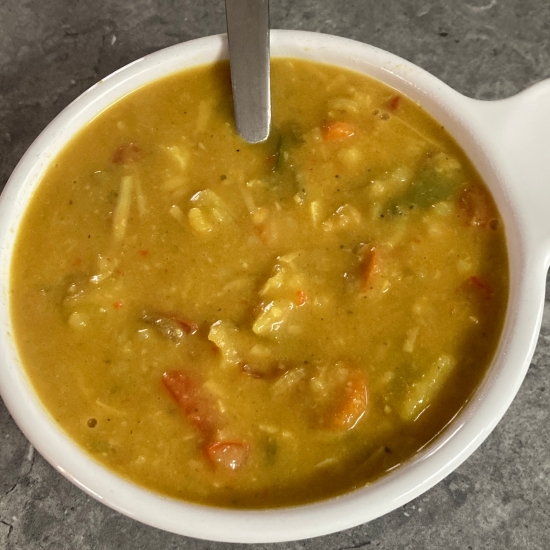
vegan mulligatawny soup

I made this recipe a few weeks ago and planned to post a recipe review, so I took all the pictures. Then I realized that I couldn't post it because it came from a recipe book! I emailed the publisher to ask for permission to post the recipe here but I didn't hear back from them... until a few days ago. Thankfully, they gave me the go-ahead to share the recipe. (I don't like to post reviews of recipes that aren't freely available.)

This recipe is from "How it all vegan!", a vegan cookbook by Tanya Barnard and Sarah Kramer. It's an old book that I got from a thrift store.

The name of this recipe, Mulligatawny Soup, caught my eye at first; and then when I read the ingredients, I thought it sounded super interesting. It was unlike any other recipe I'd seen before, but it still used common ingredients (nothing weird in this one!). The coconut was especially intriguing.

A google search just now showed me that it's not unusual at all--Mulligatawny is a common Indian dish. This particular recipe, however, is different from the few that I looked at, so I have no idea how authentic this is. 

This cookbook is kind of fun to cook from because there are no pictures. Normally, I like cookbooks with pictures for every recipe! But to make something with a weird name and not having any clue what it's going to look like in the end was kind of fun.

Here is a printer-friendly version, if you want to skip my beautiful food photography ;) 

First, the ingredients:


1 large onion, chopped
3 stalks celery, chopped
3 Tbsp. olive oil
1/2 tsp. cayenne pepper
1 tsp. turmeric
1 tsp. coriander
1 tsp. curry powder
2 Tbsp. soy sauce
6 cups vegetable stock
2 medium carrots, sliced
2 large potatoes, cut in cubes
1/2 cup rice
1 small red pepper, diced
1 small green pepper, diced
1 small tomato, diced
1 cup cauliflower, sliced
3/4 cup grated coconut
3 tsp. lemon juice
3 tsp. cilantro (optional)

A lot of ingredients, but nothing strange! It didn't specify to use sweetened or unsweetened coconut, so I just assumed unsweetened and that's what I used. Also, I chose not to use the cilantro. As usual when I make new recipes, I prepped all of the ingredients first so that I didn't have to rush while cooking.


The "vegetable stock" powder I have is a homemade blend (recipe can be found here). I just add it with water for the vegetable stock in recipes; it's easier than having containers of stock around!

I thought it was a bit awkward to slice the cauliflower instead of cut it into small florets (and if making it again, I would choose to do the florets).

First, you sauté the onions and celery in oil in a large soup pot over medium heat until the onions are translucent.


Then you add the spices, soy sauce, veggie stock, carrots, potatoes, and rice. Bring to a boil and reduce heat.


Let it simmer for 15-20 minutes. Add the peppers, tomato, cauliflower, coconut, lemon juice, and cilantro. Stir together and simmer 5-10 more minutes until vegetables are tender.


Remove half of the soup and purée in a blender or food processor.


Then pour it back in the soup pot and stir to mix it all together.


And this is what it looked like when it was done:


Thoughts? It was very good! It was surprisingly creamy, considering there weren't cashews or coconut milk in it. To me, it tasted like a smooth, spicy curry. The curry powder I have is on the spicy side, so the spice level may vary, depending on the brand of curry you use. I loved all the different textures and I thought all of the flavors went together really well.

I can't remember if the kids ate it, but I know Jerry and I both really liked it, and we each had leftovers the next day. The creaminess and the spice made me think that it's the perfect winter comfort-soup. Next time, I'll make some bread to go with it. It's a great soup to make when you've got some veggies to use up! I think I may add some tofu next time, too--because everything is better with tofu ;) 

November 12, 2022

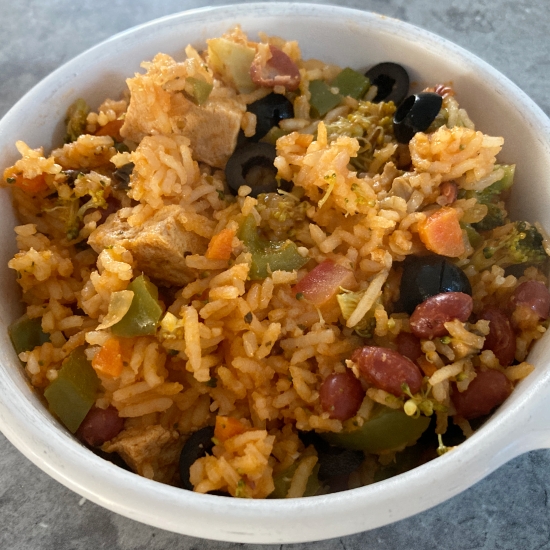
RECIPE: Everything Rice


This isn't a recipe review, but rather a recipe I adapted from a cookbook called 'How it all vegan!" by Tanya Barnard & Sarah Kramer. (In the book, it's called Kieran's Favourite Rice.) I found the book, which was printed in 1999, at a thrift store and even though there weren't pictures--I don't like recipes without pictures!--I figured it was worth a look-see for $1.

Well, let me tell you... if there is only one recipe in this book that is worth making, I'm so glad that I chose to make this. I've made a few others, which were good, but this is extra-level good.

This is my-whole-family-including-Eli-likes-it good! The second time I made it, I changed some things up and was more specific about ingredient portions, so this is the modified recipe. This is going to be a once-per-week staple in my house from now on.

This was my first time cooking tofu in a liquid. I wasn't thrilled about the idea of it because I just didn't want mushy tofu--the thought of it grossed me out. I always buy extra-firm tofu and I press it really well--usually overnight--so get the most liquid out of it and give it a meatier texture.

I was very surprised then, when I cooked the tofu in liquid this way, just how great the texture was! To describe it, I would say that it had the texture of an omelet, only a little firmer. The pieces held up well and didn't fall apart like I expected. AND ELI ATE IT. He only took a couple of the cubes of tofu, but he ate them and he liked them. That alone says it all.

I call this "Everything Rice" because it has a little of everything in it! Rice, lots of different veggies, beans, tofu, and herbs and spices. Even tomato juice instead of broth. This is a recipe that you can basically grab whatever vegetables you have on hand and toss them in. I really liked this combination of vegetables, though. Fresh green beans would be a good addition.

The nutrition profile of this rice is amazing. It reheats well. And it makes a huge amount (you may want to cut it in half if you don't want leftovers; we got six generous servings out of it).


Anyway, here is the recipe in printable form! But I'll post it here as well. Hopefully you'll enjoy it as much as my family does!

2 Tbsp. olive oil
1 onion, chopped
6 cloves garlic, minced
1 tsp. salt
2-1/2 cups tomato juice
1 cup water*
1 (14-16 oz) block extra-firm tofu, drained, pressed, and cut in bite-size cubes
1 green bell pepper, chopped
2 cups broccoli, cut into small florets
2 carrots, peeled and chopped
8 oz. mushrooms, sliced small
1 (15-oz) can red beans
1/2 tsp. dried basil
1/2 tsp. dried oregano
1/2 tsp. black pepper
1/4 tsp. cayenne pepper
1-3/4 cup basmati rice
2 roma tomatoes, chopped
1/2 cup black olives, sliced

Heat oil in a large stock pot over medium heat and add onions, garlic, and 1/2 tsp. of the salt. Stir frequently and cook until the onions are soft. Add the tomato juice, peppers, broccoli, carrots, mushrooms, beans, basil, oregano, black pepper, cayenne, the other 1/2 tsp. of salt, and water. Stir to combine, then gently fold in the tofu and rice. Give it a gentle stir, so as not to break the tofu.

Increase the heat to high, and bring to a boil. Cover the pot and reduce heat to low. Do not stir or remove the lid, or the rice may become gummy. Cook over low heat about 20 minutes, until the rice is cooked through. Remove from heat and gently toss in the tomatoes and olives. Makes about 6 generous servings.

*Note: You may need to adjust the amount of water depending on how much and what types of vegetables you use. I found 1 cup to be the right amount with the other ingredients as listed.

March 07, 2022

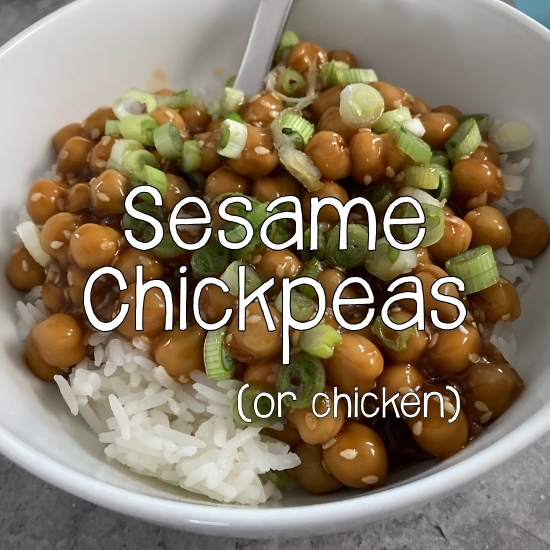
RECIPE: Sesame Chickpeas (or Sesame Chicken)


After posting about increasing my fiber yesterday, someone asked for the Sesame Chickpeas recipe. I didn't realize I never posted it before, so I figured I'd share it today. It's SO good! I always made this with chicken breasts until recently, so I'll write it out for both chickpeas and chicken, and that way you can make it how you like.

When making sauces like this (or General Tso's or Sweet & Sour, etc.) I like to use a mason jar. I put all of the ingredients inside, screw on the lid, and then shake it so everything mixes well. A lot of times, I'll prep the sauce in the morning and then when I want to cook, I don't have to take out all the ingredients; the sauce is ready.

If you like to have a lot of sauce so you can mix it into your rice, then you may want to double this sauce recipe.

Here is a printer-friendly version!

Sesame Chickpeas (or Chicken)

For the sauce:

2 Tbsp. soy sauce (I like tamari, but either is fine)
1 Tbsp. water
1-1/2 tsp. sesame oil
1-1/2 Tbsp. brown sugar
1-1/2 Tbsp. rice vinegar
1/2 tsp. fresh ginger (I buy this in a squeeze tube to keep in the fridge)
2 cloves garlic, minced
2 Tbsp. sesame seeds
1 Tbsp. cornstarch

Other ingredients:

2 (15 oz) cans chickpeas OR 1 pound chicken breasts, cut into bite-size pieces
2 tsp. cooking oil if using chicken
cooked rice or other grain for serving
4-5 green onions, sliced, for topping

Mix together all of the ingredients for the sauce and set aside.

If using chickpeas: Drain and rinse the chickpeas. Pour the chickpeas and sauce into a medium-size pot and heat over high heat just until it comes to a boil and thickens (there is no need to cook canned chickpeas--they will heat through with the sauce). Remove from heat and serve over rice; garnish with green onions.

If using chicken: Heat oil in a skillet over medium-high heat and add the chicken. Sauté until the chicken is browned and cooked through. Add the sauce and bring just to a boil so that the sauce thickens. Remove from heat and serve over rice; garnish with green onions.


Variations:

Steam some broccoli or other vegetables on the side and stir them into the chickpeas or chicken with sauce.

Use another sort of grain for serving. My favorite is barley, but I've also used quinoa.

If you like a light breading on the chicken (I haven't tried this on the chickpeas, so I'm not sure if that would work), put an egg and 2 Tbsp. cornstarch in a Ziploc bag and seal. Mash the egg and cornstarch together. Then add the chicken and and shake to coat. Then add to skillet as above.

February 05, 2022

RECIPE : Tapenade & Hummus Pizza

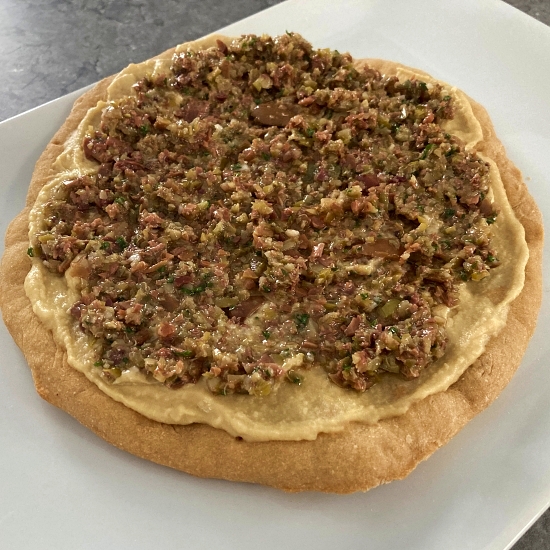
Tapenade and Hummus Pizza

I completely forgot about making a heritage recipe today! Like I said yesterday, this week feels all messed up because the kids were off of school Wednesday through Friday. It feels like today should be a Monday.

Anyway, I did have a DELICIOUS dinner and figured I'd share that instead.

I've been craving olive tapenade for months and months--it just seemed like whenever I was in the mood to make it, I didn't have one or more of the ingredients (I never have fresh parsley on hand).

I was excited when I saw that Sabra came out with a hummus that has a dollop of tapenade on top. I bought that several times to eat with pretzels. It just made me crave tapenade even more.

Today for dinner, I decided to make whole wheat pizza crusts so we could each make our own mini pizzas. When I was looking in the fridge to make sure we had cheese, I realized that I had fresh parsley in there--I forgot that I bought it the last time I went grocery shopping (with the sole purpose of making tapenade). So, I had the idea to make the tapenade and put it on my pizza.

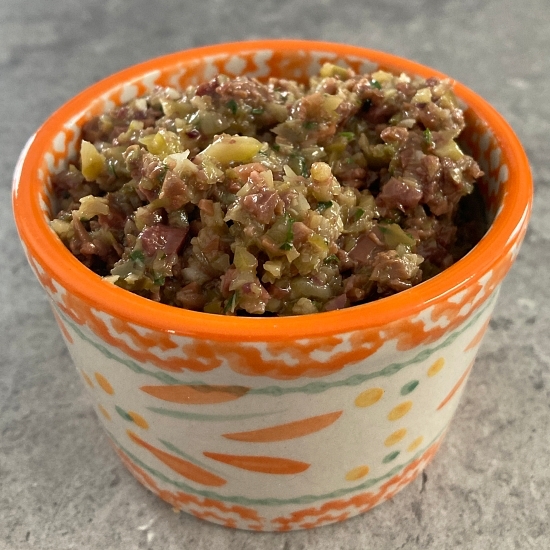
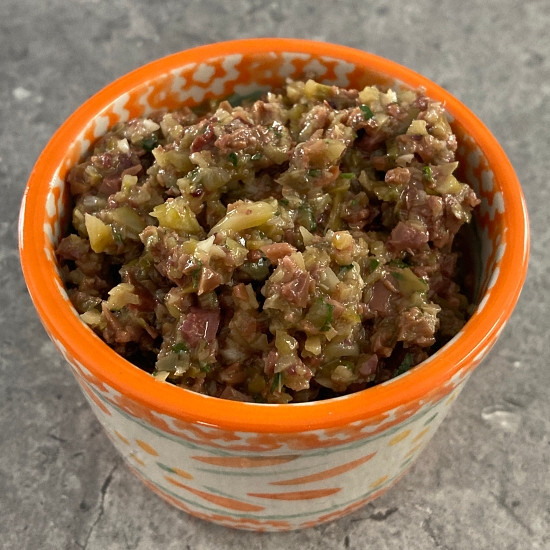
olive tapenade

We didn't have cheese, so Jerry headed to the store. I asked him to get hummus while he was there so that I could basically make a tapenade hummus pizza on whole wheat crust for dinner. It was SO good. The crust was soft and bread-like, so it reminded me of warm pita bread with the hummus on there; and then the tapenade was heavenly.

Tapenade and Hummus Pizza


To make the pizza, I just used three items: pizza crust, hummus, and tapenade. I made the pizza crust and tapenade, but I used store bought hummus (just the regular flavor).

So, here is my tapenade recipe... the tapenade tastes great on crostini (mini toasts), crackers, pretzels, etc. I usually use it as a dip, but I'm sure it would be a good condiment, too--I bet it would be awesome on a toasted Italian sandwich.

Here is a printer-friendly version of the Tapenade recipe!

Tapenade

6 oz. pitted green olives (this is the drained weight of one jar)
7 oz. pitted kalamata olives (the drained weight of one jar)
1/4 cup drained capers
1/4 cup lemon juice
1/4 cup chopped fresh parsley
5 cloves garlic, chopped
1/4 cup olive oil (I use the extra light tasting--flavorless--olive oil)

Drain the olives. Put all the ingredients into a food processor and pulse a few times. Scrape down the sides of the bowl and pulse some more until it's the consistency you like it. (Don't add salt; the olives make it very salty.)

tapenade


This recipe makes a good-size amount--probably about 2.5 cups. You could cut the recipe in half, but I don't like having half-empty jars of olives and capers in my fridge. The tapenade will store for about two weeks in the fridge (I'll eat it long before that, though!)

Here is a printer-friendly version of the Whole Wheat Pizza Crust recipe!

Whole Wheat Pizza Crust

1-3/4 to 2 cups whole wheat flour (enough to form into a ball)
1 cup hot water
1 Tbsp. olive oil
3/4 tsp. salt
2 tsp. yeast (one packet)

Directions:

Preheat oven to 450 F. Combine all ingredients in a bowl until a ball forms and cover with plastic wrap. Let the dough rise for at least 15-20 minutes. Divide dough into four portions and press them into circles. Lay them out on a baking sheet (you may need to add a little more flour to keep them from sticking). Bake at 450 F for about 10 minutes, until crust is just baked through.

Remove crusts to a plate. Spread about 1/4 cup of hummus on each crust; top with about 1/4 cup tapenade and spread to edges.

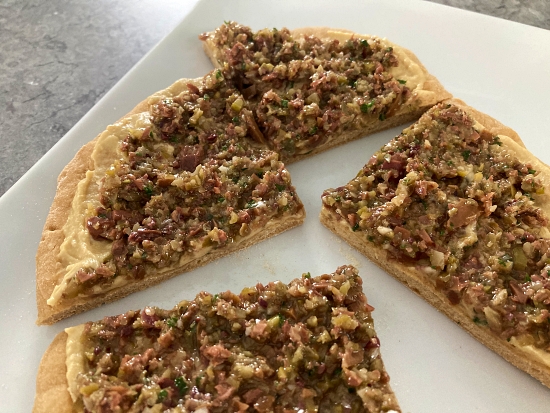
This was super filling and a nice change from the regular pizza!

Tapenade and Hummus Pizza

Featured Posts

Blog Archive