Showing posts with label training plan. Show all posts

January 27, 2022

A Simple Beginners' 10K Training Plan


I mentioned signing up for a race in the next few months for the sole purpose of that sense of discipline that comes with following a training plan. Knowing that I have to train for a race is what will make me do it when I just don't want to run.

I was looking at 10K races because 1) It's always been my favorite race distance; 2) I think it's a good distance to work toward over the next few months, and 3) I don't really have a desire to run farther than 10K at this point. My body has gotten all sorts of messed up in the last few years and I think running is great, but I don't want to push it.

I was shocked when I went to my training plans page and saw that I don't have a beginner's 10K plan! I highly recommend my "Your Best 10K" training plan when you are going for a personal record; but that is meant for seasoned runners with lots of training under their belts. Right now, I am back to being a beginner for the most part.

For the purpose of this plan, I'm defining a "beginner" as someone who can run--no matter how slowly--about three miles without stopping (or with just a couple of short walk breaks). It would be great for someone who just completed the Couch to 5K plan and is looking to train for a 10K. So it's not a "Couch to 10K" plan, but a plan to get you from running about 3 miles to running 6.2 miles over a period of 8 weeks.

(If you are a true non-runner that wants to look train for a 10K, I would start with one of my beginner 5K plans; then, when you are able to run 5K, switch over to this plan.)

I wanted this to be very beginner-friendly; if you only want to run three days a week instead of four, then just skip Thursdays' runs. If you hate speed work, then just turn that into an easy three-miler. If you'd rather do run/walking, then go for it!

I also kept this extremely simple as far as numbers go--no heart rate training and no worrying about the "80/20" rule here. It's still very balanced and is heavy on the "easy" running.

There are three days for easy runs and just one day of simple speed work. The speed work alternates each week between intervals and tempo runs. There are four effort levels:

E - Easy (a pace that is barely faster than a walk; you should be able to have a conversation with a friend at this pace).

T - Tempo (this should feel "comfortably hard" where you could only say 1-2 words at a time; you should feel like you want to slow down, but you know for sure you could finish it). 

H - Hard (this is where you can run as hard as you want--the highest effort you choose to put in).

W - Walk (walk as quickly or as slowly as you like; the walking is in between the hard intervals, so I like to run the hard part as fast as I can and then I walk this part very slowly to recover).

Here is a glimpse at the first couple of weeks:


All of that said, here is the printer-friendly plan! 

It should be very straight-forward, but let me know if you have questions. I *think* I've chosen a race for Jerry and I to do (if we don't end up doing the relay with my siblings) so this is what we'll follow. Since we'll likely be doing a lot of treadmill running, I wanted to make this as simple as possible (running by feel instead of heart rate and keeping it very beginner-friendly).

If all goes well, Jerry and I will be running a race together soon--the last time we did that was in 2015! We trained for a half-marathon in 2018, but had to cancel at the last minute. So I'm looking forward to this :)

October 17, 2021

TRAINING PLAN: My 'MAF80' Running Plan (for beginners to heart rate training)


This post is a copy of what I've attached to the (printable) running plan as well, so it may sound a bit formal. But I've put SO much work into this plan and I hope that it works out well!

Here you can download and/or print the plan (which includes all of what is written below).

I want to start by stating that this is a trial plan—it hasn’t been tested and I wrote it based on my own knowledge as an RRCA-certified running coach as well as personal experience and reading various training methods. I’ve combined a couple of principles from two main sources to create this plan: Dr. Phil Maffetone’s MAF (maximum aerobic function) heart rate training method and Matt Fitzgerald’s 80/20 Running method. This is why I’ve (so cleverly) named this self-combined method “MAF80”.

This MAF80 training method means that you will be running and/or walking at a particular heart rate zone (called your MAF zone, which I will explain later) 80% of the time. The other 20% of the time will be spent running at a heart rate higher than that zone. I wanted this plan to be something that is do-able for beginners to heart rate training as well as for people who don’t want to do a high-mileage plan. This is not for training for a specific goal; if you are a seasoned runner and want to get faster for a 5K or 10K time goal, I would suggest my other plans called “Your Best 5K” and “Your Best 10K”. My running plans can be found here: https://www.runsforcookies.com/p/training-plans.html

First, MAF stands for Maximum Aerobic Function. The MAF heart rate is the highest heart rate you have before transitioning to an anaerobic state (a state that does not help build your endurance); ideally, you want to have a very fit aerobic system, and the best way to strengthen it is to exercise aerobically.

Note: The MAF heart rate formula was based on research done by Dr. Maffetone. The number isn’t 100% carved in stone for all people; but based on his findings, that formula works for the overwhelming majority.

When you exercise at a heart rate higher than the maximum *aerobic* function (MAF), you’re working your anaerobic system. This is also beneficial—for different reasons—but a little goes a long way. Doing too much can have the opposite effect and actually be harmful. Also, without a fit aerobic system, doing anaerobic work is pretty much pointless.

As a running coach (and runner myself), I find that the hardest thing for runners to do is SLOW DOWN during their training. “Easy runs” are the most important runs in a training plan! And most runners do them too fast, which isn’t giving them the benefits that the workouts are designed for (which is to develop endurance).

I created this MAF80 plan to force the runner to do the easy runs at a truly easy (aerobic) effort 80% of the time. The other 20% is beneficial physically, of course, but also mentally; as runners, we like to let loose and go fast sometimes! It also keeps the running from getting too boring.

(Note: Dr. Maffetone’s MAF training recommends that you do 100% of your training at a MAF level. I would suggest reading his ideas before choosing what is best for you. I believe in the 80/20 rule, which is why I combined the two.)

The end goal of running at a MAF heart rate is to be able to increase your performance while maintaining the same effort level. For example, if you run in your MAF heart rate zone (let’s say it’s 130-140 beats per minute) and your average pace is 11:00/mile when you start training, after several weeks or months of MAF heart rate training, you ideally will be able to run at the same heart rate but at a faster pace (let’s say 9:30 per mile). Running at a 9:30 pace will feel the same as running at an 11:00 pace did before.

When running at a MAF heart rate, your EFFORT always remains the same; your performance/pace varies. The fitter you get, the faster you can run at the same heart rate. (I will explain more about MAF heart rate later.)

It’s important to note that this plan is designed for heart rate training, which obviously requires a heart rate monitor. There is a huge variety online. I like to use my old Garmin Forerunner 620, but feel free to use whatever heart rate monitor you’d like.

I designed this plan with a few things in mind:

1) Variety. I didn’t want it to be monotonous.

2) Sticking with the 80/20 principle (per the principles in the book ’80/20 Running’ by Matt Fitzgerald)

3) Running for time instead of mileage. This makes it easier for runners to slow down because whether you run fast or run slow, you’re still running for the same amount of time. Might as well slow down and enjoy it! Also, the 80/20 principle is based on time spent running per week—80% at an easy effort and 20% at a harder effort. “Easy” and “Hard” are relative to the individual, so mileage doesn’t work in this case.

4) I took into account the fact that your heart rate is lowest at the start of your run and highest at the end of your run. So the order of running easy/hard may seem backwards, but I designed it this way on purpose. Your runs will start out at the MAF zone, saving the harder running for later when your heart rate is likely to be higher anyway.

5) Four workouts per week, 40 minutes each. You can add more MAF running if you’d like. There are two runs that are solely for MAF running; one day for faster intervals; and another day for longer, not-as-hard intervals (called Tempo).

6) Simplicity. There are only three effort levels: MAF (easy), Hard, and Tempo:

    1. MAF (a.k.a. “easy”). Run in your MAF zone. At first, you may feel like you’re having to check your heart rate frequently, but eventually you will get a feel for it. If you don’t want to keep checking, just run as slowly as possible! You should barely get winded and should be able to hold conversation at that effort level.

    2. Hard. Run at what feels like a hard effort—about a 8-9 on a scale of 1-10. Don’t put too much thought into it, though! You don’t need to worry about your heart rate during these runs; just run at a pace that makes you wish it was over already, haha. 

    3. Tempo. Run at a moderately hard effort—about a 6-7 on a scale of 1-10. It should feel kind of uncomfortable, where you will want to slow down, but you could hold that pace for much longer if needed.

There is also Walk, which is self-explanatory. I wrote the Walk portions in the spots where I felt it was most beneficial to get your heart rate back down to your MAF zone quickly. I always walk the recovery portion of interval training and I find I get the best results that way. Walking helps you to recover so you can push hard in the next segment.

A lot of beginners discover that running, even at the slowest pace possible, puts their heart rate over the MAF threshold. This is super common! In this case, you should run/walk (or even just walk) in order to keep your heart rate in the MAF zone. It can be frustrating (I’ve been there!) but eventually, you will notice that you’re able to run for longer periods of time before having to walk again. And one day, you’ll be able to run the entire time at a MAF heart rate. On the days where you can do speed work, run to your heart’s content!

If you want to speed up your progress, you can feel free to add more workouts or extend your workouts—at a MAF effort. You don’t ever want to do more than 20% of the time per week spent running at a hard effort (meaning higher than your MAF heart rate).

Because this plan is just a trial (I basically created it as an experiment for myself), I’ve only written 6 weeks. I will see how it goes and adjust as necessary, and if it is working out well, I’ll add to it. (Feel free to give me progress reports!) But if you want to extend it as is, you can just repeat weeks. To see significant progress (which depends entirely on the individual) I’m almost certain it’ll take at least a few months.

Finally, to calculate your MAF heart rate:

Just subtract your age from 180, and that is your MAF number! That number is the maximum of the range; the minimum number is 10 beats per minute below that. For example, I’m 39 years old, so my MAF heart rate is: 180-39=141 bpm. My MAF range would be 131-141 bpm.

Note: When you first start each run, your heart rate will likely be far below the MAF range. You don’t have to rush to get it into the MAF range. It will probably reach that range within a few minutes, so again—don’t overthink it.

I could write MUCH more on the hows and whys I’ve chosen to design this plan the way it is, but for now, I just want to test it out and see how it goes. I’m sharing it in case you are interested in trying it, too!

Again, I recommend the following reading:

- The MAF 180 Formula by Dr. Phil Maffetone (https://philmaffetone.com/180-formula/). There is MUCH more to his 180 Formula and MAF training than I could even begin to cover here. The only part of his method that I used is the 180-number. (His formula actually includes a few more steps.)

- ’80/20 Running’, a book by Matt Fitzgerald, explaining the hows and whys training at 80% easy and 20% hard is ideal. (This is an Amazon affiliate link, which just means that I may get a small commission for recommending it: https://amzn.to/3n09Hip )

Finally, make sure you read the post on my blog called “The Importance of the Easy Run”—it explains more in-depth why runners should be doing easier runs: https://www.runsforcookies.com/2016/04/the-importance-of-easy-run.html

Okay, as far as the plan goes:

- There are 4 runs per week, 40 minutes each.

- You can swap runs for others that have the same number of “HARD” minutes (for the sake of simplicity, the “Hard” runs and “Tempo” runs are both considered “Hard” when calculating the 20% rule because they both are done at a heart rate higher than your MAF zone. Each week, your Hard running (which includes Tempo) should add up to no more than 32 minutes (as the plan is written, each week has 30 minutes of hard running and 130 minutes of easy MAF running).

- You may add MAF running wherever/whenever you’d like.

I think that sums it up in a nutshell. Please feel free to give me feedback or ask any questions. I plan to make changes to this training plan as needed, based on feedback (as well as my own experience—I’m going to be doing it as well).

Happy Running! xo

Here is where you can get the free training plan and all of the explanation above

January 01, 2020

My BIG Goals for 2020--How I'm Going To Be The Very Best Me


This year feels like it's going to be big for me. I've been thinking so much about it and I want 2020 to be the year of ME--working my best to be the best me I can be.

This year is a milestone for me--10 years since I lost 100 pounds, and then hit a "normal" BMI. And eventually, hit that number of 125 pounds lost, which was what would later become my reason for starting Runs for Cookies.


My initial reason for starting this blog was to basically keep a record of gaining the weight back! Hahaha. I'd lost weight several times before (nowhere near 100+ pounds, but still...) and I'd always gained it back. I wanted to know WHY. I wanted to see what I was doing that was causing the shift and piling the pounds back on.

It has served that purpose and so many others through the years! I'm hoping this year will be no different. I like to set goals, and writing about them has always helped me to stick with them.

New Year's Resolutions are usually something that people (including me) make and then rarely stick to. I might stick to one of two of them, which is better than nothing. Last year, I made resolution to quit drinking for a year (and I really didn't think I could do it). Well, midnight came and went last night, and I haven't had a drink in 365 days.

I am working on a post about the whole experience and my thoughts on it, but for right now, to answer the big question everyone has been asking, am I going to start drinking again?

The short answer is no. I am not going to say that it'll be FOREVER, but I know that I can't handle moderation right now, and I don't know if I will ever be able to again. I used to have no problem moderating my drinking, but I feel like if I was to drink again, I wouldn't be able to do so without it becoming a problem. So, no bold "never again" statements, but for now, I am choosing to continue not to drink. I will publish my post about it soon.

But moving on...

My goals for 2020! I absolutely love setting goals and making lists. Even if I don't end up following through, I can imagine it. And writing them down at least makes me try. This year, I have a couple of big things planned. Here goes:

Goal #1. Write a blog post every single day.

I know I've said this umpteenth times over the last few years, but I never really felt like my heart was in it. The desire to write was there, but I didn't have anything I desired to write about, if that makes sense. In 2013, I wrote a post every single day, and it helped me so much! It was therapeutic in a way.

My life has changed quite a bit over the years, so I don't expect I'll be writing the same things. Back then, I used to just recap my days (and I do kind of miss that). But since my life has gone in all sorts of directions and I have several different interests now, I'd like to branch out and write about those things.

My blog started as a weight loss/maintenance blog, and in 2020, I'd definitely like to make that a focus again. I really want to drop this extra weight and I feel like I'm ready to put in the work (more on this later). I've also found a love for anything DIY, so I'd like to write step-by-step posts about projects I work on. I've started running again, and I have a big plan for that--which I'll write about later--but that will make appearances as well.

I will still post the occasional recipe, and I had an idea for that the other day when I was looking for a particular recipe. When I got married, my favorite aunt gifted me the city's heritage cookbooks that she'd put together and had printed.

I came from a very small town (literally two square miles) and every knew everybody. Lots of the townspeople submitted their best recipes, and my aunt put together the cookbooks. So, my idea is to choose a heritage recipe from the books once a week and cook it, share the recipe, and my thoughts on it. The other day I came across a cake recipe from 1890 that I thought would be fun to try!

Jerry and I have continued to stick with our budget, and so I'd like to write some more finance posts. Things change here and there (Eli got expensive braces, we had to pay for a future class trip to Washington D.C., and there have been other things that we've had to re-budget; so I'd like to update that stuff). I've also learned to maximize the benefits we get from credit cards, and it's been awesome.

I still love seeing before and after photos of things, and I miss doing Transformation Tuesday posts! So, please please please send me some pictures--before and after photos of anything at all. A piece of furniture you restored, a new haircut, your pet before/after adoption, weight loss, etc. You can read about how to submit them here.

When I asked on Facebook recently of what you'd like to read more of, several people said they'd like to read guest posts by Jerry. He would love to do that, but he says he's a terrible writer and he wouldn't know what to say. So, I was thinking that if you have a question for him, you can email the question and then he'll answer questions in a post every once in a while. (I created an email for it--you can send your questions to askjerry (at) runsforcookies (dot) com.

On the occasions that I don't feel like I have anything to write about, I am coming up with a list of writing prompts. I'm going to put each of them on a slip of paper into a jar and I'll draw one when I need a topic.

And when I'm really just not feeling like writing, or I don't have the time that day, I might just post a simple picture for the day with a short caption. I hope not to do that often, but I really do want to make daily blog posts a routine for 2020.


Goal #2: Reach a "normal" BMI (body mass index) before I hit my 10-year weight loss anniversary. 

I started losing weight on August 19, 2009, and I was 253 pounds. My weight has had lots of ups and downs over the last 10 years, but I've not come anywhere close to my starting weight (or even the 200's) since then. (You can see my weigh-ins chart here.) I reached a "normal" BMI on August 15, 2010 (a year later, almost to the day). So, I think it would be really cool to be back at 144 or less by August 15, 2020. And it's certainly do-able with some lifestyle changes.


The first one... and this is a MAJOR one... give up ice cream for a year. Just like I vowed last year to give up alcohol for a year, I want this to be a major goal. I've come to rely on ice cream like I did alcohol (a comfort) and I know it's wreaked havoc on my weight. So, I am declaring loud and proud that I will not be eating ice cream (with one exception) for 2020.

The exception is that I can have McDonald's ice cream cones or sundaes. I know that sounds really odd, but when we first started budgeting our money, the family and I would go out for ice cream at McDonald's now and then--their cones are only $1 each, and their sundaes are less than $2. While they're not healthy, they are a million times better than pints of Ben & Jerry's and Haagen Dazs. Not to mention cheaper!

As far as my diet... this is also major (at least for January).

As you know, I've been doing the MAF heart rate training when I run. However, the heart rate training is only one part of endurance training as far as the MAF method. There are three parts: Nutrition, Exercise, and Stress.


I am challenging myself to do all three in January. The nutrition part starts with a two week test that is completely against everything I've ever said about "dieting"; however, it's literally a "test" for your body to figure out what foods work the best for you as far as negative symptoms you may be experiencing.

Since I haven't been feeling great lately, and I've had chronic pain for the last few years, insomnia, bloating sometimes, etc., I think that I can handle a two-week test to see if there are particular foods that are causing it. It's essentially an elimination diet, and then you add foods back in one by one (one per day after the two weeks are up) taking note of whether symptoms return.

The catch? It's a super low-carb diet. I swore I'd never eat low carb! And I don't plan to after these two weeks. I don't want a lifestyle where I can't have carbs. I believe in moderation. However, I also want to see if changing up the things I eat will help me to be the best me in 2020.

The test is obviously going to be very challenging for me! I have always been against low-carb diets, but this is only a two-week test. Then I will add carbs back in one by one to see how I feel. If certain foods make me feel crappy, then I will know which ones they are and hopefully, I will feel crappy enough to want to avoid eating them.

You can read all about the two week test (for carbohydrate intolerance, according to Dr. Maffetone, who developed the MAF endurance training method) on his website here. I spent a couple of hours reading through all the comments--it was actually really interesting and made me very curious whether this may help me learn about my body.

Along with the two-week carbohydrate intolerance test, I'm going to follow the MAF endurance program right to the letter. Dr. Maffetone developed a series of surveys on his site (or phone app) that determine your risk factors for certain diseases and ailments as well as your MAF heart rate. I scored terribly on all of the surveys, and according to those, I'm basically going to die a horrible death tonight in my sleep.


Jerry scored poorly, too, so we are going to do this experiment together. We'll do the two-week elimination diet and then we'll spend the rest of January experimenting with adding back foods to our diets to see what works well with our bodies. I'm hopeful that this will help with the digestive symptoms that Jerry's been having, too.

Depending on the results of our January plan, I'll determine an approach to moving forward with weight loss. I'm hoping that this two-week test will give me a good idea of works well for my body and help me to get back to eating healthier. I've never been a super healthy eater, but I would love to feed my body well to be the best me in 2020!

The first step for the program is to do a MAF run test. For me (based on my answers to the surveys) it consisted of a 12-minute warm-up (basically walking so that my heart rate very gradually gets up to MAF); then running at my MAF rate for 2 miles; then a 12-minute cool down. (Dr. Maffetone REALLY stresses that the warm-up and cool down parts are crucial to having success with the training.)

The hardest part about this is going to be that the app calculated my MAF rate at 133! I've been using 146 bpm for the last three months. The reason for the change (again, due to my answers on the surveys) is likely because I take medication daily (for bipolar) and taking regular medication automatically gives you a lower MAF rate. So, with a rate of 133 bpm, I am fully expecting to have to walk some, if not most or even ALL of my workouts until I start seeing some progress.

(Jerry and I did our MAF test today, so I will write about that tomorrow.)


After the MAF run test, the training workouts (for me) are to start with a 12-minute warm-up, then run for 30 minutes at 133 bpm heart rate, and then end with a 12-minute cool down.


The 133 heart rate is going to be very hard for me to do without getting frustrated, but I want to commit fully to his method so I'm going to comply. On tomorrow's post about our MAF run test, I'll write about how it went with the 133 heart rate. I like that I'll be running every other day. It'll take nearly an hour, but the whole workout is going to feel very easy on my body.

I will also write more about the two-week test (diet) as I go. Today is the first day, but I'd like to document each day just the little things I may notice. The list of foods is very restrictive, but I think I can manage to get by--it's only two weeks!

ANYWAYS, I will write as much as I can about the carbohydrate intolerance (CI) two-week test and I'll try to document about it as I go. I'm very curious to see what happens!

Today, I took down my weight, my body measurements, body fat percentage, took a full-length photo, did the MAF run test, prepped some food, and started the CI test. It's a lot! Let's hope I stick with it and see some progress. I'm going to do it all again on February 1st (not the two-week CI test, but documenting my numbers and things). And I'll post the results.

This was a very long-winded way of saying that I'm trying something new as far as my nutrition and learnings what's best for my body... again, to be the best me in 2020!


Goal #3. Prepare for my big running goal.

In 2008, I walked my first ever race--a half-marathon in Indianapolis called the Indy Mini. I had NO fucking clue what I was getting myself into. Then in 2009, I walked the same race, only I was even heavier--my heaviest, actually, of 253 pounds. That's where my infamous "before" photo of me in the blue shirt and black pants was taken. I vowed that the following year, I wouldn't be the fattest person in the race. (Or, at least, the "fat girl" in our group).


I walked it again in 2010, at 165 pounds, feeling fantastic. My older brother had run it, and I remember him jokingly telling Jen (my sister's friend) that they were going to go "sub-2:00" next year. At the time, I had no idea what that meant; I just knew that seeing that they had RUN the race made me want to set a goal to run it myself the following year. It felt like a pipe dream, but I was pretty determined.

It was then that I became a runner. After I was able to work my way up to three miles on my own, I started following training plans. In 2011, I started half-marathon training for the race. (It was in April 2011 that I started writing Runs for Cookies, too!) And on the first Saturday of May in 2011, I ran my first half marathon. I finished in 2:10:40 (a 9:59/mile pace) and I felt great! Running a half marathon "sub-2:00" was a goal I later set (and met!), but for that first one, I just wanted to finish. And I felt so proud of it!


While the 10-year anniversary of running (not walking) my first half-marathon is a long way off (May 2021), I am going to officially set that as a goal to work toward. I'd like to run that same race (The Indianapolis 500 Festival Mini Marathon) the first Saturday in May of 2021, with a finish time under 2:10:40, and at a weight of less than 144 pounds.

I'm going to invite any of my family or friends who may want to join me in celebrating the huge milestone. I'd like to make it a big deal; if I make a big thing of it, then I'll be much more likely to follow through with it! Jerry has already said he'd like to do it with me. I'm going to see my sister tonight, so I'll see if she's interested.

The good part about it being so far away is that I have lots of time to do this MAF heart rate training. With a MAF heart rate of 133 bpm, it's going to take me MONTHS to even be able to run the entire workout. However, I do believe this program will work if I have the patience for it. So, I want to follow it right to the letter (as a sort of experiment, I guess) to get in my best shape possible for the race.

That race changed my life in so many ways, and I can't think of a better way to celebrate 10 years. So, even though the race is nearly a year and a half from now, I'm going to work the training plan. I want to get in shape slowly and carefully--no injuries, no burnout, just a structured plan that I'll follow.


Those are my major goals with lots of steps to take in order to make them happen. I also have other mini goals (basically habits I'd like to set). To work on this, I have a brand new planner (the same planner I wrote about before, only I got a brand new one for the new year).

Included in those habits are things like drinking lots of water, reading 30 minutes a day, flossing daily, taking a daily vitamin, etc. Jerry and I would also like to plan a date night once a month, and I'd like to implement family nights now and then. I'm going to use that planner to track (and obviously plan) all of these things.

I've also finally started working on a vision board. I've been wanting to make one forever, and I am just a perfectionist about it, so I never really get started. I need to not care if it's not perfect and just do it.

Finally, I'll continue to work on my 40 Goals by 40 Years Old List. I've completed several goals, but I still have a lot to work on. So I'll continue to chip away at those--I only have a little over two years left! My 38th birthday is on the 25th of this month.

While my list may seem overwhelming, I've actually been working on for a few months, trying to set myself up to succeed as best as possible. Hopefully I'll be updating frequently, considering I'll be blogging every day ;)

Anyone else have some goals for 2020 that you'd like to share?


July 01, 2019

Victorious! (This is a long post)

This is the first real chance I've had to write all weekend. It's been busy!

On Wednesday, the boys had a baseball game for their summer recreation league. We were on a bad losing streak, having won only one out of seven(?) games... and even that one was cut short due to weather after the fourth inning.

I had wanted to coach the boys' team this year, and I volunteered; but I told the director of the program that I would need an assistant coach. I could handle the games and writing line-ups easily, but hitting balls to the kids at practice and doing drills with them were something that I needed help with. None of the other parents were volunteering, which was frustrating!

Finally, another mom said she would volunteer as coach. This was fine with me--I told her I'd keep score for her, and that way I could enjoy the game and still feel involved, only not have the responsibility of coaching.

Well, I got a call from the director on Wednesday saying that the coach had pink eye and he asked if I could fill in. I was actually really excited about the prospect of implementing the ideas I had for the team! I am always telling Jerry that, "If I was coach, I would put so-and-so at such-and-such position because they can do this-or-that really well. And I would do my batting order like this, because I want the faster kids in front of our best hitter, yada yada yada."

I was super nervous I was going to screw things up, but since our track record was pretty bad, I figured I couldn't do much more damage. I wrote the line up (very differently from what has been done previously) and changed up the positions a bit. Then I crossed my fingers and hoped for the best.

The team we played had coaches that were certainly not friendly toward our team, and they had the umpires in their pockets from the get-go. When we got there, since we were the away team, we were supposed to have the dugout on the first baseline (the home team sits along the third baseline.

Well, the other team was in our dugout. Normally, I wouldn't care, but it was 80-something degrees outside and the sun was full force in our dugout (literally ZERO shade). I explained the situation to the coach, but he wouldn't relent, so I just said to hell with it and we took the crappy sauna dugout.

And you know what? The first inning went SO WELL. I didn't want to get my hopes up so early in the game, but I was thrilled that we were playing good baseball. The boys (they are 13-15 year olds) were pretty excited and one of them said, "Hey Coach, if we win this game, will you take us out for ice cream?" He totally expected me to say no.

I said, "Yes! If you guys win this game, ice cream is on me tonight--and you can order anything you want!" So all the boys started talking about order their triple scoops of cookie dough ice cream and Oreo flurries and all that. They were fired up, which is totally what we needed. Each time one of them would go bat, the boys would yell out, "Think of that triple scoop!" or something as a reminder. It made the kids smile and and I think the fact that they felt relaxed helped the game.

The coaches on the other team argued with all sorts of plays, which was annoying. The umpire called a balk at our pitcher, which I didn't see, so maybe it was legit. But after that, the umpire yelled to the other coach (across the field for my whole team to hear), "Don't worry, I took care of that for you, Chris!"

I was fuming when he said that. But I just let it be, and told our team to use that as fuel to the fire to beat this team!

From that moment on, that field umpire's eyes were GLUED to our pitcher's feet. He called balks several more times, and nobody on our team could see why. At one point, our pitcher was literally as still as a statue when the umpire threw up his arms and yelled, "Balk!"

This has never happened in a game before, and from what our side could see, our pitcher was NOT balking. But if there is one thing I've learned from watching my kids play baseball for 14 years it's this: Never, ever get in an argument with the umpire. You will lose. And they will have a bad attitude toward you for the rest of the game.

Anyway, I'll stop dragging this out... WE FUCKING WON!!!

I put Eli in to pitch for the final three innings. In the last inning, he struck out the batters 1-2-3 and we won the game 10-7! I don't think I ever cheered so loudly. Seeing the look on the other coach's face was totally worth it. And the boys' spirits were up, which was great.

And as promised, I took the team out for ice cream :)  I couldn't help but feeling pretty proud that I'd successfully coached the game--with help from Jerry (he can't get to the games until 30 minutes in because of work) and Shawn (another dad) who base coached when we were batting.

I had invited the whole team to my house on Friday for nachos, a game of wiffle ball, kick ball, and a slip 'n' slide to "practice sliding", since it's been a running joke among our team that we need to learn to slide. They had a water balloon fight, too. My goal was to get them to have fun outside of baseball and feel more like a group of friends playing ball when they are on the field.

And of course, several balks were called during wiffle ball, hahaha.


I don't know if I wrote about him, but last year there was a boy on the team that I nicknamed "Wheels" because he was SO fast. I asked him if he ran cross country or track or anything, and he said he doesn't run. I was shocked! I told him he NEEDS to join a running team. He's very shy and quiet, and didn't end up joining last year. This year, I brought it up again.

On Friday, at my house, Renee's son Isaac (who is also on the baseball team) was here. He's SUPER fast at cross country (their whole family was born to be runners). Isaac and Wheels were apprehensive of going on the slip 'n' slide, so I challenged them to a foot race, and the loser had to slide. (Honestly, my money was on Isaac to win). But Wheels beat Isaac! I was shocked. And so excited. (To be fair, Isaac beat Wheels during a rematch; but still, that first race was great. And think how fast Wheels will be with some training!)

Renee told me yesterday that Wheels showed up at cross country conditioning. I really hope that he sticks with it and enjoys it. He's a great kid and has some serious running talent.

Jerry was off all weekend, and it was so nice to have him home because he's been working so much lately. We had a very lazy but fun day--Jerry, the kids, Ashley (Noah's girlfriend), and I had a movie marathon of Toy Story. We want to see Toy Story 4 and decided to watch the first three movies beforehand. We were supposed to go see the fourth yesterday, but we ended up doing something else instead...

Eli has been super into fishing for the past few months, and when he's not playing baseball, he is fishing. Sometimes he'll fish for 10 hours a day! He doesn't keep any fish, but he loves to catch and release them. He learned that Ben (my friend Renee's son) has been into it lately also, as well as another boy "B" on the baseball team.

So, I told Eli he could invite them to go to Elizabeth Park, which is on the Detroit River about 30 minutes away, and spend the afternoon fishing yesterday. Jerry, Noah, and Ashley went along as well. And Joey, of course! We found a shady spot and set up some blankets and chairs on the ground to chill out while the boys fished. I read some of my book (I'm reading World Without End).


I did not get in any of my Summer Challenge walks on Friday or Saturday, but I did do one yesterday and plan to do another later today. I'm doing really well with the checklist so far!

6/21 - Solstice Walk
6/22 - Bridge Walk
6/23 - Trail Walk
6/24 - Evening Walk
6/25 - Penny Pincher Walk (I found a penny while walking; I have no proof of this walk because I'd started it as a "Stone Age Walk"--no technology whatsoever)
6/26 - Night Owl Walk
6/27 - Silent Walk
6/30 - Generous Walk (I dropped four quarters in random places along the route)

I've been trying to get a picture representing each of the walks on the list, but it hasn't been easy.

I've also worked a bit more on my summer health goal bullet journal. (I took this pictures on Tuesday, so they are a little out of date)


Today, I have my annual gynecology appointment--fun! Kidding. But I'd like to ask about getting my vitamins and hormones checked out as part of my health goal this summer. I'm curious if everything is how it should be. I'm also wondering if I should start getting mammograms. Yikes! I don't remember getting this old. Both of my grandmothers had breast cancer, so it's always in the back of my mind.

Anyway, I hope everyone had a great weekend! Remember, tomorrow is Transformation Tuesday--if you have before and after pictures of anything at all, please send them in. I'd love to share them! I get so excited to see new ones :)

I just realized that today marks six months sober--halfway through the year!


May 26, 2019

Setting Running Goals: Tips and Training Plans for Reaching Common Goals


I have had this post in my "drafts" folder for over two years now! Haha, I finally finished it and am now publishing it.)

There is something about this time of year that makes me feel motivated to set goals. This is also the time of year that people think about signing up for fun novelty races in the summer, or start training for a fall longer-distance race.

Whether goals are big or small, they are all significant. I created this list of common running goals, and included my blog posts and training plans associated with each goal. Some of the posts and/or training plans are applicable to several of the goals, and some are unique. But whatever the goal, chances are, I've written about it ;)

So, here are the goals--whether it's taking that first step out the door or running a full marathon, running a sub-30 5K or a personal record in the 10K. Hopefully these posts will be helpful in setting and reaching some running goals!


Goal: To get in the habit of running regularly

For: Those who have perhaps finished a 5K training plan or who have just reached the point of being able to run a few miles at a time, and would like to make running part of their lifestyle

To read:


To train:


Goal: To run your first 10K

For: Those who have run a 5K and are now ready to take on the 10K

To read:


To train:


Goal: To run your first half-marathon

For: Those have experience with 5K's and 10K's, and are ready to step up to the half-marathon distance

To read:


To train:


Goal: To run your first marathon

For: Experienced runners who have run regularly, and are hoping to tackle the marathon distance

To read:


To Train:


Goal: To get faster

For: Runners who have a solid base of easy running, and whose bodies are conditioned enough to start working harder (a good base is about 300-500 miles total)

To read:


To train:


Goal: To run a personal record

For: Experienced runners who want to improve their time for a particular race distance, and are willing to put the time and energy required into reaching this goal

To read:


To train:


Goal: To make running enjoyable

For: Runners who aren't necessarily interested in racing but who want to continue to run and not get bored

To read:


Resources that I have found to be very helpful when training and/or writing my running plans:

  • Hansons Marathon Method (even if you aren't running a marathon, the information in this book is invaluable)
  • 80/20 Running (this is what helped me get my fastest; but even if not training for speed, it is great information to get stronger, stay injury free, and simply train properly. I highly recommend buying the paperback rather than Kindle version, because you will do a lot of flipping back and forth between pages.)
  • After reading 80/20 Running, I suggest reading about The 180 Formula by Dr. Phil Maffetone. I used this formula to calculate my heart rate when doing easy runs.

In addition, here are my favorite books/movies about running that you can use for inspiration :)

Finally, I have a ton of other posts that may be helpful when setting goals, which can be found on my "Running" page, as well as several free training plans. I hope this is helpful!


May 24, 2019

Summer Running and Walking Challenges for 2019

#CookiesSummerChallenge

It's that time of year again! Summer is quickly approaching, and as I've done for the last few years, I'm sharing a summer running/walking challenge that I created. (New this year, I have a fun alternate list as well.)

I've always found getting motivated to exercise in the summer very difficult--it's hot outside and with Michigan's horrible humidity, the thought of drowning in sweat isn't too appealing. So, in 2016, I made up a list of ways to make running during the summer a little more fun. I challenged myself to check off the runs on the list, and focusing on the list rather than plain old running was much more appealing!

I shared the list on my blog, and it became pretty popular, so I posted an updated version in both 2017 and 2018. I tried to think of some new ideas to change up the list this year, but my mind was totally blank. In looking at the previous years' lists, which included a couple of national "holidays", such as National Ice Cream Day and International Beer Day, I had an idea...

I thought it would be fun to make a list of runs or walks that centered entirely around these quirky national "holidays". Since this one isn't quite as customizable, I suggest that people pick 13 or more of the runs/walks (there are 13 weeks of summer) and try to do at least one per week. Super bonus to anyone who does all of them!

I made it in this calendar form to make it easier to see what holiday falls on each day:

Summer Run/Walk Challenge 2019 calendar screenshot


I also included a list of the runs in case you prefer to check things off. Here is a snippet of the "traditional" list (this traditional challenge is more difficult)

Summer Run/Walk challenge checklist screenshot


So, here they are--in checklist form as well as a calendar--each is printer friendly! Just choose whatever challenge you'd like (or even come up with some combination that suits you). The challenge starts with the Summer Solstice on June 21st and ends with the Fall Equinox on September 23rd.


For Runners:

Runs for Cookies Summer Running Checklist 2019 (the traditional challenge)
Runs for Cookies Summer Running Calendar 2019 (fill this in to plan out when you're going to do each run on the checklist)

Runs for Cookies Summer Running (Quirky Holiday) Checklist 2019
Runs for Cookies Summer Running (Quirky Holiday) Calendar 2019 (this is filled in for you)


For Walkers:

Runs for Cookies Summer Walking Checklist 2019 (the traditional challenge)
Runs for Cookies Summer Walking Calendar 2019 (fill this in to plan out when you're going to do each run on the checklist)

Runs for Cookies Summer Walking (Quirky Holiday) Checklist 2019
Runs for Cookies Summer Walking (Quirky Holiday) Calendar 2019 (this is filled in for you)


I would love to see updates on your runs or walks on social media, so please make sure to use the hashtag #CookiesSummerChallenge and tag me @runsforcookies on Instagram, Twitter, or Facebook (I use Instagram the most).

I even made a little badge if you want to commit to the challenge by going public. Haha! Being very public about certain goals helps me sometimes (ahem, clearly not *all* the time). As for myself this summer, I haven't yet decided whether I'm going to do either challenge, but I am thinking I might try the traditional one again--walking, not running. Since I've been walking lately, I think it would be fun to work on the checklist--and in three years, I haven't even come close to finishing it!

#CookiesSummerChallenge : Runs for Cookies Summer Run/Walk Challenge 2019

(My blog settings don't allow you to right click the badge to save, but you can click it once to open it in a new window and save it that way. Then just upload it to Instagram or wherever you want to announce that you're doing the challenge.)

Hope you enjoy :)


March 24, 2019

Walking for Weight Loss: A 12-Week Training Plan

Walking for Weight Loss by Runs for Cookies

First, I'd like to preface this post by saying that this plan is in the "trial" phase--it has not yet been tested to see if it works for weight loss. So many people seemed interested in it, however, that I decided to release it now. I based this plan on the 10K training plan that I made and used to run a personal record in 2016. During that time, I wasn't actively trying to lose weight beyond my goal weight (my goal was 133 pounds at the time), but I pretty easily dropped down to 121 pounds.

I believe this is due to my training plan. I finally did my "easy runs" correctly (keeping my heart rate low) and really pushed hard on my "hard runs". I dropped from 160 pounds and an 11:00/mile 10K race pace to 121 pounds and a 7:54/mile 10K race pace between October 2015 and April 2016.

I had counted calories before, and continued to count while I was following the plan, but I would swear on my life that it was the training plan that allowed me to get my weight down.

Currently, I am having a very hard time getting back into running. I try and try to find the "love" part of my love/hate relationship with it, but it's just not there right now. So many of you suggested that I try walking, but I always kind of balked at the idea of walking for fitness. It seemed too easy, and "not good enough".

However, I hadn't thought to create an actual walking plan that involved more than just 30 minute strolls around my neighborhood. Once I got this idea in my head, I started transforming my 10K running training plan into a "Walking for Weight Loss" training plan.

And I hope that some of you will be my guinea pigs! ;)

This plan starts on a Monday, so I plan to start using it tomorrow. I've been doing my Wednesday Weigh-Ins again, so I will keep you updated on the progress. I'm not going to change the way I've been eating lately (basically intuitive eating, but with a couple of modifications). So, the real variable will be the Walking for Weight Loss plan. Let's see how it goes!

Here is a printer-friendly version of the plan

I do have one small favor to ask... if you share the plan with someone, I would really appreciate a link to this page rather than directly to the plan itself. The reason for this is that I get paid based on the number of page views I have on my blog, and because I offer my training plans for free, it'd be nice to get a little compensation for the hours of work I put in to create this plan.

And PLEASE let me know how it goes for you! If you find it too challenging, too boring, too easy, or just not working out well, I need to know that. And likewise, if you find it to be working out well, I'd love to hear that, too.

I am currently working on a treadmill plan that is similar to this, but with conversions to use incline in order to get the same benefits as speed. I'm really excited about it! It's very different than anything I've done before. So, I will share that when it's ready. For now, though, this plan will work indoors or on the treadmill.

Thanks, Friends! And happy walking :)


February 23, 2018

A Six-Month Marathon Training Plan to get from 5K to 26.2 Miles

For a few years now, I've been asked why I don't write a marathon training plan--I have the other distances covered--1 mile, 5K, 10K, and half-marathon. Why not a marathon?

Honestly, when I training for the Chicago Marathon using Hansons Marathon Method, I thought the plan was pretty flawless. I trained per the schedule, and I had an AMAZING race--I never hit the infamous wall, and my legs felt fantastic the entire time. I was running just "for fun" that day, but because I had trained as if to run a 3:55, I believe I could have run a sub-4:00 marathon if that had been my goal. I really believe in the Hansons Marathon Method.

And that is why I haven't written a marathon training plan. I always direct people to Hansons.

However, I understand that not everyone has hours to run every day. There were two months in a row that I ran over 200 miles while training! For someone who has a family and a full-time job, I just don't see Hansons being a plan that would fit into his or her life very easily. Also, not everybody wants to run six days a week.

So, while I still think that Hansons is a fantastic plan if you are a dedicated runner that has the time it takes to fit in all of that running, I think there should definitely be other options for those of us that can't or don't want to follow that plan. Which is why I finally wrote a plan that I believe will be worthwhile.


This isn't necessarily a plan for "beginners", because there is a fair amount of speed work involved (a true beginner should work on building up a solid base of easy running before adding in speed work).  However, runners who are familiar with using training plans and have been running for a while could certainly do well with this plan, even if the most they've run is a 5K.

My goal for this plan was to keep it regular-runner friendly (people who have families and/or full time jobs or otherwise busy lives), but to also contain the necessary work it takes to run a good race. (This plan is five days a week, and the weekday runs are under 60 minutes.)

It's a six-month plan so that it doesn't have to be so fast-paced to prepare one to run a marathon. Life happens--we get sick for a week, we go on vacation, etc. I've written in a "step back" week every third week throughout the plan and, if necessary, that can be used to help out in those circumstances.

I also wanted it to be fun. I've included a variety of different workouts--in addition to the token (although necessary) easy runs, I've scheduled short sprint intervals, longer intervals, tempo runs, tempo interval runs, race pace runs, and a touch of light speed work thrown into some long runs to keep the double digit miles from getting boring.

You all know I'm a fan of the 80/20 running method (check out Matt Fitzgerald's book, 80/20 Running). So, I've actually done all the math for you in this plan! Believe me, I spent more time doing that than I did losing 125 pounds. It's super important to do your easy runs at a very easy pace--then feel free to let loose on the speed work ;)

So, if you can run a 5K, you can run a marathon... in six months. I wish I could say that I was going to sign up for a marathon and test out this plan... but I'll leave that to you, hahaha. I am not in the mental place to train for a marathon right now (or probably ever). If you do use the plan, though, I welcome your feedback.

If something in the plan isn't clear, please feel free to ask. Best wishes on your training!

Click here for the printer-friendly PDF of the Runs for Cookies Marathon Training Plan

While you're at it, check out some other posts that may be helpful while you train:

The Importance of the Easy Run (A *must* read!)
My Favorite Running Things
50 Tips for Running
All About Fueling During Runs
Tips for Running (and training for!) Your First Marathon
First Marathon: A guest post by my sister
Final Thoughts on Hansons Marathon Method

January 04, 2018

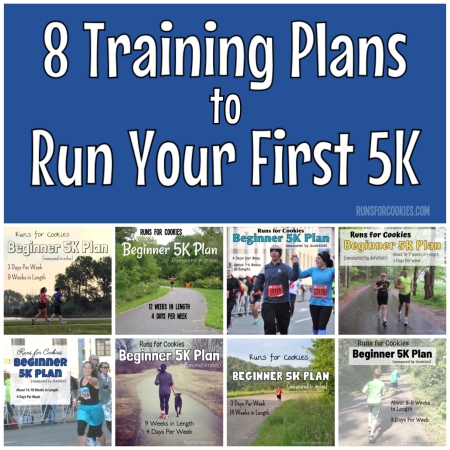
Run Your First 5K: 8 Beginner Training Plans!

Training Plans to Run Your First 5K

As I've mentioned several times, when I first started running in 2010, I literally could not run even 500 feet. A mile sounded completely impossible. And a 5K? How on earth did people do that?!

I tried the Couch to 5K plan a few times, and I just couldn't get past week 3. Week 4 was too big of a jump in distance for me. Also, I despised running intervals. The Couch to 5K plan has you run for a period, then walk, then run, then walk, over and over again. I found myself dreading hearing that beep on my watch, signaling me to start running.

So, I started doing my own thing. I ran as far as I could manage, and then I walked until I'd reached 30 minutes total. The next time, I ran a little farther than the first, and then walked the rest of the workout.

I only had one running segment, and I simply increased it each time I ran (three times per week). After the running segment, I would walk until the workout totaled 30 minutes. So, the running portion was increasing and the walking portion was decreasing, little by little. And eventually, I ran the entire 30 minutes.

After that, I continued to increase my distance until I'd reached 5K. (You can read my running story here.)

I wrote out a plan for all of this, to be able to go from "couch potato" to running for 30 minutes. But I didn't have a specific 5K plan for beginners, and several people have requested that I write one.

Instead, I wrote eight. Haha! They are all very similar, but they have several options to choose from: 3 days per week or 4 days per week; the number of weeks in the training plan; and running by time or running by distance. (I recommend using time spent running, but some people prefer to measure by distance; so, I included four of each.)

Some of the plans are short, and some are long. Some increase time/distance more quickly than others.

There are eight different plans for one common goal: to go from non-runner to runner.


Here, you can click on the link below any of the pics for a PDF copy of the plans. I think the plans are pretty self explanatory, but here are a few tips:

1) I know it's redundant, but make sure your doctor okays the plan.

2) Running is going to be hard. If it was easy, there wouldn't be training plans to go from non-runner to runner. Expect it to be difficult, but I promise you that it will get easier.

3) Run as slowly as possible. You may feel like you can walk faster than your running pace, but building up distance is the top priority. You will naturally get faster as you build up your distance, and you can always work on your speed later. At this point, running slowly will allow you to complete the workout.

4) When choosing the plans that are measured by time spent running, rather than distance, the number of weeks in the plan will vary by individual. Some people will get in more distance during the time spent running than others, so they may finish the plan earlier.

These posts may help as well:

Tips for running (and training for) your first 5K
50 Running Tips
How to Become a Runner
Running Lingo (running terms you may hear or read, and what they mean)


First, these are the plans that are measured by mileage. The first few weeks of each measures the running portion in duration (time), because it is such a short distance; but then it switches over to distance.

5K Training Plan 9 Weeks 3 Day per Week
PLAN 1
Measured in mileage
3 days per week
9 weeks in length


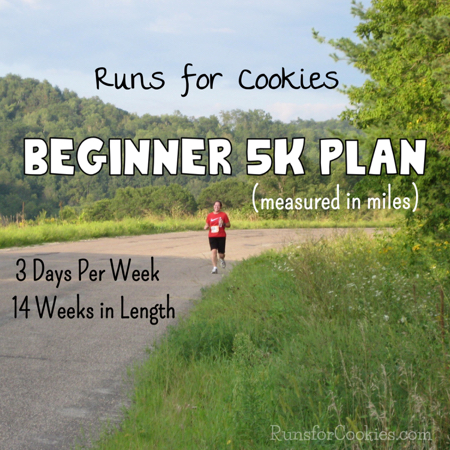
5K Training Plan 14 Weeks 3 Day per Week
PLAN 2
Measured in mileage
3 days per week
14 weeks in length


5K Training Plan 9 Weeks 4 Day per Week
PLAN 3
Measured in mileage
4 days per week
9 weeks in length


5K Training Plan 12 Weeks 4 Day per Week
PLAN 4
Measured in mileage
4 days per week
12 weeks in length


Next, these are the plans that are written in duration, so it schedules minutes instead of miles. It's just a matter of personal preference.

5K Training Plan 8-9 Weeks 3 Day per Week
PLAN 5
Measured in duration (minutes)
3 days per week
About 8-9 weeks in length


5K Training Plan 16-17 Weeks 3 Day per Week
PLAN 6
Measured in duration (minutes)
3 days per week
About 16-17 weeks in length


5K Training Plan 7-9 Weeks 4 Day per Week
PLAN 7
Measured in duration (minutes)
4 days per week
About 7-9 weeks in length


5K Training Plan 16-18 Weeks 4 Day per Week
PLAN 8
Measured in duration (minutes)
4 days per week
About 15-18 weeks in length


I hope these are helpful! I'd love to know your thoughts, as always, if you choose to use one of the plans. Let me know how your race goes! :)


Featured Posts

Blog Archive