... Also known as the longest post I've ever written.
I'm always surprised at how many people are interested in my posts about coaching cross country. I don't mean my personal cross country team, but coaching kids in general. They are (surprisingly) my most popular pins on Pinterest! To be honest, coaching kids is a bit of a challenge compared to high schoolers.
This is probably my longest post ever, and I thought of splitting it into two (or ten) posts, but I'd like all of the information in one single spot, and I hope it will be helpful to other coaches. If you're going to read it, make sure you're comfy with a cup of tea or glass of wine before diving in (and taking notes!).
I've coached cross country for five years, with kids ranging from second grade through sixth grade. (I've also coached adults who are looking to getting started running or run personal records.) I'm very confident in my ability as a coach, and I love to see some (if not all) of the kids I've coached go on to run in middle school (and even high school!).
That said, coaching kids isn't exactly a cake walk (literally). It's tough!
Challenges of Coaching Kids
1) They are younger and aren't sure of what sport they're "into" (if any at all). Many of them were made to sign up for cross country by a parent, and some of them don't want to be there. It's my job to (hopefully) make it fun enough that they will enjoy the season.
1) They are younger and aren't sure of what sport they're "into" (if any at all). Many of them were made to sign up for cross country by a parent, and some of them don't want to be there. It's my job to (hopefully) make it fun enough that they will enjoy the season.
2) Kids get bored EASILY. You have to keep them interested enough to want to continue the season and hopefully join again the following year. One of my favorite moments this season was when a boy on my team came to his first practice and said afterward, "I love cross country! I want to join again next year!" (We hadn't done sprints at the track yet, so maybe he'd spoken too soon, haha)
This photo was on a crazy hot day when I told the kids if they did extra sprints, they could dump ice water on my head. They clearly chose to do the extra sprints!

3) While high school kids tend to find motivation in their own running goals and personal bests, we all know that elementary school kids need a little more push. That means you have to get creative with ways to motivate them (which I'll share later in this post).4) Kids have very short attention spans. While it's easy to tell a high schooler to go run five or six miles, getting a fourth grader to run a quarter mile without dancing around, grabbing leaves from trees, and walking when they should be running is another story.
5) Trying to explain the complexities of competitive running to young kids would probably be comparable to a NASA physicist explaining rocket science to me. There are way too many technicalities that come into play with running, a trillion different training techniques, and SO many reasons for doing things the way they are done.
But there ARE reasons. I was very lucky to be invited by Runner's World magazine to their headquarters and learn tips from some of the best runners in the world! When I started using the techniques I learned, I became a much better runner (and coach). I also read pretty much any book I can get my hands on about different training methods. I even recently wrote a post about "How To Breathe While Running" about a seminar I sat in at RW headquarters.
But there ARE reasons. I was very lucky to be invited by Runner's World magazine to their headquarters and learn tips from some of the best runners in the world! When I started using the techniques I learned, I became a much better runner (and coach). I also read pretty much any book I can get my hands on about different training methods. I even recently wrote a post about "How To Breathe While Running" about a seminar I sat in at RW headquarters.
6) Kids never want to go for an "easy run". And I can't stress enough how important the easy run is! (Please, please read that post.) When kids first start running, they love to either sprint or walk, and nothing in between. As coaches, we know that the best runners utilize many different paces during training.
In fact, the biggest challenge I have with first year runners is trying to get them to learn to pace themselves appropriately. "What's the fastest pace you can run for an entire mile?" "What's the fastest pace you can run 100 meters?" There is a big difference between those two distances, but the kids will give a single pace answer, not two ;)
In fact, the biggest challenge I have with first year runners is trying to get them to learn to pace themselves appropriately. "What's the fastest pace you can run for an entire mile?" "What's the fastest pace you can run 100 meters?" There is a big difference between those two distances, but the kids will give a single pace answer, not two ;)
7) The long running can get boring during practices, because with little kids, you can't let them out of your sight. So, we have to stick with short (1/4 mile to 1/3 mile) loops in order to be able to watch all the kids at the same time. Running the same loop over and over isn't the best--I know that! Ideally, we'd go to a park and run a 3-mile loop--much less boring--but it's just not possible when you have elementary kids of all ages. So I try to find other ways to make it fun.
8) Some kids, no matter how badly you want them to succeed, will just NOT do what you ask them to do. I have heard every single excuse in the book about why they can't run that day: sore throat, foot hurts, leg hurts, ate too much dinner, stomachache, headache, too hot, too cold, too tired, etc. (Hint: 99% of those are simple excuses--I'm tough on my runners, and I *rarely* accept an excuse not to run.)
My philosophy is: If they can't run, they shouldn't come to practice! (I also try to find out from the parents whether they tend to be dramatic or if those excuses should be taken seriously.) We had a crazy hot race last weekend, so I brought a bottle of water to spray on the kids at the starting line. They loved it!

My philosophy is: If they can't run, they shouldn't come to practice! (I also try to find out from the parents whether they tend to be dramatic or if those excuses should be taken seriously.) We had a crazy hot race last weekend, so I brought a bottle of water to spray on the kids at the starting line. They loved it!
9) This one is a bit of a sore spot for me, especially now that I'm coaching without Renee... Our "club" (since the kids aren't yet in middle school, and the elementary school doesn't technically have a team, we are considered a club) isn't taken very seriously by the senior coaches at the school:
I hate to use this word, but I almost feel like the senior coaches think of our team as a "joke"--where I am a babysitter rather than a coach. Which is unfortunate for them, because the kids on my team will be the ones to be on their team in a few years! Haha ;) I feel like I go way above and beyond for our team, but it would be nice if the senior coaches recognized that. (I'm sure they have no idea how much work I do.)

We don't have a budget to get the things that the middle and high schoolers have--such as our own tent for the meets (the other teams have tents (like these) set up as a meeting space and to keep their gear). See those tents in the background? Every team has one except for us! This year, I bought the wagon; next year I'll buy a tent.

Unlike the older kids, we don't get singlets, but rather t-shirts instead (a t-shirt is great, but a singlet would make them feel like they are more a part of the "real" running teams at meets. Not to mention, they'd be more comfortable.
For me, coaching is a volunteer position; I don't mind this at all, because I love doing it, but I do end up spending much more of my own money than I probably should. I had to buy a wagon to carry our gear (Renee had one last year, but since I'm coaching solo, I had to purchase my own).
I also bought several of the prizes before creating the Amazon Wish List (these are unnecessary, of course, and I obviously don't expect the school to buy them, but it shows that I am passionate about the team).
I have to pay to get into the Metroparks where a couple of the races are held (the passes are $10 each)! It would be nice if I didn't have to cover that expense. To be fair, I'm not sure if the other coaches are paying out of pocket; but the middle and high school coaches have paid positions.
This year, because I was coaching without Renee, I chose to have just fourth and fifth graders on the team (which literally cut the potential team in half, from 24 to 12). I didn't understand that this would be a problem, but I've since learned that the races are paid for by the school per TEAM and not per RUNNER as I'd thought. So, the senior coach wasn't happy with me regarding that decision. Next year, I will include 3rd graders again.
However, due to the smaller team this year, I was able to concentrate on coaching each kid much more personally--focusing on strengthening their weaknesses and playing up their strengths. It's hard to do that with 25-30 kids on the team (past numbers). I believe I can have a much larger team next year; this year was a nice way to ease myself into coaching alone.
This is my team this year (don't worry, I got permission from their parents to post this)--we started with 12, but one of the girls quit coming, so we are down to my very favorite number ;) Next year, I'll try to get 33 😬
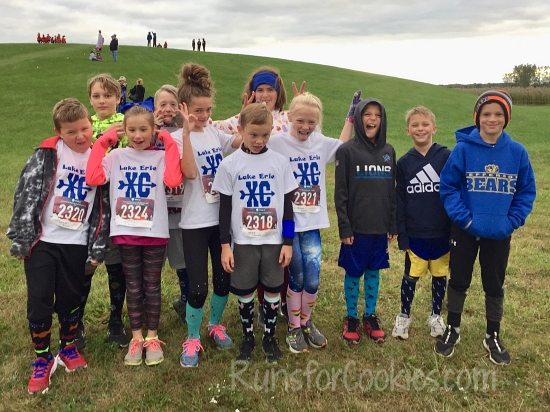
I miss Renee (we had fun coaching together, and we started the team together!). I do enjoy coaching alone, but I didn't realize or truly appreciate just how much "behind the scenes" work she did until I started to do it myself this season. It's much easier--and more fun--when you have a partner to coach with.
Helpful Tips for Coaching Kids
So, as you can see, there are many more challenges when coaching little kids than when coaching older kids. I could coach a middle or high school team no problem and they'd do great! But coaching young ones is a different ball game (err, race course, rather).
Here are some things I've learned over the last five years of coaching that may be helpful for those of you who are coaches and feel as lost as I did when I started. I was used to coaching single adults who had a race goal--and then my friend Renee and I started our elementary school team.
1) Find a place to practice that has the following conditions:
Grassy (or at least unpaved) because cross country races are not on pavement
A smaller loop where the entire thing is visible, roughly 1/4 mile (so you can keep track of the kids without losing anyone
Doesn't have a lot of traffic--people, dogs, bikes, etc. coming through
2) Get the following necessities to make your (coaching) life much easier:
A water cooler big enough for the team (kids are always forgetting water bottles--I tell them to bring them, but the cooler is for refills and for the kids who forget). I have a five gallon one which is way too big--three gallons would be perfect, even for a team twice my size.
A collapsible wagon for getting your stuff to and from your meeting locations (I'll explain why you'll need it later, when I describe all the stuff you need)
A huge tote bag, similar to this (or two--in my case, I've acquired three!)
A 3-ring binder for all the necessary paperwork (as well as the not-so-necessary nerdy spreadsheets that I love).
A whistle (you know, for authority and stuff--haha)!
A stopwatch app on your phone, or an actual stopwatch. My app is cleverly called Stopwatch+ on iOS.(There will be several more things ("luxuries" listed below); but these above are necessities, in my opinion.)
3) Luxuries to have, if possible:
Garmin (or other GPS) watches to track distance and pace. I was lucky enough to have a few blog readers send me their old Garmins and I LOVE USING THEM. I used to use a rubber band system to keep track of distance (I'll explain below) but I found that some of the kids would "accidentally" run less than they said they did. Having the watches is proof! ;)
If Garmins aren't a possibility, which I'm sure they aren't for most people, I used a rubber band system. Each rubber band was equivalent to one lap around the park. On some days, I would give each kid a particular number of rubber bands (based on their ability) to put on their wrist. Each time they finished a lap, they would remove one rubber band, until they'd finished removing all of them.
Sometimes, I would do it in reverse. For long run days, for example, I'll have them collect a rubber band for each lap instead of removing one. This way, they just keep running until I tell them to stop. (Otherwise, some kids will do the minimum that you give them and not aim for anything more.) But beware, they will ALWAYS ask how many more laps!
This year, as I will explain later in the post, I acquired some running parachutes. These are SO fun for the kids and make sprints very hard work!
Items to use for an obstacle course (I've done obstacle courses once in a while when we have a race the following day; that way, they are moving and getting exercise, but aren't pushing themselves too hard before the race). I'll post ideas for that later.
4) Choose the days of the week and times you want to have practices.
Usually, I am a people pleaser and do everything I can to accommodate everyone else; but when it came to practices this year, I chose what was best for ME and my family. I'm a volunteer coach, so I don't get paid for my time. I choose to practice three evenings a week, and I am done by the time Jerry is home from work and showered. I also chose a location that is close to home. That way, I can spend the evening with my family.
5) Don't baby the kids, especially from the very beginning.
As soon as you fall for one of their excuses, you're a goner ;) (Kidding, but you do have to be tough about the rules, otherwise they will walk--or run, rather--all over you).
As soon as you fall for one of their excuses, you're a goner ;) (Kidding, but you do have to be tough about the rules, otherwise they will walk--or run, rather--all over you).

6) Develop a game plan:
Short, tempo run once a week (tempo pace = harder than easy pace, but not quite race pace)
Speed work at the track another day (super hard! I'll have some ideas below)
Long runs on another day (for my kids, this is anywhere from 2.5-5.5 miles)
And if you're fortunate enough to have 4-5 days a week for practice, I'd throw in some extra easy runs to get in more mileage.(It's okay to vary from the schedule, of course; if my kids have a race on Tuesday, I'm either going to cancel practice for the Monday before or we'll do a very easy, fun workout, like the obstacle course.
7) Start each season with a time trial (a timed one-mile run on an outdoor track).
Since cross country starts in the late summer, ideally, practices should start in early summer (right when school gets out, or at least by July). Go to a local school track when nobody is using it, and time the kids for a one mile run (four laps around the inner lane).
I use an app on my phone where I press a "lap" button after each child finishes, and it marks each of those times while the timer is still going. (Again, mine is Stopwatch+). Practice with it several times before you use it for the time trial!
During the trial, the kids take a number as soon as they are finished--that number correlates with their finishing order (so that I know which lap time belongs to each kid). If they finish their mile in third place, for example, they take the number 3 (written on a post-it) and hold onto it until everyone is finished (it helps to have a parents or assistant coach hand out the post-its while you time them). When the trial is over, I will look at lap 3 on the stopwatch to see that person's personal mile time. I wrote more details about this on this post.
The reason for starting the season with this time trial is so that at the end of the season, you can repeat it and see if the kids' times have improved. (I don't think I've ever had a kid NOT improve throughout the season). It's a confidence boost to them. And to me, as their coach! These stats are after just one month.
Since cross country starts in the late summer, ideally, practices should start in early summer (right when school gets out, or at least by July). Go to a local school track when nobody is using it, and time the kids for a one mile run (four laps around the inner lane).
I use an app on my phone where I press a "lap" button after each child finishes, and it marks each of those times while the timer is still going. (Again, mine is Stopwatch+). Practice with it several times before you use it for the time trial!
During the trial, the kids take a number as soon as they are finished--that number correlates with their finishing order (so that I know which lap time belongs to each kid). If they finish their mile in third place, for example, they take the number 3 (written on a post-it) and hold onto it until everyone is finished (it helps to have a parents or assistant coach hand out the post-its while you time them). When the trial is over, I will look at lap 3 on the stopwatch to see that person's personal mile time. I wrote more details about this on this post.
The reason for starting the season with this time trial is so that at the end of the season, you can repeat it and see if the kids' times have improved. (I don't think I've ever had a kid NOT improve throughout the season). It's a confidence boost to them. And to me, as their coach! These stats are after just one month.

8) Try to have either an assistant coach to help out OR a parent who has no problem with allowing you to be the one to take charge and control the practices.
I've found that when parents stay at practice, one of two things tends to happen:
That said, I always tell the parents they are welcome to stay if they wish! But I don't let it affect how I coach; I don't go easier on the kids just because they may have a parent there. I have no problem yelling across the football field during a time trial, "IF YOU'RE TALKING, YOU'RE NOT RUNNING FAST ENOUGH! GO FASTER!"I've found that when parents stay at practice, one of two things tends to happen:
They are way too hard on their kids--they tell them to run faster and harder when I might be coaching an easy run that day, for example. I'm an experienced certified running coach, and I know what I'm doing! Last year, I had a parent who just broke her daughter's spirit by being so tough on her. Her daughter chose not to continue XC in middle school.
On the opposite note, the kids may get a little babied by the parents, which makes coaching tough. You can't be a babysitter and a coach at the same time if you intend to help the entire team become better runners. As I get to know the kids, I know who can be pushed and who just needs a little encouragement. I tailor my ways to the best of my ability. My goal is to keep running fun but also to make the kids better runners.
I'm a relatively tough coach! And proud of that ;) If the kids do what I say, they will become better runners. Usually, I am a humble person; but I am pretty badass when it comes to coaching people (not just kids) who want to become better runners.
9) If you're a numbers nerd like me, create some spreadsheets to get organized and put in your binder. If you're familiar with spreadsheets, I can email some to you. But it'd be easier to create your own and tailor them to your team's goals.
After the initial time trial, I gave the kids the goal of bettering their time by 10% (likely), 15% (tough, but doable), or 20% (a "superman" goal).

10) Super important: This will likely be required by your club or school, but make sure you get waivers signed before any practices.
If you're not working with a school, liability insurance is a great idea, too. Kids are resilient, but things happen, and it's good to be prepared. On the front cover of my binder (inside the clear plastic) I keep a list of names, emergency contacts, phone numbers, allergies, and any health conditions for easy reference. I have two kids with (non-epileptic) seizure disorders, and their parents have given me instructions on what to do if it should happen during practice.
If you're not working with a school, liability insurance is a great idea, too. Kids are resilient, but things happen, and it's good to be prepared. On the front cover of my binder (inside the clear plastic) I keep a list of names, emergency contacts, phone numbers, allergies, and any health conditions for easy reference. I have two kids with (non-epileptic) seizure disorders, and their parents have given me instructions on what to do if it should happen during practice.
11) For some reason, the kids always want to take breaks after each (1/4 mile) lap. *sigh*
Since our laps are only 1/4 mile, this is a problem! If I can run three miles non-stop when I'm this out of shape right now, they can certainly run the 2-4 miles I assign at practice. This has been a problem every year, so this year, I came up with a solution: handheld water bottles.
Since our laps are only 1/4 mile, this is a problem! If I can run three miles non-stop when I'm this out of shape right now, they can certainly run the 2-4 miles I assign at practice. This has been a problem every year, so this year, I came up with a solution: handheld water bottles.
Since the one that I have and love (Amphipod) is super expensive, and so are others like Nathan's brand, I had to find something I could afford. I bought a couple packs of these water bottles and a few packs of these handles to go on them. This way, they can carry their water with them while they run--no excuses. It has cut down the walking/stopping quite a bit.

However, several of the kids have complained that they are heavy, so they choose not to use them. A few people donated some small wrist water bottles that the kids went nuts over--they love them! So, if you're feeling generous and would like to donate something to our team, here is the link on Amazon for the water bottles on our wish list.
12) Form a Facebook group for all the parents.
When you have a lot of information to give at once (about the meets, for example) I like to post it all on there. I post race maps, where to meet, what time to meet; in addition to information, the parents share photos from races, etc.
I also have a group text where I remind the parents of any information on practice days and ask who will be there. On race days, I remind them of the times/location and to make sure their child is hydrated, etc. I like to keep the texts short and to the point. Thankfully, all of the parents have Facebook, so I sometimes just text them to check Facebook for important info.
When you have a lot of information to give at once (about the meets, for example) I like to post it all on there. I post race maps, where to meet, what time to meet; in addition to information, the parents share photos from races, etc.
I also have a group text where I remind the parents of any information on practice days and ask who will be there. On race days, I remind them of the times/location and to make sure their child is hydrated, etc. I like to keep the texts short and to the point. Thankfully, all of the parents have Facebook, so I sometimes just text them to check Facebook for important info.
Making Running FUN
Have an incentive program:
The incentive programs for my team have varied throughout the years, depending on what works and what doesn't (and how expensive it is). This year, thanks to my super generous readers, has been (by far) the best! This incentive program can be very expensive if you're not getting donations or a budget from a school to use, so if you can't do it, I have other ideas. But here is what I'm doing this year:
Points system with awards: I created an Amazon Wish List for our team, and I was shocked at how many people donated. That (and the donations for Mark when he was dying from cancer) are the two most generous things people have ever done for me, and I can't express my gratitude enough. Really. (Anything leftover or donated post-season will go toward next year's season.)
Mushy stuff aside, here is how it works: In a nutshell, the kids earn points and the points are like "money" to buy prizes. I have found their favorite prizes to be novelty compression socks (the size S/M works out great for the kids! I was worried they'd be too big), wrist water bottles (mentioned above), headbands/sweatbands, and a few other things.
This is the same photo from earlier, but I wanted to show off the socks that the kids are wearing--those are a VERY hot item that they like to spend their points on!
I bought a Garmin (new in the box for $25 on Facebook Marketplace!) with my own money at the beginning of the season to use as an incentive, which started this whole idea. If you look at the Wish List, you'll see the things we use.
Mushy stuff aside, here is how it works: In a nutshell, the kids earn points and the points are like "money" to buy prizes. I have found their favorite prizes to be novelty compression socks (the size S/M works out great for the kids! I was worried they'd be too big), wrist water bottles (mentioned above), headbands/sweatbands, and a few other things.
This is the same photo from earlier, but I wanted to show off the socks that the kids are wearing--those are a VERY hot item that they like to spend their points on!
I bought a Garmin (new in the box for $25 on Facebook Marketplace!) with my own money at the beginning of the season to use as an incentive, which started this whole idea. If you look at the Wish List, you'll see the things we use.
The kids earn points for things like:
Doing their best at practice (I can always tell who is working hard and who is not)
One point for every mile run
5 points for each mile run without stopping or walking
20 bonus points when they hit a cumulative 20 miles for the season
30 bonus for 30 miles, etc. (One of my kids has run over 80 miles so far!)
They get 20 bonus points each time they run their fastest mile pace at a race or time trial.
And once in a while, I'll give out bonus points for things like running extra laps when they are done with their workout, or for doing a couple of extra interval sprints, things like that. I keep track of all the mileage, points, and race times on spreadsheets (again, I'll share those later).
Doing their best at practice (I can always tell who is working hard and who is not)
One point for every mile run
5 points for each mile run without stopping or walking
20 bonus points when they hit a cumulative 20 miles for the season
30 bonus for 30 miles, etc. (One of my kids has run over 80 miles so far!)
They get 20 bonus points each time they run their fastest mile pace at a race or time trial.
And once in a while, I'll give out bonus points for things like running extra laps when they are done with their workout, or for doing a couple of extra interval sprints, things like that. I keep track of all the mileage, points, and race times on spreadsheets (again, I'll share those later).
Some other incentive ideas:
Last year, I did a "token" system (which were basically different color charms, but I called them tokens so that the boys didn't feel like they were too girly). I bought them on clearance and I made the wrist keychains from old pairs of jeans. Each token represented a different accomplishment: running a mile under 10 minutes, under 9 minutes, etc. Running a personal record. Beating the seasonal goal I gave them. Hitting a certain number of miles run. I wrote all about that in this post.
Last year, I did a "token" system (which were basically different color charms, but I called them tokens so that the boys didn't feel like they were too girly). I bought them on clearance and I made the wrist keychains from old pairs of jeans. Each token represented a different accomplishment: running a mile under 10 minutes, under 9 minutes, etc. Running a personal record. Beating the seasonal goal I gave them. Hitting a certain number of miles run. I wrote all about that in this post.

This one is totally free, and quite useful: A leaderboard. This works for kids who are competitive. Before each practice, I write down on a dry-erase board a list of the kids' names in order of who has the most cumulative miles or who has the most points. For some reason, just seeing their names made them want to climb to the top of the list.

Another is candy. Yes, this is more of a bribe, but it's come in useful, too. I bought a large bag of Jolly Ranchers and the kids who participate as I ask during practice will get a Jolly Rancher when practice is over. You would be amazed at how much a single Jolly Rancher inspires the kids to work harder!
The candy actually works two-fold; when the kids are doing a long run during practice, they may ask for a Jolly Rancher to keep their mouth from getting dry as they run. Since I totally understand how this feels, and I want to encourage them from stopping for breaks, I allow them to have one or two if they are really trying their best.
Workouts That Kids May Enjoy
Let's face it--running, by itself, just isn't fun! But there are ways to make it fun, and I've come up with lots of ideas over the last five years.
Parachute Sprints:
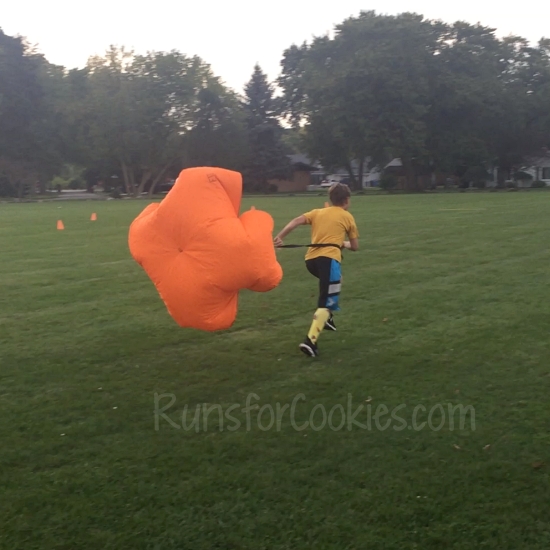
This year, a few of my blog readers donated (from our Wish List) some running parachutes. The kids LOVE THESE. You strap it to your waist and then run as hard as you can (against the wind) and the force of the wind resistance in the parachute really strengthens their legs.
This year, a few of my blog readers donated (from our Wish List) some running parachutes. The kids LOVE THESE. You strap it to your waist and then run as hard as you can (against the wind) and the force of the wind resistance in the parachute really strengthens their legs.
Fast Finish Runs:
The kids run their usual laps, but on the last lap, they run as fast as they can get it done without stopping or walking. This teaches them to finish strong on tired legs. Sometimes I'll offer extra points if they really push hard on that last lap.
The kids run their usual laps, but on the last lap, they run as fast as they can get it done without stopping or walking. This teaches them to finish strong on tired legs. Sometimes I'll offer extra points if they really push hard on that last lap.
Obstacle Courses - When the kids have a race the following day, to avoid burning them out and using up all their energy, I've created an obstacle course for them to do at practice. I usually find things around the house or garage that I can set up. Some ideas:
Jumprope
Hurdles (I made some with these and these from Lowe's. You just stick two sign stakes in the ground next to each other a few feet apart, and then thread this driveway reflector through the holes.) I make some higher ones for them to jump over and lower ones for them to crawl under. Not the fanciest, but they were super cheap.
A pillow case to put both feet in and hop to the next obstacle
A giant pair of Jerry's work boots that they had to quickly put on and run with them to the finish (it was much harder than I expected!)
Running 100 meters with a running parachute
Kicking a kick ball 100 meters
Rings for quick steps
Cones to zig zag
Jumprope
Hurdles (I made some with these and these from Lowe's. You just stick two sign stakes in the ground next to each other a few feet apart, and then thread this driveway reflector through the holes.) I make some higher ones for them to jump over and lower ones for them to crawl under. Not the fanciest, but they were super cheap.
A pillow case to put both feet in and hop to the next obstacle
A giant pair of Jerry's work boots that they had to quickly put on and run with them to the finish (it was much harder than I expected!)
Running 100 meters with a running parachute
Kicking a kick ball 100 meters
Rings for quick steps
Cones to zig zag
Basically, just look around the house and get creative ;) For the obstacle course, I have all the kids complete it on their own while I time them; then at the end, I announce the winner. I gave 30 points to the first place winner, 20 to second place, and 10 to third place.
Running with Jerry's work boots was surprisingly very difficult for most of the kids!

The Marbles Game (this is great for running sprints on the track; on a hill is even better! And the kids love it):
This game is best for a hill, but you could modify it for 70-ish meter sprints on flat ground, too. I bought two bags of marbles--one blue and one green. The blue marbles are worth 3 points, and the green marbles are worth 1 point. You place a bucket with all the green (1 point) marbles halfway up the hill, and a bucket with the blue (3 point) marbles at the very top of the hill.
This game is best for a hill, but you could modify it for 70-ish meter sprints on flat ground, too. I bought two bags of marbles--one blue and one green. The blue marbles are worth 3 points, and the green marbles are worth 1 point. You place a bucket with all the green (1 point) marbles halfway up the hill, and a bucket with the blue (3 point) marbles at the very top of the hill.
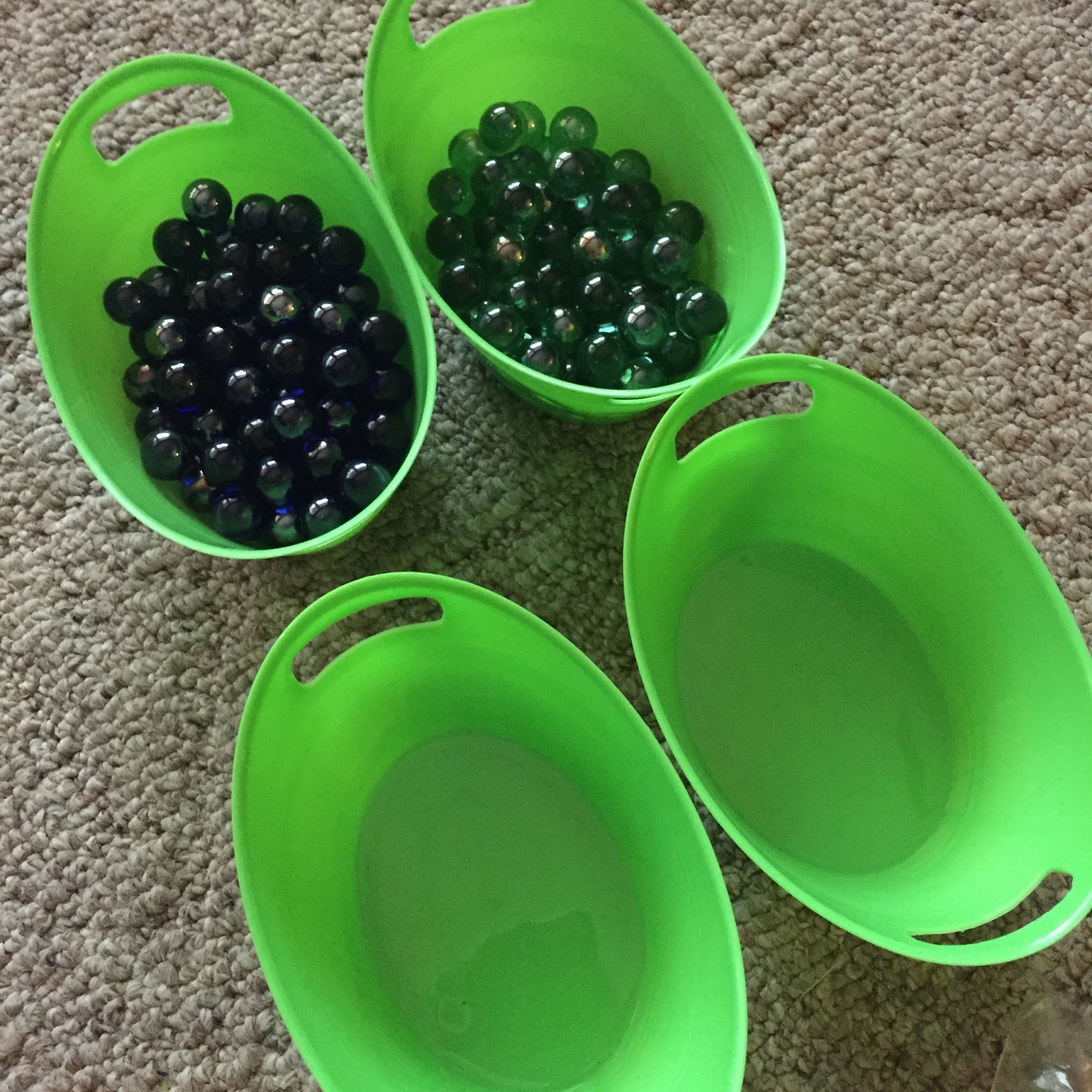
Divide the kids into two teams of equal ability, and when you blow the whistle, all the kids (the entire team) run at the same time up and down the hill, picking up only one marble at a time and returning it to the bottom of the hill into their team's assigned bucket.
They can choose to get the 1-point marbles by only having to go halfway up the hill, or they could choose the 3-point marbles by going to the top of the hill. At the end, total the points for each team, and the team with the most points is the winner.
They can choose to get the 1-point marbles by only having to go halfway up the hill, or they could choose the 3-point marbles by going to the top of the hill. At the end, total the points for each team, and the team with the most points is the winner.
Connect Four Game (again, for sprinting or hills):
I bought a Connect 4 board game, and our team uses that in a few different ways. There is a hill in one of the parks where we practice, so to get the kids to run hill repeats, we place all of the game pieces (the little red and yellow discs) on the top of the hill. Then I hold the game board at the bottom of the hill. We divided the kids into the yellow team and the red team (trying to make them equal based on how fast the kids are).
I bought a Connect 4 board game, and our team uses that in a few different ways. There is a hill in one of the parks where we practice, so to get the kids to run hill repeats, we place all of the game pieces (the little red and yellow discs) on the top of the hill. Then I hold the game board at the bottom of the hill. We divided the kids into the yellow team and the red team (trying to make them equal based on how fast the kids are).
Each team lined up at the bottom of the hill, and when I blew the whistle, the first person on each team ran to the top of the hill, grabbed one game piece, and ran back to the bottom to put their piece on the board. When they reached the bottom, the next person from their team headed up the hill. This went on until one of the teams got four tokens in a row! We usually fit in two or three rounds of this game.
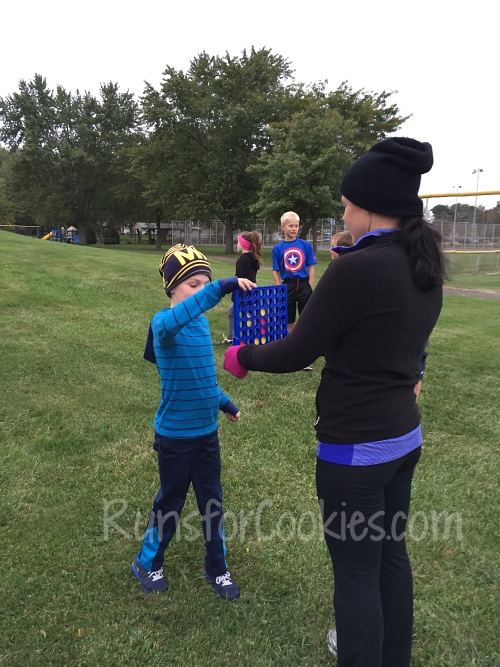
Another way to use the Connect 4 game is to do a relay like I wrote above, only instead of a hill, they can run a straight line or in a loop.
Musical Hula Hoops:
This is basically musical chairs, but instead of putting a bunch of chairs in a circle, I put a bunch of hula hoops in a giant circle in the field. For 20 kids, I started with 8 hula hoops and allowed 2 kids per hula hoop.

When I blow the whistle, the kids start running a circle around the circle of hoops, just like in musical chairs; and then when I blow the whistle again, they have to scramble to find a hoop to stand in. Only two kids were allowed per hoop, so the leftover kids are out.
Then I take away one of the hoops, and continue. We do this until there were two kids fighting for one hoop. Last one standing is the winner. With fewer kids this year, I used more hoops (the same hoops I used for the obstacle course that I linked to above) and each kid must find his/her own.
This is basically musical chairs, but instead of putting a bunch of chairs in a circle, I put a bunch of hula hoops in a giant circle in the field. For 20 kids, I started with 8 hula hoops and allowed 2 kids per hula hoop.
When I blow the whistle, the kids start running a circle around the circle of hoops, just like in musical chairs; and then when I blow the whistle again, they have to scramble to find a hoop to stand in. Only two kids were allowed per hoop, so the leftover kids are out.
Then I take away one of the hoops, and continue. We do this until there were two kids fighting for one hoop. Last one standing is the winner. With fewer kids this year, I used more hoops (the same hoops I used for the obstacle course that I linked to above) and each kid must find his/her own.
Sharks & Minnows:
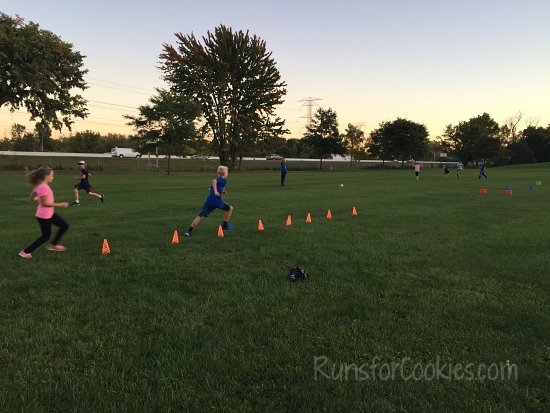
This is a game that the kids actually taught me. Using orange cones, we set up a large rectangular play area. You choose two kids to be "sharks", who start in the center of the rectangle. The rest of the kids are "minnows", and they line up across one end of the rectangle. The goal is for the minnows to get from one side of the play area to the other without getting tagged by a shark.
When I blow the whistle, the kids all run as fast as they can to the other side, and try not to get tagged by a shark. If they get tagged, they become "seaweed" and they have to sit down on the spot they were tagged. The seaweed can then tag minnows as the minnows run by, but they have to stay seated. You do several rounds of this until there is only one minnow left standing, who is the winner.
We use this as a game, but the kids get a TON of running out of it!
This is a game that the kids actually taught me. Using orange cones, we set up a large rectangular play area. You choose two kids to be "sharks", who start in the center of the rectangle. The rest of the kids are "minnows", and they line up across one end of the rectangle. The goal is for the minnows to get from one side of the play area to the other without getting tagged by a shark.
When I blow the whistle, the kids all run as fast as they can to the other side, and try not to get tagged by a shark. If they get tagged, they become "seaweed" and they have to sit down on the spot they were tagged. The seaweed can then tag minnows as the minnows run by, but they have to stay seated. You do several rounds of this until there is only one minnow left standing, who is the winner.
We use this as a game, but the kids get a TON of running out of it!
Scavenger Hunt:
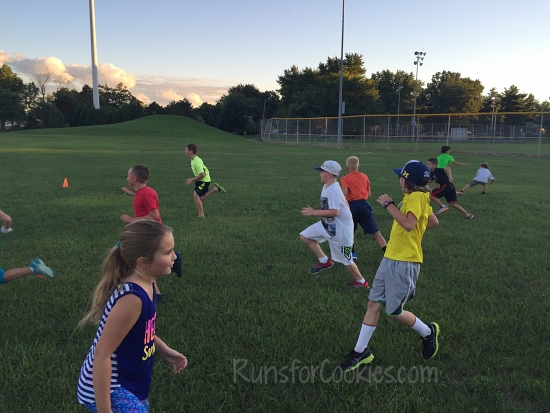
This was a little different than your average scavenger hunt. I bought about 10 small buckets from the dollar store, and a large package of plastic toy food items. On index cards, I wrote down the name of each food item. Then, I placed 3-4 items in each bucket, and placed all the buckets spread across the field randomly. I divided the kids into two teams, and they lined up relay-style. I handed each kid one of the index cards with an item written on it.
When I blew the whistle, the first kid from each team ran off to look in the buckets for their item (if they were lucky, it would be in the first bucket they checked; but if not, they had to keep searching). When they found their item, they ran it back to the team, and the next person took off. The first team to find all their objects was the winner. The kids are allowed to help their teammates--if the first kid, for example, saw the banana in one bucket and knew their teammate was going to be looking for it, they could tell their teammate what bucket the banana was in.
This was a little different than your average scavenger hunt. I bought about 10 small buckets from the dollar store, and a large package of plastic toy food items. On index cards, I wrote down the name of each food item. Then, I placed 3-4 items in each bucket, and placed all the buckets spread across the field randomly. I divided the kids into two teams, and they lined up relay-style. I handed each kid one of the index cards with an item written on it.
When I blew the whistle, the first kid from each team ran off to look in the buckets for their item (if they were lucky, it would be in the first bucket they checked; but if not, they had to keep searching). When they found their item, they ran it back to the team, and the next person took off. The first team to find all their objects was the winner. The kids are allowed to help their teammates--if the first kid, for example, saw the banana in one bucket and knew their teammate was going to be looking for it, they could tell their teammate what bucket the banana was in.
Matching Card Game:
I bought a few packs of Matching Game cards from the dollar store (the deck consists of cards with pictures on them, and each card has a match). I would have the kids run their laps and collect ONE card after each lap (without peaking at the cards). They were divided into two teams, and each card they collected was put in a pile for their team. Once all the cards were gone, the teams got together to see how many matches they made. The team with the most matches was the winner. The kids learned that the faster they ran, the more laps--and therefore, more cards--they would get.
This can also be played on a hill, with the cards at the top of the hill and the kids running up to grab a card then bringing it down to the bottom.
I bought a few packs of Matching Game cards from the dollar store (the deck consists of cards with pictures on them, and each card has a match). I would have the kids run their laps and collect ONE card after each lap (without peaking at the cards). They were divided into two teams, and each card they collected was put in a pile for their team. Once all the cards were gone, the teams got together to see how many matches they made. The team with the most matches was the winner. The kids learned that the faster they ran, the more laps--and therefore, more cards--they would get.
This can also be played on a hill, with the cards at the top of the hill and the kids running up to grab a card then bringing it down to the bottom.
Simple Sprints (I like to do these on the track):
Set up two cones about 50-100 meters apart on the track. If you have a large group of kids, you may want to separate them into "waves" that start about 10 seconds apart so that they aren't getting trampled.
When you blow the whistle, the kids sprint as hard as they can from one cone to the next. Then, they turn and walk back to the first cone. Repeat for the number of times that is appropriate for your group. For my 3rd through 5th graders, I have them do twelve 100-meter sprints and they are TOTALLY wiped out. But several of them do extra, because I offer 3 extra points per sprint ;)
Set up two cones about 50-100 meters apart on the track. If you have a large group of kids, you may want to separate them into "waves" that start about 10 seconds apart so that they aren't getting trampled.
When you blow the whistle, the kids sprint as hard as they can from one cone to the next. Then, they turn and walk back to the first cone. Repeat for the number of times that is appropriate for your group. For my 3rd through 5th graders, I have them do twelve 100-meter sprints and they are TOTALLY wiped out. But several of them do extra, because I offer 3 extra points per sprint ;)
Animals (for speed control--teaching easy running, moderate running, tempo running, and sprints):
I made little signs, each with the name of one of four animals on it--turtle, pig, horse, or cheetah. I put the signs on cones that were set up in their loop where they run laps. Turtle means walk; pig means jog slowly; horse means run steady; and cheetah means sprint. Each time they come to a cone, they have to run like the speed of the animal on the cone. When they reach the next cone, they change it up. I have eight cones total, with two of each animal.
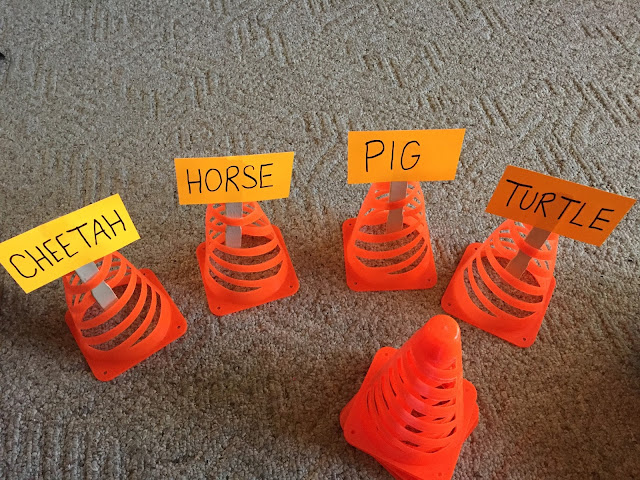
I made little signs, each with the name of one of four animals on it--turtle, pig, horse, or cheetah. I put the signs on cones that were set up in their loop where they run laps. Turtle means walk; pig means jog slowly; horse means run steady; and cheetah means sprint. Each time they come to a cone, they have to run like the speed of the animal on the cone. When they reach the next cone, they change it up. I have eight cones total, with two of each animal.
Water Bucket Sprints:
I bought four 5-gallon buckets (two filled with water and two empty--the empty ones were the kind you find in the paint sections at Lowe's--they have measuring marks on them). I give each of the kids an empty cup and separate them into two teams. When I blow the whistle, the kids fill their cup with water from the full bucket and run 100 meters across the field to the empty bucket and pour it in. Then run back and get more. Over and over until the team who gets to four gallons first wins (Trying to scoop out five gallons of water from a five gallon bucket is challenging, so we just go up to four).
I bought four 5-gallon buckets (two filled with water and two empty--the empty ones were the kind you find in the paint sections at Lowe's--they have measuring marks on them). I give each of the kids an empty cup and separate them into two teams. When I blow the whistle, the kids fill their cup with water from the full bucket and run 100 meters across the field to the empty bucket and pour it in. Then run back and get more. Over and over until the team who gets to four gallons first wins (Trying to scoop out five gallons of water from a five gallon bucket is challenging, so we just go up to four).
Ice Block Relay:
On one very hot day of practice, Renee brought a couple of large ice blocks (she filled a couple of milk cartons with water and froze them in order to make the blocks). Then the kids did a relay race, carrying the ice block and passing it to the next kid in the relay. They loved doing this!
On one very hot day of practice, Renee brought a couple of large ice blocks (she filled a couple of milk cartons with water and froze them in order to make the blocks). Then the kids did a relay race, carrying the ice block and passing it to the next kid in the relay. They loved doing this!
To end the season, I always like to give recognition to the kids who really went above and beyond during training. I create award certificates for the kids and print them out on nice card stock, each saying something to recognize a particular strength they had. Here is an example:

The kids seem to like the recognition, and I hope that it encourages them to join again next year! We usually have a pizza party "awards ceremony" as well.
Well, I realize this is a doozy of a post. I've been working on it for days (literally, probably 30 hours total). I'm wiped! But I hope it's helpful to have all of this info in one place.
I believe I've covered it all here, but just in case, here are more posts I wrote about coaching kids' cross country:
Speed Work Outs for Kids
Musical Hula Hoops
Cross Country Incentives for Kids
A New Incentive System for Cross Country
Speed Work for Kids
Hill Workouts for Kids' Cross Country
Tips for Coaching Kids to Run
Running Games for Kids
A Solution to Keep Kids Moving at Cross Country Practice
Speed Work Outs for Kids
Musical Hula Hoops
Cross Country Incentives for Kids
A New Incentive System for Cross Country
Speed Work for Kids
Hill Workouts for Kids' Cross Country
Tips for Coaching Kids to Run
Running Games for Kids
A Solution to Keep Kids Moving at Cross Country Practice
I may add to this post here and there as I think of more. I feel like I'm forgetting things. But it's nearly midnight, and I have to get up at 6:00, and I really want to get this posted! If you made it through this whole post, congratulations! Hopefully, if you're a coach (or prospective coach) you'll find it helpful :)
Anyway, good luck coaching!! It's been super fun and rewarding for me.