October 09, 2019

Born To Run (a super simple book review) and a giveaway!

Born to Run paperback

So, for YEARS I've been saying that I was going to read Born to Run by Christopher McDougall. I bought the paperback copy so long ago I don't even remember buying it. I took it on airplanes with me, I tried reading it when I was between other books, but I just couldn't get into it!

As a runner, I felt it was a rite of passage to read that book. It's been on my list forever, and when I was able to borrow it from the library and read it on my Kindle instead of the paperback, it seemed much less daunting.

And it was! Once I got about 50 pages in, I could definitely understand the appeal. I happen to forget books as soon as I read them, so this isn't really going to be a real review. I'll just write the gist of my thoughts on it and include some parts that I highlighted. (I love that on the Kindle, you can highlight things and have them all emailed to you!)

Let me first apologize if I don't have everything EXACTLY perfect on this post. I finished the book about a month ago, so the details are a little fuzzy. I wrote this based on my notes and on what I found most interesting in the book.

In a very small nutshell, the book is about a running tribe called the Tarahumara that is so remote in Mexico, they seem non-existent. Very exclusive, and despite the fact that they are literally some of the fastest long-distance runners in the world, they are very humble and don't travel around, running races. They just run for fun amongst their community.

The author of the book, Christopher McDougall, spent some time trying to track down anybody he could to learn about this mysterious tribe. Once he finds them, he learns all sorts of running tips and techniques from them. He meets an eccentric man named Caballo who lives among the Tarahumara who comes up with a plan to have a real race in the tribe's home turf. He invites some of the best runners in the world, including Scott Jurek--and he accepted!

While I thought the race preparation was very interesting, I was mostly interested in how the Tarahumara run, which is what I'll focus on here (because that's mostly what I have highlighted).

Here is what McDougall was told about running the Tarahumara way:
"Think Easy, Light, Smooth, and Fast. You start with easy, because if that's all you get, that's not so bad. Then work on light. Make it effortless, like you don't give a shit how high the hill is or how far you've got to go. When you've practiced so long that you forget you're practicing, you work on making it smooooooth. You won't have to worry about the last one--you get those three, and you'll be fast."
The Tarahumara seem to run with no effort at all, and I'm talking dozens and dozens of miles at a time. They have races that seem to go on forever--FOR FUN.
"...the only way to truly conquer something, as every great philosopher and geneticist will tell you, is to love it." 
Since the Tarahumara love running so much, they've got it conquered. Without sponsors or coaches or even running shoes, they are some of the best runners in the world.

When this book was first published, it started the big "barefoot running" trend. I was never on board with it (then again, I'd never read the book). I can totally see why people started running barefoot! The Tarahumara run barefoot or close to it (flat-soled sandals that are strapped on).

Something that I found very interesting was about easy and hard runs. I'm always preaching about the importance of easy runs, and Ken Mierke (developer of Evolution Running, a method of staying injury free) says of this,
"Nearly all runners do their slow runs too fast, and their fast runs too slow. So they're just training their bodies to burn sugar which is the last thing a distance runner wants. You've got enough fat stored to run to California, so the more you train your body to burn fat instead of sugar the longer your limited sugar tank is going to last."
Perhaps that is why when I switched to running VERY easy 80% of the time, I dropped to my lowest weight almost effortlessly and my body fat was as low as it's ever been. I was eating a lot of calories, but I was running very slowly 80% of the time and VERY hard 20% of the time.

Another interesting note about the Tarahumara is about their diet, both for running and health: Eat like a poor person (eat less). Also, the more generic, "Eat better". In this case, eating better is referring to building our diets around fruit and vegetables instead of red meat and processed carbs (nothing new).

The Tarahumara tend to eat pinto beans, squash, chili peppers, wild greens, pinole (a sweetened flour made from ground dried corn mixed with flour made from mesquite beans, sugar, and spices--this seemed to be very popular throughout the book, something that was eaten daily), and LOTS of chia seeds. I admit, I ordered some more chia bars from Amazon after I read this, haha.

I don't want to spoil the race itself in the book (the entire book is leading up toward this unofficial race full of elite runners and the Tarahumara.

Finally, about the barefoot running...

I always thought it seemed so dumb. A passing fad (which it kind of was). However, I did take something from it in this book that I think makes a lot of sense.

Running shoes these days have a LOT of support. However, our bodies weren't made to have all that support under our feet, so our feet have adapted to require it. The benefit to running barefoot is that it strengthens all of the little muscles, tendons, ligaments, and bones that make up our feet.

When all of those things are tough, as they are meant to be, we don't need all the support from running shoes. We may want to protect our feet from things like rocks and debris, but the added arch support is only there because we've adapted to it.

I did learn all about this when I went to the Runner's World headquarters and listened to Golden Harper, founder of Altra running shoes (I wrote an interview with him here). And I believed everything he was saying about the shape of our feet and having less support is actually a good thing (in context).

However, when I got the shoes (a cushioned, but flat running show, without arch support--basically barefoot only with padding), I switched to them immediately. I did not, as recommended, *gradually* make the switch as recommended.

I wound up injured, and I wondered if it was the shoes. I believe, after reading Born to Run, that my feet weren't strong enough to just switch to running without any support. The solution to this? Run barefoot every once in a while for a very short distance (a quarter mile or so) until your feet get adjusted to it. Each time you run that way, you're strengthening your feet to use less support from shoes--which will in turn make you a better runner with less injuries.

I decided to try it out a couple of times. The first time, I was running (in shoes) on the treadmill and my knee started hurting after two miles. I have no idea why! Remembering the book, I kicked off my shoes to run just a short distance (0.25 miles) and my knee pain went away!

I had to put my shoes back on to finish the run (running without the shoes was tiring on my feet and the book recommended only doing it for shorts periods of time as you adjust), but it was interesting to see how much my gait had changed when I took off my shoes. I was landing on the balls of my feet, which I don't do in shoes.

And I have to say, the following day, I was SO SORE. Just that short, easy run without shoes definitely used muscles that I wasn't used to. So, I'm hoping that doing that once in a while will strengthen my feet.

I've even had my cross country kids take off their shoes and socks after practice and do about 0.12 miles (across the field and back) with their bare feet. I tell them to run naturally, and not sprint. Just run however it feels comfortable. They said they love the feeling of the grass on their feet, and taking off their shoes feels great after running 3-4 miles in them.

I'm hoping that by doing it now and early, while they are young, they won't need so much support in running shoes when they are older. I hope that their bare feet will be nice and strong to help prevent injury. And besides, running barefoot is actually pretty fun! ;)

So, now that I've finally finished Born to Run, I can say that I actually recommend it. It took me a long time to read far enough into it to really get invested, but once I did, I found so much of it fascinating. It's a funny read, and reading it on the Kindle made it go by so much faster than the paperback! (Read how much I love my Kindle Paperwhite on this post. I can't say enough good things about it!)


Since I love my Kindle so much, I still have this paperback copy of Born to Run that isn't going anywhere. It's not brand new (like I said, I started it 8 million times) but I'd love to give it to someone who would like to read it!

So, if you live in the U.S. and are interested in reading Born to Run, just fill out the Google form below. You don't have to jump through hoops by posting on social media and all that jazz (although it would make me feel good if you followed me on Facebook or something; even though I rarely post there! "Fans" have been dropping like flies, hahaha).

Just fill out your name and email address--it will be for my eyes only--and I will select a winner via random.org on Monday, October 14th at 1:00 pm ET. I will email you if you're selected :) And let's pay nicely, kids--one entry per person. I hope you enjoy the book! I really did like it a lot once I got into it.

(Ugh, apparently I didn't change a setting when I posted this, and the form wasn't working. It should be working okay now!)

October 08, 2019

Having My Dad Teach Me to Change the Oil in My Car (a 40 Goals by 40 Years Old Goal)

40 x 40 Goal: Having My Dady Show Me How to Change the Oil in My Car


For those of you that read my previous post in its entirety, props to you! Hahaha, I have never written a post that long before without breaking it into different segments, but I hope that it will be helpful to anyone that coaches cross country or is interested in coaching cross country. It explains a lot of what I do during the months of July through October!

Today, I had such a great morning with my dad! I got to cross off one of the goals on my list of things I'd like to do before I turn 40 years old (in January 2022): Have my dad teach me how to change the oil in my car.

It sounds like an odd goal, but my dad has been an auto mechanic for his entire life; even now that he's retired, people still prefer to bring their cars to him. I wouldn't trust anyone else with my car!

Because of his expertise, I've saved literally thousands of dollars over the years by having him do the work (for free, because family discount, haha). My dad is getting older (so is everyone, obviously, but working on cars isn't as easy on his body as it used to be. He's not going to be around forever, so I wanted to learn how to do things for myself. (I also asked him today if, when he dies, I can have his garage full of tools! 😂)

I literally knew NOTHING about changing oil going into this. I may have learned something in Auto Shop class in high school, but mostly what I remember of Auto Shop was leaving class to get fast food with my friend Jake. (Our teacher was a first-year, and sadly, we took full advantage of that).

First, I had to buy the oil and filter. My dad explained that it would either be in the car's manual or I could look it up in a book at the store (they have books for a few different brands at the store so you can conveniently look up by car make, model, and year to get what you need.

Unfortunately, my car (a 2015 Jeep Renegade) called for an expensive oil: 0W-20. They didn't sell it in the big containers, so I had to buy several quart size ones (I bought five but it turned out that I needed 5-1/2, so I still have to add half a quart as soon as I can get one). My dad said next time, I can buy the 5W-20 instead, which will work just fine and and be much cheaper.

Expensive 0W-20 oil


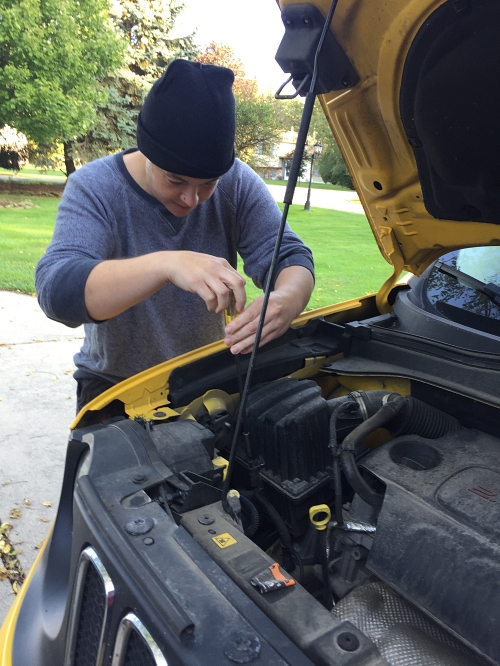
Sometimes my dad is very patient and sometimes not so much. I was glad he was very patient with me today, because I learned so much! He taught me how to check the levels of brake fluid, antifreeze, washer fluid, oil, air in my tires, the condition of the brake pads, fan belt, engine filter, and more. The engine filter was filthy! He said I should probably buy a new one, but for now, he used a high pressure air hose to clean it out. That's what I'm unscrewing in this photo:

unscrewing the filter


He told me to wear clothes that I didn't mind getting messy, and once I got started, I discovered why. There is a lot of lying on the ground (he has carpets outside to make it a little more comfortable, but they aren't the cleanest, either).

After checking all the fluid levels and filling what needed to be filled, we got to work on the oil. After checking the oil level, he was shocked at how low it was. He said it wouldn't have lasted a couple more weeks and would have done some serious damage. Yikes!

Anyway, he said the very first thing I should do is open a window in the car so I don't somehow lock myself out. (Smart. He remembers all the times he had to rescue me in high school when I either ran out of gas or locked myself out of my car).

Then, he showed me where to put the jack lift under the car to raise the car up.

lining up the jack lift under the car

When I was a kid, I remember playing with the jack lift--one of us kids would stand on it and the other would jack us up, hahaha. The lift seemed so much bigger back then! I specifically remember one time I was standing on the jack, chewing root beer bubble gum (with a liquid center--ew! and some of the liquid dripped on my thumb. Apparently, a bee was attracted to the syrup I was stung. It's funny, random the things you remember.

Once I got the lift in position, it was time to jack it up. This is basically a good arm workout, pumping up and down until the jack lifts the car off the ground high enough to get a one of those small jacks underneath it.

jacking up the car


Once I had two jacks under the car (one on each side) as well as the jack lift, I prayed that the car wouldn't fall on me while I was underneath it. My dad's been doing this for 40 years and has never had a car fall on him, so I was pretty confident.

Unfortunately, I don't have a photo of the messiest part--removing the old oil. I had to unscrew the old filter and the oil came gushing out (it's not just a drip when you remove the old filter--it gushes!) into an oil pan, but while I was unscrewing the cap, the oil was pouring down my hand. My dad has a dozen (well used) towels lying around, thankfully.

Once the oil had all drained into the pan, I had to screw the new filter in. Thankfully, I'd bought the correct size! If it hadn't fit, I'd have to go buy another (with someone else's car). Screwing in the new filter was messy, too, because there was still a bit of oil dripping down into the pan (and all over my arm). After that, the mess wasn't too bad.

getting read to empty the old oil

Once the new one was screwed into place, it was time to lower the car. Basically, I did everything backwards. I lifted the car just a touch so that I could remove the jacks, and then I slowly (well, he told me to go slowly, but it was tough to keep it from dropping down quickly!) lowered the jack lift.

With the car back on the ground, he said it was a good time to check the the air in the tires (which I did, and they were all at 30 psi--and they needed to be at 35 psi, so I added some air. Then he said it was a good time to check all the lights (headlights, brake lights, etc.). I checked them all and they all worked except for one fog light, which I'll have to replace (although I rarely use the fog lights).

If you have a Jeep Renegade, here's a short tip. Even after changing the oil, the oil change light will still come on when you start the car. To reset this, you just turn the key halfway (to where it's just the battery on) and then pump the gas three times within 10 seconds. Turn the car off. Then start the engine, and voila! No more change oil light.

Other than the air filter, the only other thing that needs replacing is my tires. I'm dreading it, because it'll cost a fortune, but it must be done. Preferably before winter.

Anyway, I'm glad to have knocked another goal off my list, and this was a fun one! I got to spend some quality time with my dad and learn all about my car. And now I'll be able to change my own oil the next time it needs it :)

Dad and me


October 07, 2019

Everything You Need To Know About Coaching Kids' Cross Country Teams

Everything you need to know about coaching kids' cross country teams

... Also known as the longest post I've ever written.

I'm always surprised at how many people are interested in my posts about coaching cross country. I don't mean my personal cross country team, but coaching kids in general. They are (surprisingly) my most popular pins on Pinterest! To be honest, coaching kids is a bit of a challenge compared to high schoolers.

This is probably my longest post ever, and I thought of splitting it into two (or ten) posts, but I'd like all of the information in one single spot, and I hope it will be helpful to other coaches. If you're going to read it, make sure you're comfy with a cup of tea or glass of wine before diving in (and taking notes!).

I've coached cross country for five years, with kids ranging from second grade through sixth grade. (I've also coached adults who are looking to getting started running or run personal records.) I'm very confident in my ability as a coach, and I love to see some (if not all) of the kids I've coached go on to run in middle school (and even high school!).

That said, coaching kids isn't exactly a cake walk (literally). It's tough!

Challenges of Coaching Kids

1) They are younger and aren't sure of what sport they're "into" (if any at all). Many of them were made to sign up for cross country by a parent, and some of them don't want to be there. It's my job to (hopefully) make it fun enough that they will enjoy the season.

2) Kids get bored EASILY. You have to keep them interested enough to want to continue the season and hopefully join again the following year. One of my favorite moments this season was when a boy on my team came to his first practice and said afterward, "I love cross country! I want to join again next year!" (We hadn't done sprints at the track yet, so maybe he'd spoken too soon, haha)

This photo was on a crazy hot day when I told the kids if they did extra sprints, they could dump ice water on my head. They clearly chose to do the extra sprints!

kids pouring water on coach's head

3) While high school kids tend to find motivation in their own running goals and personal bests, we all know that elementary school kids need a little more push. That means you have to get creative with ways to motivate them (which I'll share later in this post).

4) Kids have very short attention spans. While it's easy to tell a high schooler to go run five or six miles, getting a fourth grader to run a quarter mile without dancing around, grabbing leaves from trees, and walking when they should be running is another story.

5) Trying to explain the complexities of competitive running to young kids would probably be comparable to a NASA physicist explaining rocket science to me. There are way too many technicalities that come into play with running, a trillion different training techniques, and SO many reasons for doing things the way they are done.

But there ARE reasons. I was very lucky to be invited by Runner's World magazine to their headquarters and learn tips from some of the best runners in the world! When I started using the techniques I learned, I became a much better runner (and coach). I also read pretty much any book I can get my hands on about different training methods. I even recently wrote a post about "How To Breathe While Running" about a seminar I sat in at RW headquarters. 

6) Kids never want to go for an "easy run". And I can't stress enough how important the easy run is! (Please, please read that post.) When kids first start running, they love to either sprint or walk, and nothing in between. As coaches, we know that the best runners utilize many different paces during training.

In fact, the biggest challenge I have with first year runners is trying to get them to learn to pace themselves appropriately. "What's the fastest pace you can run for an entire mile?" "What's the fastest pace you can run 100 meters?" There is a big difference between those two distances, but the kids will give a single pace answer, not two ;)

7) The long running can get boring during practices, because with little kids, you can't let them out of your sight. So, we have to stick with short (1/4 mile to 1/3 mile) loops in order to be able to watch all the kids at the same time. Running the same loop over and over isn't the best--I know that! Ideally, we'd go to a park and run a 3-mile loop--much less boring--but it's just not possible when you have elementary kids of all ages. So I try to find other ways to make it fun.

8) Some kids, no matter how badly you want them to succeed, will just NOT do what you ask them to do. I have heard every single excuse in the book about why they can't run that day: sore throat, foot hurts, leg hurts, ate too much dinner, stomachache, headache, too hot, too cold, too tired, etc. (Hint: 99% of those are simple excuses--I'm tough on my runners, and I *rarely* accept an excuse not to run.)

My philosophy is: If they can't run, they shouldn't come to practice! (I also try to find out from the parents whether they tend to be dramatic or if those excuses should be taken seriously.) We had a crazy hot race last weekend, so I brought a bottle of water to spray on the kids at the starting line. They loved it!

Coach spraying water on the kids before a hot race


9) This one is a bit of a sore spot for me, especially now that I'm coaching without Renee... Our "club" (since the kids aren't yet in middle school, and the elementary school doesn't technically have a team, we are considered a club) isn't taken very seriously by the senior coaches at the school:

 I hate to use this word, but I almost feel like the senior coaches think of our team as a "joke"--where I am a babysitter rather than a coach. Which is unfortunate for them, because the kids on my team will be the ones to be on their team in a few years! Haha ;) I feel like I go way above and beyond for our team, but it would be nice if the senior coaches recognized that. (I'm sure they have no idea how much work I do.)


 We don't have a budget to get the things that the middle and high schoolers have--such as our own tent for the meets (the other teams have tents (like these) set up as a meeting space and to keep their gear). See those tents in the background? Every team has one except for us! This year, I bought the wagon; next year I'll buy a tent.


 Unlike the older kids, we don't get singlets, but rather t-shirts instead (a t-shirt is great, but a singlet would make them feel like they are more a part of the "real" running teams at meets. Not to mention, they'd be more comfortable.

 For me, coaching is a volunteer position; I don't mind this at all, because I love doing it, but I do end up spending much more of my own money than I probably should. I had to buy a wagon to carry our gear (Renee had one last year, but since I'm coaching solo, I had to purchase my own).

 I also bought several of the prizes before creating the Amazon Wish List (these are unnecessary, of course, and I obviously don't expect the school to buy them, but it shows that I am passionate about the team).

 I have to pay to get into the Metroparks where a couple of the races are held (the passes are $10 each)! It would be nice if I didn't have to cover that expense. To be fair, I'm not sure if the other coaches are paying out of pocket; but the middle and high school coaches have paid positions.

 This year, because I was coaching without Renee, I chose to have just fourth and fifth graders on the team (which literally cut the potential team in half, from 24 to 12). I didn't understand that this would be a problem, but I've since learned that the races are paid for by the school per TEAM and not per RUNNER as I'd thought. So, the senior coach wasn't happy with me regarding that decision. Next year, I will include 3rd graders again.

 However, due to the smaller team this year, I was able to concentrate on coaching each kid much more personally--focusing on strengthening their weaknesses and playing up their strengths. It's hard to do that with 25-30 kids on the team (past numbers). I believe I can have a much larger team next year; this year was a nice way to ease myself into coaching alone.

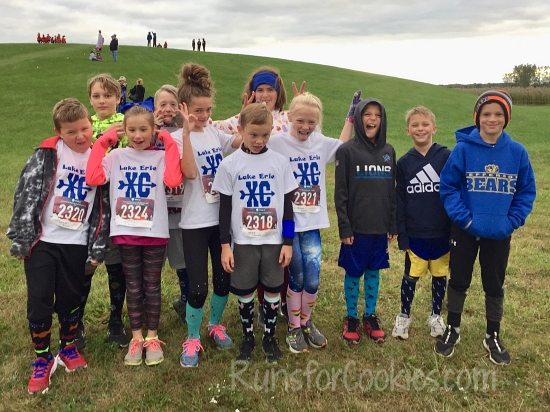
This is my team this year (don't worry, I got permission from their parents to post this)--we started with 12, but one of the girls quit coming, so we are down to my very favorite number ;)  Next year, I'll try to get 33 😬

My current cross country team

 I miss Renee (we had fun coaching together, and we started the team together!). I do enjoy coaching alone, but I didn't realize or truly appreciate just how much "behind the scenes" work she did until I started to do it myself this season. It's much easier--and more fun--when you have a partner to coach with.


Helpful Tips for Coaching Kids

So, as you can see, there are many more challenges when coaching little kids than when coaching older kids. I could coach a middle or high school team no problem and they'd do great! But coaching young ones is a different ball game (err, race course, rather).

Here are some things I've learned over the last five years of coaching that may be helpful for those of you who are coaches and feel as lost as I did when I started. I was used to coaching single adults who had a race goal--and then my friend Renee and I started our elementary school team.

1) Find a place to practice that has the following conditions:
 Grassy (or at least unpaved) because cross country races are not on pavement 
 A smaller loop where the entire thing is visible, roughly 1/4 mile (so you can keep track of the kids without losing anyone 
 Doesn't have a lot of traffic--people, dogs, bikes, etc. coming through

2) Get the following necessities to make your (coaching) life much easier:
 A water cooler big enough for the team (kids are always forgetting water bottles--I tell them to bring them, but the cooler is for refills and for the kids who forget). I have a five gallon one which is way too big--three gallons would be perfect, even for a team twice my size. 
 A collapsible wagon for getting your stuff to and from your meeting locations (I'll explain why you'll need it later, when I describe all the stuff you need) 
 A huge tote bag, similar to this (or two--in my case, I've acquired three!) 
 A 3-ring binder for all the necessary paperwork (as well as the not-so-necessary nerdy spreadsheets that I love). 
 A whistle (you know, for authority and stuff--haha)! 
 A stopwatch app on your phone, or an actual stopwatch. My app is cleverly called Stopwatch+ on iOS.
(There will be several more things ("luxuries" listed below); but these above are necessities, in my opinion.)


3) Luxuries to have, if possible:
 Garmin (or other GPS) watches to track distance and pace. I was lucky enough to have a few blog readers send me their old Garmins and I LOVE USING THEM. I used to use a rubber band system to keep track of distance (I'll explain below) but I found that some of the kids would "accidentally" run less than they said they did. Having the watches is proof! ;) 
 If Garmins aren't a possibility, which I'm sure they aren't for most people, I used a rubber band system. Each rubber band was equivalent to one lap around the park. On some days, I would give each kid a particular number of rubber bands (based on their ability) to put on their wrist. Each time they finished a lap, they would remove one rubber band, until they'd finished removing all of them. 
Sometimes, I would do it in reverse. For long run days, for example, I'll have them collect a rubber band for each lap instead of removing one. This way, they just keep running until I tell them to stop. (Otherwise, some kids will do the minimum that you give them and not aim for anything more.) But beware, they will ALWAYS ask how many more laps!
 This year, as I will explain later in the post, I acquired some running parachutes. These are SO fun for the kids and make sprints very hard work! 
 Items to use for an obstacle course (I've done obstacle courses once in a while when we have a race the following day; that way, they are moving and getting exercise, but aren't pushing themselves too hard before the race). I'll post ideas for that later.

4) Choose the days of the week and times you want to have practices. 

Usually, I am a people pleaser and do everything I can to accommodate everyone else; but when it came to practices this year, I chose what was best for ME and my family. I'm a volunteer coach, so I don't get paid for my time. I choose to practice three evenings a week, and I am done by the time Jerry is home from work and showered. I also chose a location that is close to home. That way, I can spend the evening with my family.


5) Don't baby the kids, especially from the very beginning.

As soon as you fall for one of their excuses, you're a goner ;)  (Kidding, but you do have to be tough about the rules, otherwise they will walk--or run, rather--all over you).

Shirt- our blood, our sweat, your tears


6) Develop a game plan:
 Short, tempo run once a week (tempo pace = harder than easy pace, but not quite race pace) 
 Speed work at the track another day (super hard! I'll have some ideas below) 
 Long runs on another day (for my kids, this is anywhere from 2.5-5.5 miles) 
 And if you're fortunate enough to have 4-5 days a week for practice, I'd throw in some extra easy runs to get in more mileage.
(It's okay to vary from the schedule, of course; if my kids have a race on Tuesday, I'm either going to cancel practice for the Monday before or we'll do a very easy, fun workout, like the obstacle course.


7) Start each season with a time trial (a timed one-mile run on an outdoor track). 

Since cross country starts in the late summer, ideally, practices should start in early summer (right when school gets out, or at least by July). Go to a local school track when nobody is using it, and time the kids for a one mile run (four laps around the inner lane).

I use an app on my phone where I press a "lap" button after each child finishes, and it marks each of those times while the timer is still going. (Again, mine is Stopwatch+).  Practice with it several times before you use it for the time trial!

During the trial, the kids take a number as soon as they are finished--that number correlates with their finishing order (so that I know which lap time belongs to each kid). If they finish their mile in third place, for example, they take the number 3 (written on a post-it) and hold onto it until everyone is finished (it helps to have a parents or assistant coach hand out the post-its while you time them). When the trial is over, I will look at lap 3 on the stopwatch to see that person's personal mile time. I wrote more details about this on this post.

The reason for starting the season with this time trial is so that at the end of the season, you can repeat it and see if the kids' times have improved. (I don't think I've ever had a kid NOT improve throughout the season). It's a confidence boost to them. And to me, as their coach! These stats are after just one month.

time trial improvements


8) Try to have either an assistant coach to help out OR a parent who has no problem with allowing you to be the one to take charge and control the practices. 

I've found that when parents stay at practice, one of two things tends to happen:
 They are way too hard on their kids--they tell them to run faster and harder when I might be coaching an easy run that day, for example. I'm an experienced certified running coach, and I know what I'm doing! Last year, I had a parent who just broke her daughter's spirit by being so tough on her. Her daughter chose not to continue XC in middle school. 
 On the opposite note, the kids may get a little babied by the parents, which makes coaching tough. You can't be a babysitter and a coach at the same time if you intend to help the entire team become better runners. As I get to know the kids, I know who can be pushed and who just needs a little encouragement. I tailor my ways to the best of my ability. My goal is to keep running fun but also to make the kids better runners. 
That said, I always tell the parents they are welcome to stay if they wish! But I don't let it affect how I coach; I don't go easier on the kids just because they may have a parent there. I have no problem yelling across the football field during a time trial, "IF YOU'RE TALKING, YOU'RE NOT RUNNING FAST ENOUGH! GO FASTER!"

I'm a relatively tough coach! And proud of that ;)  If the kids do what I say, they will become better runners. Usually, I am a humble person; but I am pretty badass when it comes to coaching people (not just kids) who want to become better runners.


9) If you're a numbers nerd like me, create some spreadsheets to get organized and put in your binder. If you're familiar with spreadsheets, I can email some to you. But it'd be easier to create your own and tailor them to your team's goals.

After the initial time trial, I gave the kids the goal of bettering their time by 10% (likely), 15% (tough, but doable), or 20% (a "superman" goal).

goals for the kids


10) Super important: This will likely be required by your club or school, but make sure you get waivers signed before any practices.

If you're not working with a school, liability insurance is a great idea, too. Kids are resilient, but things happen, and it's good to be prepared. On the front cover of my binder (inside the clear plastic) I keep a list of names, emergency contacts, phone numbers, allergies, and any health conditions for easy reference. I have two kids with (non-epileptic) seizure disorders, and their parents have given me instructions on what to do if it should happen during practice.


11) For some reason, the kids always want to take breaks after each (1/4 mile) lap. *sigh* 

Since our laps are only 1/4 mile, this is a problem! If I can run three miles non-stop when I'm this out of shape right now, they can certainly run the 2-4 miles I assign at practice. This has been a problem every year, so this year, I came up with a solution: handheld water bottles.

Since the one that I have and love (Amphipod) is super expensive, and so are others like Nathan's brand, I had to find something I could afford. I bought a couple packs of these water bottles and a few packs of these handles to go on them. This way, they can carry their water with them while they run--no excuses. It has cut down the walking/stopping quite a bit.

hand held water bottle

However, several of the kids have complained that they are heavy, so they choose not to use them. A few people donated some small wrist water bottles that the kids went nuts over--they love them! So, if you're feeling generous and would like to donate something to our team, here is the link on Amazon for the water bottles on our wish list.


12) Form a Facebook group for all the parents.

When you have a lot of information to give at once (about the meets, for example) I like to post it all on there. I post race maps, where to meet, what time to meet; in addition to information, the parents share photos from races, etc.

I also have a group text where I remind the parents of any information on practice days and ask who will be there. On race days, I remind them of the times/location and to make sure their child is hydrated, etc. I like to keep the texts short and to the point. Thankfully, all of the parents have Facebook, so I sometimes just text them to check Facebook for important info.


Making Running FUN

Have an incentive program:

The incentive programs for my team have varied throughout the years, depending on what works and what doesn't (and how expensive it is). This year, thanks to my super generous readers, has been (by far) the best! This incentive program can be very expensive if you're not getting donations or a budget from a school to use, so if you can't do it, I have other ideas. But here is what I'm doing this year:

Points system with awards: I created an Amazon Wish List for our team, and I was shocked at how many people donated. That (and the donations for Mark when he was dying from cancer) are the two most generous things people have ever done for me, and I can't express my gratitude enough. Really. (Anything leftover or donated post-season will go toward next year's season.)

Mushy stuff aside, here is how it works: In a nutshell, the kids earn points and the points are like "money" to buy prizes. I have found their favorite prizes to be novelty compression socks (the size S/M works out great for the kids! I was worried they'd be too big), wrist water bottles (mentioned above), headbands/sweatbands, and a few other things.

This is the same photo from earlier, but I wanted to show off the socks that the kids are wearing--those are a VERY hot item that they like to spend their points on!

my kids cross country team

I bought a Garmin (new in the box for $25 on Facebook Marketplace!) with my own money at the beginning of the season to use as an incentive, which started this whole idea. If you look at the Wish List, you'll see the things we use.

The kids earn points for things like:
 Doing their best at practice (I can always tell who is working hard and who is not)
 One point for every mile run
 5 points for each mile run without stopping or walking
 20 bonus points when they hit a cumulative 20 miles for the season
 30 bonus for 30 miles, etc. (One of my kids has run over 80 miles so far!)
 They get 20 bonus points each time they run their fastest mile pace at a race or time trial.
 And once in a while, I'll give out bonus points for things like running extra laps when they are done with their workout, or for doing a couple of extra interval sprints, things like that. I keep track of all the mileage, points, and race times on spreadsheets (again, I'll share those later).

Some other incentive ideas:

 Last year, I did a "token" system (which were basically different color charms, but I called them tokens so that the boys didn't feel like they were too girly). I bought them on clearance and I made the wrist keychains from old pairs of jeans. Each token represented a different accomplishment: running a mile under 10 minutes, under 9 minutes, etc. Running a personal record. Beating the seasonal goal I gave them. Hitting a certain number of miles run. I wrote all about that in this post.

"token" awards for cross country

 This one is totally free, and quite useful: A leaderboard. This works for kids who are competitive. Before each practice, I write down on a dry-erase board a list of the kids' names in order of who has the most cumulative miles or who has the most points. For some reason, just seeing their names made them want to climb to the top of the list.

leaderboard for cross country

 Another is candy. Yes, this is more of a bribe, but it's come in useful, too. I bought a large bag of Jolly Ranchers and the kids who participate as I ask during practice will get a Jolly Rancher when practice is over. You would be amazed at how much a single Jolly Rancher inspires the kids to work harder!

The candy actually works two-fold; when the kids are doing a long run during practice, they may ask for a Jolly Rancher to keep their mouth from getting dry as they run. Since I totally understand how this feels, and I want to encourage them from stopping for breaks, I allow them to have one or two if they are really trying their best.

Workouts That Kids May Enjoy

Let's face it--running, by itself, just isn't fun! But there are ways to make it fun, and I've come up with lots of ideas over the last five years.

Parachute Sprints:

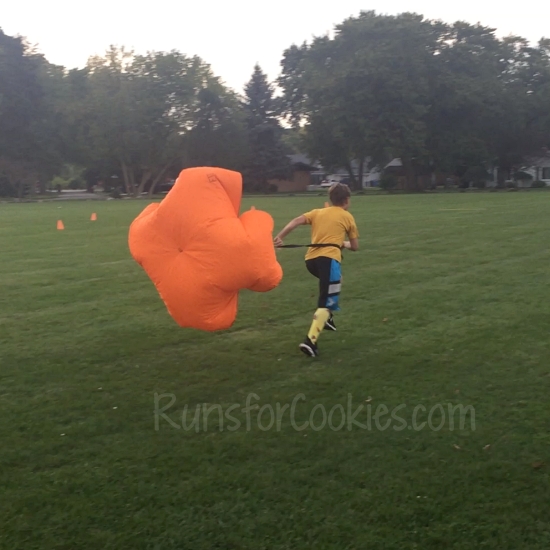
This year, a few of my blog readers donated (from our Wish List) some running parachutes. The kids LOVE THESE. You strap it to your waist and then run as hard as you can (against the wind) and the force of the wind resistance in the parachute really strengthens their legs.

running parachute


Fast Finish Runs: 

The kids run their usual laps, but on the last lap, they run as fast as they can get it done without stopping or walking. This teaches them to finish strong on tired legs. Sometimes I'll offer extra points if they really push hard on that last lap.


Obstacle Courses - When the kids have a race the following day, to avoid burning them out and using up all their energy, I've created an obstacle course for them to do at practice. I usually find things around the house or garage that I can set up. Some ideas:

 Jumprope
 Hurdles (I made some with these and these from Lowe's. You just stick two sign stakes in the ground next to each other a few feet apart, and then thread this driveway reflector through the holes.) I make some higher ones for them to jump over and lower ones for them to crawl under. Not the fanciest, but they were super cheap.
 A pillow case to put both feet in and hop to the next obstacle
 A giant pair of Jerry's work boots that they had to quickly put on and run with them to the finish (it was much harder than I expected!)
 Running 100 meters with a running parachute
 Kicking a kick ball 100 meters
 Rings for quick steps
 Cones to zig zag

Basically, just look around the house and get creative ;) For the obstacle course, I have all the kids complete it on their own while I time them; then at the end, I announce the winner. I gave 30 points to the first place winner, 20 to second place, and 10 to third place.

obstacle course run


Running with Jerry's work boots was surprisingly very difficult for most of the kids!

running with men's boots


The Marbles Game (this is great for running sprints on the track; on a hill is even better! And the kids love it):

This game is best for a hill, but you could modify it for 70-ish meter sprints on flat ground, too. I bought two bags of marbles--one blue and one green. The blue marbles are worth 3 points, and the green marbles are worth 1 point. You place a bucket with all the green (1 point) marbles halfway up the hill, and a bucket with the blue (3 point) marbles at the very top of the hill.
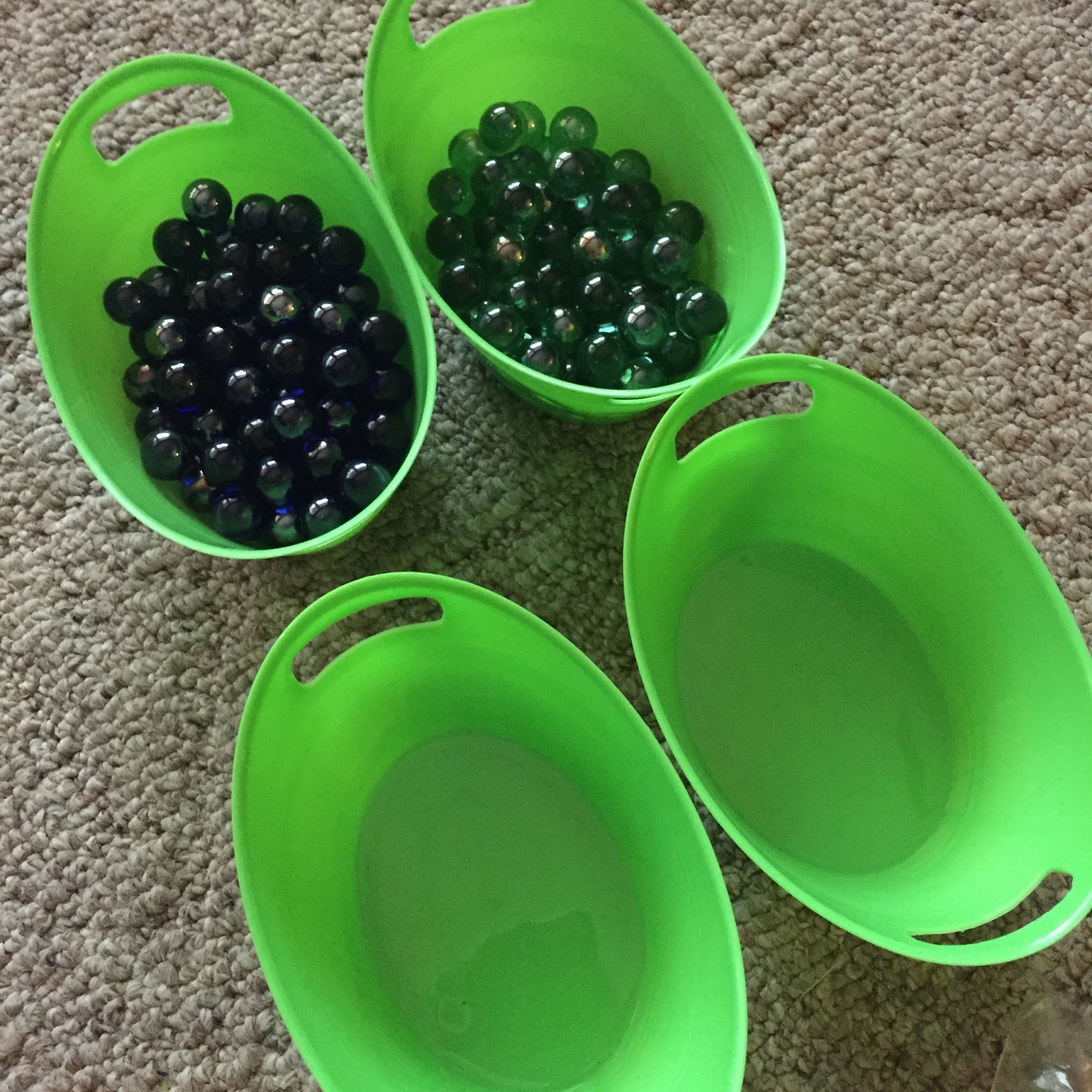
marbles for running games


Divide the kids into two teams of equal ability, and when you blow the whistle, all the kids (the entire team) run at the same time up and down the hill, picking up only one marble at a time and returning it to the bottom of the hill into their team's assigned bucket.

They can choose to get the 1-point marbles by only having to go halfway up the hill, or they could choose the 3-point marbles by going to the top of the hill. At the end, total the points for each team, and the team with the most points is the winner.


Connect Four Game (again, for sprinting or hills):

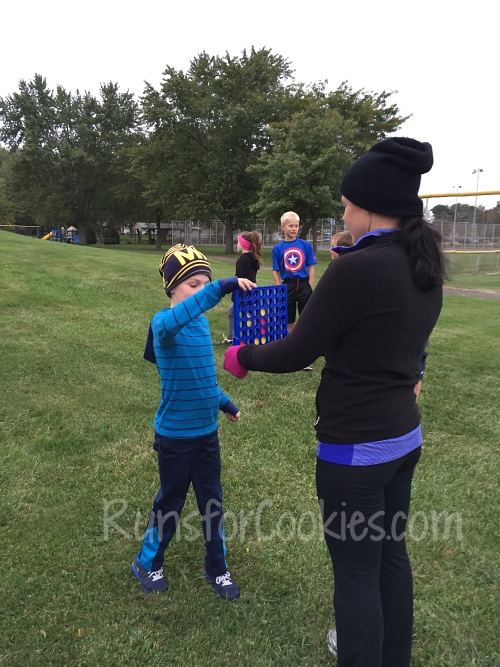
I bought a Connect 4 board game, and our team uses that in a few different ways. There is a hill in one of the parks where we practice, so to get the kids to run hill repeats, we place all of the game pieces (the little red and yellow discs) on the top of the hill. Then I hold the game board at the bottom of the hill. We divided the kids into the yellow team and the red team (trying to make them equal based on how fast the kids are).

Each team lined up at the bottom of the hill, and when I blew the whistle, the first person on each team ran to the top of the hill, grabbed one game piece, and ran back to the bottom to put their piece on the board. When they reached the bottom, the next person from their team headed up the hill. This went on until one of the teams got four tokens in a row! We usually fit in two or three rounds of this game.

connect 4 running game

Another way to use the Connect 4 game is to do a relay like I wrote above, only instead of a hill, they can run a straight line or in a loop.


Musical Hula Hoops:

This is basically musical chairs, but instead of putting a bunch of chairs in a circle, I put a bunch of hula hoops in a giant circle in the field. For 20 kids, I started with 8 hula hoops and allowed 2 kids per hula hoop.

hula hoop running game


When I blow the whistle, the kids start running a circle around the circle of hoops, just like in musical chairs; and then when I blow the whistle again, they have to scramble to find a hoop to stand in. Only two kids were allowed per hoop, so the leftover kids are out.

Then I take away one of the hoops, and continue. We do this until there were two kids fighting for one hoop. Last one standing is the winner. With fewer kids this year, I used more hoops (the same hoops I used for the obstacle course that I linked to above) and each kid must find his/her own.


Sharks & Minnows:

This is a game that the kids actually taught me. Using orange cones, we set up a large rectangular play area. You choose two kids to be "sharks", who start in the center of the rectangle. The rest of the kids are "minnows", and they line up across one end of the rectangle. The goal is for the minnows to get from one side of the play area to the other without getting tagged by a shark.

When I blow the whistle, the kids all run as fast as they can to the other side, and try not to get tagged by a shark. If they get tagged, they become "seaweed" and they have to sit down on the spot they were tagged. The seaweed can then tag minnows as the minnows run by, but they have to stay seated. You do several rounds of this until there is only one minnow left standing, who is the winner.

We use this as a game, but the kids get a TON of running out of it!
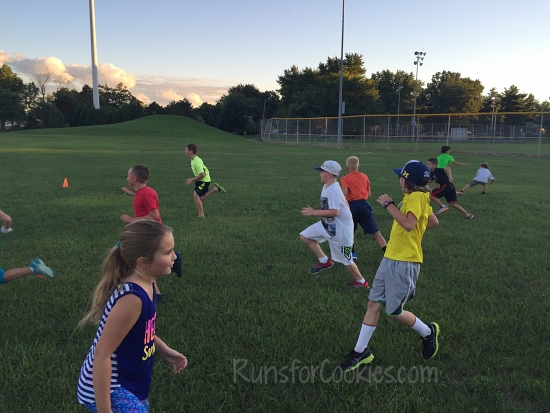
sharks and minnows running game


Scavenger Hunt:

This was a little different than your average scavenger hunt. I bought about 10 small buckets from the dollar store, and a large package of plastic toy food items. On index cards, I wrote down the name of each food item. Then, I placed 3-4 items in each bucket, and placed all the buckets spread across the field randomly. I divided the kids into two teams, and they lined up relay-style. I handed each kid one of the index cards with an item written on it.

When I blew the whistle, the first kid from each team ran off to look in the buckets for their item (if they were lucky, it would be in the first bucket they checked; but if not, they had to keep searching). When they found their item, they ran it back to the team, and the next person took off. The first team to find all their objects was the winner. The kids are allowed to help their teammates--if the first kid, for example, saw the banana in one bucket and knew their teammate was going to be looking for it, they could tell their teammate what bucket the banana was in.


Matching Card Game:

I bought a few packs of Matching Game cards from the dollar store (the deck consists of cards with pictures on them, and each card has a match). I would have the kids run their laps and collect ONE card after each lap (without peaking at the cards). They were divided into two teams, and each card they collected was put in a pile for their team. Once all the cards were gone, the teams got together to see how many matches they made. The team with the most matches was the winner. The kids learned that the faster they ran, the more laps--and therefore, more cards--they would get.

This can also be played on a hill, with the cards at the top of the hill and the kids running up to grab a card then bringing it down to the bottom.


Simple Sprints (I like to do these on the track):

Set up two cones about 50-100 meters apart on the track. If you have a large group of kids, you may want to separate them into "waves" that start about 10 seconds apart so that they aren't getting trampled.

When you blow the whistle, the kids sprint as hard as they can from one cone to the next. Then, they turn and walk back to the first cone. Repeat for the number of times that is appropriate for your group. For my 3rd through 5th graders, I have them do twelve 100-meter sprints and they are TOTALLY wiped out. But several of them do extra, because I offer 3 extra points per sprint ;) 


Animals (for speed control--teaching easy running, moderate running, tempo running, and sprints):

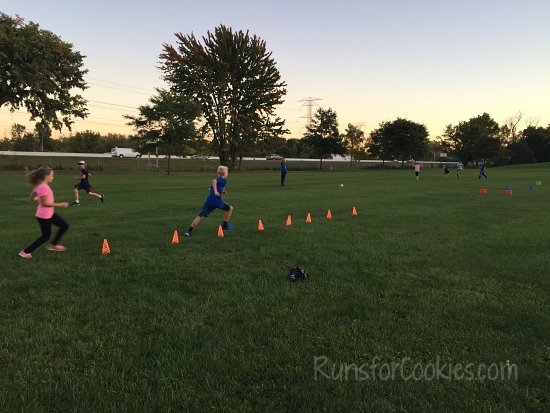
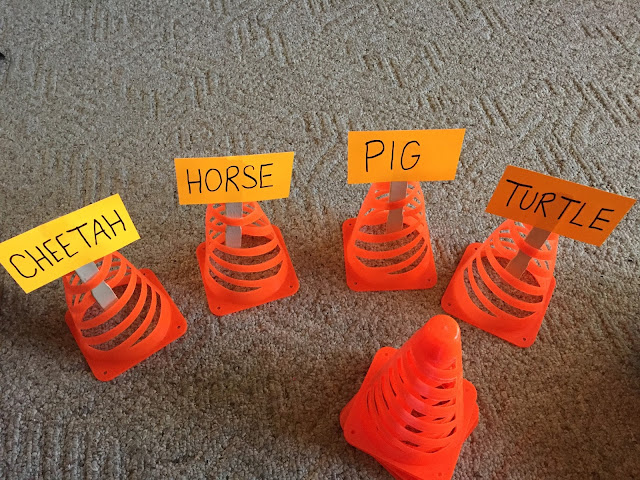
I made little signs, each with the name of one of four animals on it--turtle, pig, horse, or cheetah. I put the signs on cones that were set up in their loop where they run laps. Turtle means walk; pig means jog slowly; horse means run steady; and cheetah means sprint. Each time they come to a cone, they have to run like the speed of the animal on the cone. When they reach the next cone, they change it up. I have eight cones total, with two of each animal.

speed work idea for kids


Water Bucket Sprints:

I bought four 5-gallon buckets (two filled with water and two empty--the empty ones were the kind you find in the paint sections at Lowe's--they have measuring marks on them). I give each of the kids an empty cup and separate them into two teams. When I blow the whistle, the kids fill their cup with water from the full bucket and run 100 meters across the field to the empty bucket and pour it in. Then run back and get more. Over and over until the team who gets to four gallons first wins (Trying to scoop out five gallons of water from a five gallon bucket is challenging, so we just go up to four). 


Ice Block Relay:

On one very hot day of practice, Renee brought a couple of large ice blocks (she filled a couple of milk cartons with water and froze them in order to make the blocks). Then the kids did a relay race, carrying the ice block and passing it to the next kid in the relay. They loved doing this!


To end the season, I always like to give recognition to the kids who really went above and beyond during training. I create award certificates for the kids and print them out on nice card stock, each saying something to recognize a particular strength they had. Here is an example:

running achievement award for kids

The kids seem to like the recognition, and I hope that it encourages them to join again next year! We usually have a pizza party "awards ceremony" as well.


Well, I realize this is a doozy of a post. I've been working on it for days (literally, probably 30 hours total). I'm wiped! But I hope it's helpful to have all of this info in one place.


I may add to this post here and there as I think of more. I feel like I'm forgetting things. But it's nearly midnight, and I have to get up at 6:00, and I really want to get this posted! If you made it through this whole post, congratulations! Hopefully, if you're a coach (or prospective coach) you'll find it helpful :)

Anyway, good luck coaching!! It's been super fun and rewarding for me.

October 04, 2019

Week One Recap of 3-3-3 Running

I was hoping to get a post up every day in October, but I spent ALL DAY working on a post yesterday and just didn't get it finished before cross country practice. I'm hoping to finish it up this weekend and get it posted. It's probably the longest post I've ever written!

In case you missed it, I'll explain what the 3-3-3 running is (it's kind of a dumb name for the simplest training plan ever, basically). My friend Thomas, the runner who paced me to my 10K PR, was having problems with his legs shortly after that race. The pain was so bad that he wasn't able to run. After lots of doctor's appointments, testing, and physical therapy, he was diagnosed with psoriatic arthritis.

The whole process took about a year, so after getting on meds for the arthritis, he wasn't exactly in the same running shape that he was when we ran the 10K. He wanted to get back to running, so he started running for 3 miles, 3 days a week--and after 3 months, he was pretty much back to his old running schedule. (He's actually running a marathon on Sunday!)

Since I've taken so much time off of running (other than the occasional 3-miler), I'm extremely out of shape. I ran faster and farther than this in 2010, when I was still a beginner! I'm basically starting from scratch. After talking whining to Thomas about it, he told me to get off my ass and start running--3 miles, 3 days a week, for 3 months. Thus, the 3-3-3 training plan.

I was going to start it last Monday (September 23rd) but my knee started hurting on the treadmill. Out of nowhere! When I mentioned it to Thomas, he asked when was the last time I changed out my running shoes. Um, I'd say probably since before I quit running in 2017, hahaha. It didn't occur to me, but that was definitely the reason! I had a pair of Ghost 8's that I'd hoarded when they were on sale, and they were still brand new, so I started the 3-3-3 again this past Monday.

I don't know why it's so hard to make myself get started for a run. I always want to procrastinate. But since I started counting calories on Monday (which I'm still doing), I really wanted to get started with the 3-3-3 training. So, I put on some (now too tight) workout clothes and began running on the treadmill.

As you know, I am a huge believer in a combination of two running methods: the MAF (maximum aerobic function) heart rate training developed by Dr. Phil Maffetone AND the 80/20 Method by Matt Fitzgerald. Here is quick summary of my combination (I will write a more detailed post on this soon):

The 80/20 Method is simply a percentage. You spend 80% of your TIME spent running (not distance) at an easy pace; and 20% is speed work (each week). I combine this with the MAF method by using my MAF heart rate (180 minus my age (37) so mine is 143 bpm) to keep my easy runs easy enough.

I used this method to train for my 10K, and it worked SO WELL that I became a big believer of the combination of the two.

Anyway, that's what my plan is for getting back into running: 3-3-3 with MAF heart rate for now, and after some time (maybe 6 weeks or so) I'll add in 20% of my time doing speed work.

Running on the treadmill makes running at your MAF heart rate super simple. You start at what you think is an easy pace, and then when your heart rate hits your MAF rate, you slow the speed a notch. For example, I might start mine at 4.8 mph; once my heart rate reaches 144 (the number above my MAF rate) then I'll bump the speed down to 4.7 mph. I might have to lower it again to lower my heart rate. The goal is to keep your heart rate under your MAF rate the entire time.

I wrote about my first run (Monday's) on this post. It went how I expected! Slower than the last time I worked on MAF training, but I was able to run the whole time (at a turtle's pace).

Treadmill run, Week 1 Day 1


On Wednesday, I did my second run, and it didn't go so well. I couldn't believe the difference in my heart rate at the same speeds! I had to lower the speed to 4.1 mph for most of it (I can walk faster than that). Even that raised my heart rate too much sometimes, so rather than go even slower, I lowered the incline to -1 (walking "downhill" basically).

On Day 2, you can see the trend of my pace getting slower and slower until the end (more-so than the previous run).

Treadmill run, Week 1 Day 2


If I thought Wednesday was a mess, today was the slowest run I've EVER done--even when I was a beginner! Today, I went outside to run, because the temp was great: 56℉. I was very curious to see how my outdoor running would compare to indoor running at the same heart rate. I know I've done these comparisons before, but I love this kind of stuff.

I set my watch to beep an alarm each time my heart rate got over 143.

And beep it did.

I wanted to keep running without slowing to a walk, but I was right on the edge of that difference. (Technically speaking, running is when both feet are off the ground for a fraction of a second with each stride; with walking, one foot always has contact with the ground).

This run felt like it was all over the place--I was trying to go as slowly as I possibly could without walking, and I was concentrating on my breathing to slow my heart rate. All the normal tricks I can do to lower my heart rate! But I had a very hard time with it.

I did stop twice during the run, which actually probably helped my heart rate (it got very low each time I stopped). First, I didn't realize my parents were having a garage sale and when I ran by their house, I stopped by to say hi and see what they were selling. Then, I ran into that elderly man who I've seen for YEARS out walking.

When I was running almost every morning, he was always out walking, and we'd say a polite hello. He used to say encouraging words to me when I was marathon training. Then one day, I asked to walk with him for a bit to learn more about him. He's a very nice man (I'm guessing in his late 70's?) and he literally walks 6 days a week for 3-5 miles at a time. Doesn't even matter what the weather is!

So, when I saw him, he mentioned it was good to see me out there again, and I told him I'm trying to get back into it. We chatted for a few minutes, and then I got going again. It didn't even take two minutes or so for my heart rate to be back up to my MAF rate again.

I wasn't planning to look at my mile splits during the run, but I couldn't help it--and I was shocked to see that they were in the mid-14:00's! I don't know if this was just a bad day or if I truly am THAT out of shape. That's nearly twice as slow as my pace 10K pace (in 2016).

And this is the mess that was my outdoor run today. The drops in heart rate are the points where I stopped running for a few minutes.

Outdoor run, Week 1 Day 3


I'm beyond the point of being "too proud" to write about my running pace. I don't care about being in the back of the pack (it's funner back there!); but I do want to get in shape at least enough to where I don't have to constantly slow down my speed.

Also, I'd like to run where it doesn't take me over 43 minutes to finish a 3 mile run! I love doing 10-minute miles, because it's easy to figure out exactly how long it will take. I would be very happy to get to that point. Or even 11:00/mi.

Anyway, that was the first week of 3-3-3 training. Ideally, I'd like to run on Mondays, Wednesdays, and Fridays. If I can make those my regular days, then there will be no procrastination. And I'll have the weekends off!

By the way, the calorie counting is going well. I am choosing not to weigh myself until the end of October, though. I just don't want to see a small number after the work I've been putting into it, so if I continue like I am, I'll post my results at the end of the month and then hopefully I'll do weekly weigh-ins again (and running recaps!).

I kind of miss writing about this stuff :)


October 02, 2019

'Tis the Season for Weight Loss


(The above picture is from 2017, in case you're wondering if I've lost 30 pounds in the last 3 days, hahaha)

I know that I am only on the third day of calorie counting (and running again), so it's way too soon to say that I'm going to stick with it to get these extra pounds off. However, I started thinking about what makes things different each time I attempt to lose weight.

Fall has always been the best time for me when it comes to sticking with an eating and exercise plan. Summer is the hardest.

Fall is coincidentally my favorite season. I love everything about it! The crisp air, the changing colors, wearing hoodies, having bonfires, cooking lots of soup... it's fantastic. So, I think that because it's my favorite season and I am so happy with all those things, I tend not to eat for emotional reasons. I'm typically a happier person in the fall.

Katie and Eli at bonfire


I think that the reason fall has so much to do with it is because it's the busiest time of year for me. The kids go back to school, so I'm getting them up and ready and driving them to and from. I coach cross country (in the past, we always started practices in mid-August, but this year, I started in mid-July, so it was a busy summer as well).

Cross country takes up way more time than it actually needs to--I just love doing it, especially all the nerdy stuff. I'm embarrassed to even say how many spreadsheets I have for this season! Hahaha.

After each practice and race, I enter a bajillion numbers into my spreadsheets (not just to keep track of results and all that, but also for the points system I have going this year--it has been so helpful in keeping the kids motivated).

Katie and Renee watching the start of cross country race

The season is over two weeks from today! That just seems so crazy how fast it went by.

Anyway, staying busy with cross country has definitely kept me busy and when I'm busy, I have less time to think about food and eat for reasons other than hunger.

I also tend to go through hypomanic episodes in the fall, and that helps with weight loss (when hypomanic, I never want "waste" the time to eat!) but hypomania has so many bad side effects as well. Not worth the weight loss. Since starting my bipolar meds in 2017, my mood has been pretty stable.

If you picture a roller coaster, while I'm on my meds the hills and valleys are very small; before my meds, a hypomanic episode was like the peak of a huge roller coaster and a depressive episode was at the very bottom. I still have ups and downs, but nothing like they were before.

With the cool, crisp air in the fall, I'm also much more likely to run. I love running in the late fall and early winter when it's cold enough to wear my "ninja clothes" as I like to call them (long sleeves and pants).

Katie wearing "ninja" running clothes

(Man, I wish I was back at that weight... I was 133-ish in this picture, I think. It was from late 2017.)

Right now, I'm too self-conscious to wear my ninja clothes (if I could even fit into them!). Maybe, if I stick with this weight loss attempt, I'll be able to wear them again in a few months. This one was from last fall:

post-run selfie

One thing that I need to plan for is when I'm NOT super busy. When cross country ends in two weeks, I'm going to have 3-4 evenings a week where I won't have practice or a meet, AND I won't be spending a few hours on the computer each week working on cross country stuff.

Last year, I was super busy remodeling the house. I would like to work on the outside of the house, but wintertime isn't exactly the best time to do that. The laundry room is our final room that needs to be remodeled, so perhaps I'll work on that. It's going to be tough, because we have the washer, dryer, and furnace in there, which are all too big to move around. And the room is fairly small.

Several of the kids on my cross country team have asked about continuing to run through the winter. I'd love to do something like that, but it takes up a lot of time, and I think I'd want to be paid for it. It's an option, at least.

And if you haven't noticed, I've been blogging more! My goal last month was to blog every day, and while I didn't do that, I did blog a heck of a lot more than if I hadn't set that goal. I am going to try again to do it this month.

I have a book of writing prompts (random questions) so if I can't think of anything to write about, I'll just choose a writing prompt. Blogging keeps me super busy and the time goes by way too fast when I'm doing it!

Well, Jerry and I are going on a date night tonight... to see Friends at the theater!! They are showing four episodes of Friends on the big screen, and you all know that we are pretty much the biggest Friends fans ever--so I'm very excited about going. We never go out on dates anymore! And what could be more "us" than going to see Friends? :)


October 01, 2019

Day One of Calorie Counting

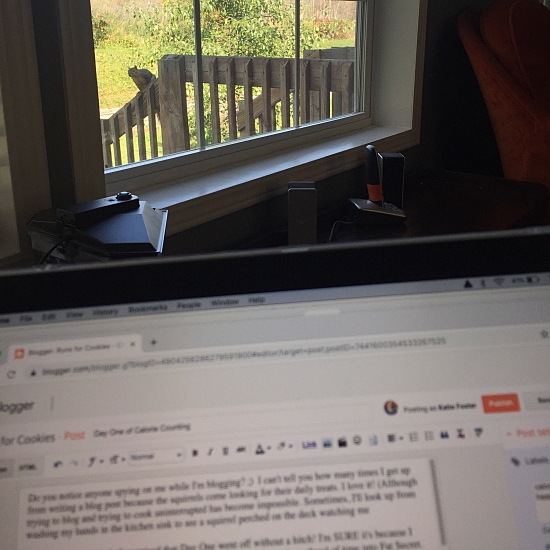
squirrel watching me through the window


Do you notice anyone spying on me while I write this blog? ;)  Here's a clearer look:

spying squirrel


I can't tell you how many times I get up from writing a blog post because the squirrels come looking for their daily treats. I love it! (Although trying to blog and trying to cook uninterrupted has become impossible. Sometimes, I'll look up from washing my hands in the kitchen sink to see a squirrel perched on the deck watching me.
Anyway, I have to say, I'm kind of surprised that the first day of calorie counting went off without a hitch! I'm SURE it's because I had everything planned out well (especially having entered the recipes ahead of time into Fat Secret.

It felt odd getting back in the eating schedule. I spent some time in the morning baking the Pumpkin Cranberry Apple Baked Oatmeal for breakfast, so I ate lunch much later than I planned. As a consequence, I wasn't hungry for lunch. But then I was starving for dinner at 4:00, which is the time I planned on eating dinner anyway.

I just re-published the recipe (when I originally published it, I back-dated it so that I wouldn't bombard my feed with a trillion recipes at one time; but with it being fall now, I thought it'd be an appropriate time to share again. And since I'm counting calories again, I even included the nutrition info.)

The Baked Oatmeal was delicious and reminded me of fall. So did the weather! We've had very nice fall weather the last few days (although today it's supposed to be 88 degrees--yay, Michigan).

Today, my team has a cross country meet so I didn't hold a practice yesterday, which meant I had more time to spend on cooking dinner. So, I chose the most laborious dinner I'd planned for the week--Chicken Fajita Bowls.

I despise doing the prep work for this dish! But it's so delicious that once in a while, I will do it. And complain the entire time. Just ask Jerry. He offers to help, but I am such a control freak in the kitchen that I won't accept help. He does the dishes instead, which is a chore that I hate even more than prepping food, so it balances out ;)

I had to trim and slice the raw chicken breasts (I'd bought four pounds of chicken for two meals--that usually yields 3-1/2 pounds after I trim it to my liking). I used to get by with one pound per meal, but my growing boys are always asking for more. Since I was already slicing chicken for this meal, I just figured I might as well do all of it at once. So, I swear I felt like I was slicing chicken for hours. (Because chicken breasts are so big, I butterfly them, cut them in half, and THEN slice them, which is why it takes so long.)

After all of that, I had to slice two onions and four bell peppers. Thankfully, I already had some Homemade Fajita Seasoning mix made and stored in the pantry. Once the prep work is done, the meal is a breeze, though. (I used to love to cook; I don't know what happened.)

So, dinner was delicious and we had plenty of leftovers for lunch today. I was surprised just how few calories the meal has--300 total, which includes 2/3 cup of cooked rice and 1/6 of the recipe (probably about one cup--maybe a little more--of chicken, peppers, and onions with sauce). If you're looking for something filling, this is perfect!


On top of counting calories yesterday like the old pro that I am, I actually ran three miles on the treadmill. I'm still doing heart rate training with my MAF (maximum aerobic function) heart rate (180 minus my age, so my maximum is 143 beats per minute right now). When I ran regularly for three weeks a month or so ago, I was seeing progress--my pace was getting faster while maintaining the same heart rate. (I will do an in-depth post about MAF training--my way--soon, because I've been getting a lot of questions about it lately.)

However, I have found that I backslide quickly when I stop running. So, instead of being able to run from 4.7-5.0 mph (ish) to maintain a 143 bpm heart rate, I started at 4.7 mph yesterday and had to lower it a few times--ending on 4.4 mph. I'd like to run three days a week (four would be even better!) and see if I can make some improvement again.

running split with heart rate on the treadmill


On the treadmill, I started watching the show 24 starting with the first season (I watched the show YEARS ago, and I don't really remember anything except that I liked it). It's such a fast-paced show and each episode is roughly the same amount of time it takes for me to run three miles right now. The episode actually finishes about a minute or so before I do--so my first goal is to be able to watch the whole episode in under three miles, haha.

I thought about getting up early today to run, but I was SO tired I just couldn't do it. I really need a schedule so that I force myself to do it. My "Your Best 5K Plan" is perfect in the sense that it combines the MAF method with the 80/20 method; but it's not necessarily for beginners. So, I think I'll work on writing a plan similar to that, only for beginners. (I'm basically a beginner again)

For some reason, I still prefer to run on the treadmill right now. I think that's perhaps because it's easier to control my heart rate with the treadmill belt being a constant speed. Now that it's cooling off outside, though, and with fall being my favorite season, I may take it outdoors. I always feel fantastic after an outdoor run! I miss that feeling a lot.

Anyway, I'm glad I had a good first day with calorie counting. It's only a day, but still--it's a day! :)


October 01, 2019

RECIPE: Pumpkin Cranberry Apple Baked Oatmeal


Pumpkin Cranberry Apple Baked Oatmeal Recipe


I've had this recipe on my blog for a while, but I back-dated it so that it wouldn't show up on my feed (I didn't want to bombard you all with dozens of recipes in a single day). But since it's finally fall, and it's pumpkin season, I thought I'd re-share it now.

This baked oatmeal combines all the best flavors of fall! Pumpkin, cranberries, apples, pecans, and cinnamon--a delicious combination! I made some tweaks from the original recipe, which can be found at My Kitchen Addiction.


Click here for the printer-friendly PDF

Pumpkin Cranberry Apple Baked Oatmeal

Ingredients:

2 cups old-fashioned oats

1/4 cup flaxseed

1/3 cup packed brown sugar

2 tsp. cinnamon

1/4 tsp. salt

1 tsp. baking powder

1/2 cup dried cranberries (or raisins, but the cranberries are the best!)

1-1/2 cups milk (I use whole fat milk)

1/2 cup canned pumpkin

1 Tbsp. melted coconut oil or butter
1 egg, beaten

1 tsp. vanilla extract

1 medium apple, peeled and chopped

1/2 cup chopped pecans, divided
warm milk and brown sugar, for serving

Directions:

Preheat oven to 375 F. Spray an 8x8 or 9x9 baking dish with cooking spray or grease with a teaspoon or so of oil. In a mixing bowl, combine the brown sugar, egg, pumpkin, milk, oil or butter, and vanilla. Add the oats, flaxseed, cinnamon, salt, and baking powder, and mix well. Fold in the cranberries, apples, and half of the pecans.

Pour into prepared baking dish and top with the rest of the pecans. Bake uncovered at 375 F for about 25 minutes. Let it cool for about 10 minutes before cutting. It will be soft-set (not firm like oatmeal bars). Cut into 6 pieces. Top each serving with 2 Tbsp. warm milk and 1 tsp. brown sugar.

When made as written in the recipe, 1/6 of the recipe contains 347 calories; for 1/8 of the recipe, it contains 260 calories (without topping with milk and sugar)


Featured Posts

Blog Archive