Showing posts with label vegan recipe. Show all posts

January 16, 2024

How To Prepare Tofu (notes to Noah)

This is kind of an odd post because it's actually directed to Noah (and my "voice" in the post is written toward him) but I thought maybe someone who is new to tofu, or just interested in trying tofu, might find it helpful.

I remember very specifically a time that made me feel really damn GOOD about being a mother. I think that parents probably question themselves all the time about whether they're doing a good job and I think we're probably very hard on ourselves sometimes. I'm extremely critical of myself (something I'm always trying to work on). But there was one moment that I remember so well; it made me feel better as a mom than I've ever felt!

It was the night before my mom and I were going to take Noah and Eli to Belle Isle in Detroit to run a 5K. The kids were excited and I told them to pick out the clothes they wanted to run in the next morning. Eli, out of nowhere, said, "I want to make a shirt that says 'Runs for Cookies is my mom'." I have no idea where that came from, I swear.

It was too late for him to make a shirt, but my heart just melted. He was proud of *me*?! He was *that* proud that I was his mom?! I couldn't stop thinking about it, so I decided to get out of bed, pull out what crafting supplies I had, and make Eli a shirt. It turned out pretty good, all things considered! In any other circumstance, I'd have been really embarrassed about a shirt that is basically saying I'm a big deal; but I would have worn anything Eli'd asked me to that day. He loved the shirt and was proud to wear it. (And yes, I still have it.)


I recently had another moment where I thought with pleasant surprise, "Really? Me?!" as a mother. I'd asked Noah to write a Christmas wish list and most of the things on there were tools that he'll need for working on cars. Toward the bottom, though, he'd written that he wanted me to make him a cookbook of his favorite recipes that I've been making all these years. And then he specifically asked for instructions on making tofu.

I never knew that Noah thought anything special about the dinners I cook. I certainly never expected him to ask for a book of the recipes! One of the things I wish I'd done more of is teach the kids about cooking. I've had them help me cook lots of times, but I never really explained things the way I wish I would have--like what types of spices to use for different cuisines, for example.

So, I wanted to make this little cookbook for him. Not necessarily for Christmas, but because he wants to have the foods he loved when living here. (He knows he can always come home for food--actually, I just made him waffles this morning when he came by--but I like that he wanted to learn to cook for himself.)

I won't post the whole thing here, but since tofu can be intimidating if you're never made it, I figured this would be a good part to post. I'm obviously not an expert at making tofu--I've only been making it for a year and a half--but I do make it a LOT because I love it. I've experimented with lots of different ways of making tofu, but these are what I've found work best.

So, here is what I wrote for Noah (about tofu). I don't have actual recipes posted here; just the ways of preparing tofu. Maybe I'll put together a post of a few favorite recipes another day. (You can download the PDF for the tofu prep here--it's the exact same instructions as below.)


How To Prepare Tofu (in various ways)


BEFORE MEAL PREP:

I like to buy the extra-firm tofu, which you can find in the refrigerated “healthy” section of the store. First, either put it in the freezer (freezing it and then thawing it gives it a more “meat-like” texture) or just open the package. It will have a lot of liquid in it, so drain off the liquid and then put it in the tofu press that I bought you.

Press the tofu (like I showed you) for a couple of hours to get out most of the liquid. Then cut it in the shape you want (I like to do slices or cubes, or you could even tear it with your fingers into “nuggets”.)

You will almost always want to marinate your tofu before using it, but it’s not completely necessary. 

TO MARINATE:

When marinating, always try to do it the night before you plan to cook it (or at least in the morning). You want it marinating long enough to absorb the flavors of the marinade.

In a large reusable ziploc bag, combine all of the marinade ingredients. Zip the bag shut and shake it well. Then add the tofu and gently turn the bag over a few times to let all of the tofu get some marinade. Put it in the fridge overnight (give it a turn every once in a while if you want).

After marinating, move on to cooking methods...


FOR “CHICKEN-LIKE” OVEN-BAKED TOFU:

Make sure the marinade you make has oil in it (the oil makes the tofu more firm and crispy; if there is no oil, it’s hard to get a crispy texture on the outside). Preheat the oven to 350 F. Line a baking sheet with parchment paper and then spread the marinated tofu across the paper. Bake at 350 F for between 30-50 minutes. That’s a huge time span, I know, but it largely depends on how the tofu is cut (size and shape). Check it after 30 minutes and it will likely still be soft. Then check it every 5-10 minutes until it’s firmed up how you want it. It will CONTINUE to firm up a little as it cools, so take it out before the texture gets too tough.


FOR BREADED OVEN-BAKED TOFU:

Prepare the tofu just like you did above, but before you put it in the oven, prepare the breading. Get out 3 bowls and in them, combine:

Bowl 1: Flour (about ¼ cup)

Bowl 2: Milk (I like soy milk; about ½ cup) + ½ tsp. vinegar (which will curdle the milk; don’t let that alarm you)

Bowl 3: Panko bread crumbs (about ¾ cup) + seasonings you like (remember that the marinade was probably salted, so make sure you keep that in mind when you add salt to the seasonings).


Dip each piece of tofu into the flour to lightly coat the sides. Then dip it into the milk. And then, roll it in the panko + seasoning mixture. (If you want it super crispy, do a second dip in the milk and a second roll in the panko.)  Spray with cooking spray (optional; it just makes the breading crispier).

Preheat oven to 375 F. Line a baking sheet with a piece of parchment paper. Spread the tofu around in a single layer, then bake at 375 F for about 30-50 minutes (it depends on the size of your pieces. Just lightly press a spoon or spatula on a piece of tofu to feel how firm it is, then take it out when the firmness is just slightly softer than you want (because it firms a little as it cools).


PAN-FRIED BREADED TOFU:

Prepare the tofu just like for the oven baked tofu, but don’t prepare a baking sheet. Instead, heat a good layer of oil on the bottom of a pan. Heat the pan over med-high heat, then place the tofu in a single layer and fry for a few minutes. Turn the tofu and cook the other side (or if there are cubes, just keep flipping them around, gently). Add more oil if it becomes dry. Cook until the tofu is crispy on all sides and the firmness is how you like it. You will probably have to turn the heat down once the outsides are crisp—don’t let it burn.


TO USE TOFU IN PLACE OF GROUND MEAT:

Depending on what you’re making, you don’t need to press this tofu very much. If you’re going to leave it as-is (meaning no prepping/seasoning beforehand) then just squeeze excess water over the sink. Then crumble the block of tofu into a bowl so that it’s broken up like ground meat. Then just add it to your dish. This method is good for things like spaghetti, chili, etc.


If you want it to be drier (but seasoned), you can mix together in a bowl:

2 Tbsp. tamari (the “good” soy sauce)
1 tsp. kitchen bouquet (optional, for color)
1 tablespoon oil
1 teaspoons smoked paprika (if you don’t have this, it’s okay to leave it out; it’s different than regular paprika)
½ teaspoon garlic powder
½ teaspoon onion powder
1 block extra-firm tofu (14-16 oz) (gently pressed)

Crumble the tofu into the bowl with all the seasonings. Then bake at 350 F for about 20-30 minutes, until it resembles ground meat. This is a good method when you’re not using a sauce or when you want to use it for tacos or something.

TO ADD TO SOUP, RICE, CURRY, ETC.

You don’t even have to really prep it. Just press it, then cut into cubes and add it directly to the sauce you want. Then let it simmer (it will soak up the liquid, which will flavor it). This way will result in much softer tofu. I love it like this in curry sauce!


TO USE IN PLACE OF SCRAMBLED EGGS:

To use it in place of eggs for fried rice, press it well (to remove any tofu flavor) and put it in clean water to rehydrate (soak the water back up so it’s soft). Crumble it into pieces into the fried rice. You can season the tofu to look and even taste like eggs with a spice blend that I make—I will give you some if you want). You can also use soft tofu or silken tofu (the kind that is in a box in our pantry). I like the silken tofu for a tofu scramble (potatoes, green peppers, onions, and scrambled tofu). With ketchup! ;) That's the kind that I've made for you before.


Here is the way that I prep tofu when I know *you’re* going to be eating it (usually in an Asian sauce, like orange sauce, with rice). Thaw a block of tofu from the freezer (I leave it on the counter for several hours; it takes a few days to thaw when it’s in the fridge). Press the block very well to remove the liquid. Combine this marinade in a bag: ¼ cup olive oil, 2 Tbsp. lemon juice, 2 Tbsp. water, 1 Tbsp. of my vegan bouillon seasoning, and about ¼ tsp. black pepper. Cut the tofu into bite-size pieces and toss gently in the marinade. The marinade will be absorbed quickly, but let it sit for several hours if you can. Then spread it on a baking sheet with parchment paper, bake at 375 F for about 35-45 minutes (until it’s almost as firm as chicken). Then just eat it as-is or stir it into whatever sauce you like. (You really like the orange sauce that I gave you the recipe for! And serve with rice.)

August 05, 2023

Comfort Food: Jerry's Beans & Greens Recipe

Even if you aren't interested in my recipe posts, please still watch the video in this post. It's kind of perfect for this ;)  I'm definitely feeling better today than yesterday! My dad came over for help with a woodworking project and it was nice to talk to him for a while. Since I've been talking about Jerry's Beans & Greens lately, I wanted to share the story behind my comfort food and his recipe for this.


When people think of comfort food, I imagine them thinking of foods like macaroni and cheese, Mom's chicken paprikash, Grandma's meat pie, etc. Before becoming vegan, my favorite comfort food was "Jerry's Chicken Casserole Surprise"--I guess he thought that the name of the casserole had to have "surprise" in it because that's what we grew up hearing ;)  (Spoiler: There was no surprise.)

(You MUST watch this wholesome 11-second video clip at this point. Please.)


When I was very early in my pregnancy with Noah, I had some spotting and I was sure I was going to have a miscarriage. Being my first pregnancy, I had no idea what to expect. It was also the weekend, so my doctor's office was closed. I wasn't hemorrhaging, so I just spent the evening feeling sad and worried. Jerry said he would make dinner.

I think he took one of the heritage recipe books (remember the series I did on those in 2021?) and made a creamy chicken and noodle dish. (Everything turned out to be just fine when I saw the doctor on Monday.)

[Side note/funny story about that: The doctor did an ultrasound and he pointed out the gestational sac on the monitor (the sac just looked like a black spot the size of a grape). Jerry said with so much excitement, "Oh look! There's its eye! It's blinking!" I'm sure my doctor was dying inside, but he hid it well with a hint of a smile. I, however, burst out laughing. And now it's a story that makes us laugh. I'm sure my gynecologist shares that story when appropriate, haha.]

Anyway, Jerry's Chicken Casserole Surprise turned into a comfort food for me. I can remember everything about that evening: sitting at the dining room table, eyes red and sore from crying, the delicious aroma from the oven, the ambient lighting, and just a general warm feeling in our new home. (We had just moved in.) Even though the circumstances weren't good, I took comfort in those moments--and the food was a big part of it.

And thus, it became my comfort food.
Jerry and I watched that over and over and laughed and laughed. So sad and funny at the same time. (By the way, American Housewife--where I got the clip above--is the best sitcom of all time!)

Now, being vegan, I have new comfort food (that I like even more than the casserole)--Jerry's Beans & Greens. He was visiting a friend in NYC a couple of years ago and ordered it at a restaurant (I thought it was such an odd thing for him to order; I never would have guessed he'd pick that). He texted me to tell me just how delicious it was and he wanted to try to recreate it when he got home.

I'm not a "greens" person--I don't like salad and the only time I ever really ate greens was when I stirred spinach into a hot meal (even then, I would use about half the amount called for). Jerry found a recipe online and tried it--it tasted pretty good, but I definitely didn't like the greens (I think maybe it was kale?). I suggested trying collard greens, because I'd wanted to try them after going to a soul food restaurant in Detroit one time (they were popular). He switched out some other things and tried a second time.

The Beans & Greens were absolutely DELICIOUS. I never, in a million years, would have guessed that this dish would become one of my very favorite foods, let alone a comfort food. And now, when I have a bad day, he likes to make this. He loves that he has a dinner that he can make and I love. He's tweaked it here and there, but it only gets better each time.

I didn't do progress photos as he cooked, but I wanted to share his recipe. 

I put the recipe in a printable format, which you can find here!

Jerry's Beans & Greens

Ingredients:
2 Tbsp. olive oil
1 onion, diced
2 carrots (diced small, because Katie doesn't like the texture of undercooked carrots)
2 celery stalks (also diced small, because Katie doesn't like celery if she can feel the strings or crunch)
3 cloves of garlic, minced (or more, because everything can use more garlic)
2 dried bay leaves
1/2 tsp. sea salt (plus more if needed after tasting at the end)
1/2 tsp. dried thyme
3 cans of great northern beans, drained and rinsed
2 Tbsp. white miso paste (found in the Asian food section of the grocery store in a little tub--even my Kroger has it, and they don't have much variety of anything!)
4 cups vegetable broth* (see note below)
1 small bunch of collard greens**
1/2 tsp. lemon juice, to finish

*Note about vegetable broth: We make our own vegetable broth powder ("chickenless bouillon powder") and we LOVE it. We use it any time something calls for chicken broth or vegetable broth. The recipe we use can be found at Plant Power Couple. The only "weird" vegan ingredient in it is nutritional yeast (thankfully, it can be found at most grocery stores now--even my Kroger--but I can't recall what section it is usually in. I *think* it's with the baking stuff, like cocoa powder, baking powder, etc.You probably already have the other ingredients for it.

We use so much of it that I buy it in bulk on Amazon. I do leave out the turmeric when making the powder, only because of the color--we use the powder when making seitan, and we don't want the seitan to be yellow). To use this for broth, like called for in the Beans & Greens recipe, use one tablespoon of powder for each cup of water. (So, you'd use 4 Tbsp. of powder + 4 cups of water in this recipe.) I wouldn't substitute this broth, because it's part of what makes it so good!

**Note about collard greens: I buy them in a bundle (not chopped in a bag) because I like to remove the the thick stem in the middle. It takes a little longer, but I cut each leaf in half, removing the entire stem that runs down the center. Then I stack all the leaves and chop them on the small side--about the size of a quarter--because they fit on the spoon easier when you're eating.

Directions:

In a large sauce pan over medium heat, heat the oil. Then add the onions, carrots, and celery and cook until they are soft, about five minutes (lower the heat if needed so they don't burn). Add the garlic and cook another minute or two (don't burn the garlic), stirring frequently.

Add the rest of the ingredients and bring to a slow boil over medium heat, then reduce the heat to a simmer. Let it cook on low for about 10 minutes, stirring occasionally, until the collard greens are the texture you like. (If you like your collard greens on the firmer side, don't add them until after about five minutes.) Remove the bay leaves (it takes some searching sometimes, with the collard greens in there!).

Add the lemon juice and stir, then taste and add more salt if needed.

I really hope that you love this as much as I do! It makes me feel loved, and that's the best comfort food there is.

June 19, 2023

RECIPE METHOD: Shredded Seitan


Seitan (pronounced SAY-tan) is one of those "weird vegan foods" that I swore I'd never cook. I had absolutely no clue what it was until I attempted to make it for the first time. I learned that making seitan is more of an ART than anything else--getting the texture and the taste right is a lot more difficult than I thought.

First, if you don't know what seitan is, I'll explain in a very tiny nutshell: Seitan is a vegan meat alternative that is made out of vital wheat gluten. Vital wheat gluten is what is left when you remove *everything* but the gluten from wheat flour. Gluten holds things like dough together and makes things stretchy (think pizza dough). This is what vital wheat gluten looks like:


It looks like flour, basically, but it's "springy"--which sounds odd until you see it for yourself. Anyway...

All seitan has one common ingredient: vital wheat gluten. But there are a million recipes out there for different flavors and textures of seitan. You can make it taste like pretty much whatever you'd like, based on what seasonings you use. Depending on what you add to it, you can get all sorts of different textures. Usually, the recipes involve adding some sort of protein (like tofu or beans), lots of seasonings, and vital wheat gluten. The only other thing you need is a blender or food processor.

I tried what felt like ten billion recipes for seitan and something was always off. Each time, though, I learned something else I might be able to tweak for next time. When I mentioned this several weeks ago on my blog, someone asked for the recipe--and naturally, I forgot to share! However, I made some seitan today, so I took pictures for the post.

This recipe for seitan is meant to replace shredded chicken. I tried so hard with other recipes to get the shredded texture and it just wasn't happening. This recipe is where it finally came together for me. Then I tweaked it to my preferences in taste and method. This recipe isn't from one source, although the basis of it comes from this video on YouTube by Green Beets Kitchen. That is how I made it before I started tweaking things.

Below is the recipe as I make it... including my changes. This is how Jerry and I like it best!

(Here is a PDF copy if you'd like to print it!)

First, the ingredients:


480 mL water
2 Tbsp. miso paste
1 tsp. salt (or ¾ tsp. salt + ¼ tsp. msg)
2 servings vegan “chicken” bouillon powder (2 cubes, 2 tsp. paste, etc. I use 2 Tbsp. of this homemade vegan powder)
2 tsp. garlic powder
1 Tbsp. onion powder
½ tsp. white pepper
20 g. nutritional yeast
1 Tbsp. white wine vinegar
1 Tbsp. neutral flavored oil
70 g. pea protein isolate powder
230 g. vital wheat gluten

Notes about ingredients:

Since seitan can be finicky, the difficult-to measure-ingredients are listed by weight--which makes it much more consistent. (I love when recipes list ingredients by weight!)

About the msg (monosodium glutamate)... I know it's a super "frowned upon" ingredient, so it's definitely not necessary here. However, after reading quite a bit about it a while ago, I decided to give it a try in this recipe. The point is, though, it's optional.

The vegan "chicken" bouillon... this can be vegan bouillon cubes or paste or powder. For this recipe, you just want two servings of it. I use 2 Tbsp. of this homemade bouillon powder by Plant Power Couple. (I use that powder for everything, by the way! I don't put the turmeric in it, though, just because of the color--it makes the seitan very yellow, which is off-putting.)

Pea protein isolate is literally just pea protein powder--I bought a big bag of it on Amazon and it was pretty cheap (especially considering we make this seitan all the time). The same with the vital wheat gluten--I buy big bags on Amazon (I use Anthony's brand for both of them, as well as nutritional yeast and several other products).

A note about appliances:

Most recipes call for use of a food processor to make seitan. I got rid of my food processor when I got the Ninja "all-in-one"-type system. I use the Ninja--I use the metal blade for the first part of the recipe and then the dough blade to finish it.


However, you can use whatever you have, as long as the motor is strong enough to hold up to the dough. I even used my KitchenAid stand mixer to knead the dough before! (It takes much longer, but I'll write about that later.) For this post, I'll refer to the appliance as a blender, since that's what I'm using.

Okay, on to the method of how I make the "perfect" shredded seitan...

First, just add all of the ingredients *except for* the pea protein and the wheat gluten to the blender:

1) Before blending; 2) after 30 seconds I scraped down the sides; 3) after another 30 seconds.


Then, you add the pea protein (don't add the gluten yet). This is what it will look like after blending with the pea protein:


Finally, add the vital wheat gluten to the blender:


(I switched out to the dough blade at this point. If you want to use a heavy duty stand mixer, you'll want to put it all in there now. If you're using a food processor, just make sure you don't overheat your machine. That goes for all appliances, really.)

Now comes the monotonous part. Blend on high with the gluten for 60 seconds. It will look like this:

60 seconds of blend time.

Let it rest for 5-10 minutes; this gives your motor a chance to calm down and it gives the gluten some time to activate (and become "stretchy"). After the rest, blend again--for 45 seconds. It will look like this:

1:45 minutes of blend time.

Rest the dough again, 5-10 minutes. Then blend on high again for 45 seconds. It should look similar to this:

See on the bottom right, how it's starting to look stretchy? 2:30 minutes of blend time.

Keep repeating this process--45 seconds on high, 5-10 minutes rest...

3:15 minutes of blend time

4:00 minutes of blend time

4:45 minutes of blend time

That last picture, the one that was 4:45 minutes of blend time, is what the texture should look like when it's ready to move to the next step. It will be very sticky and stringy. It'll feel like soft taffy, and you'll see individual striations/fibers when you stretch it.

(Note: Be careful not to let the blender get too hot--it will start to steam the seitan, and you don't want that! Just be patient and let it rest as often as needed.)

In this picture, you can see the comparison between just 45 seconds of blend time. If you stop too early, and it doesn't look like the ball on the left, then the texture won't be shreddable. You want it to look like the ball on the left:


Once the dough is ready, divide it into two portions:


Working with just one ball at a time, form it into a long rope (the longer the better; don't let it break, though!).


Once you have a long rope, grab a small bowl and add some water to it. Using your fingers, just barely glaze the rope with water to make it slippery (don't douse it with water, but you don't want it to be sticky for this next part).

Next, starting in the middle of the rope, tie a knot (the same kind of knot you would use to tie your shoe--very simple):


After that, tie another knot, directly on top of it, as close as possible:


Continue tying knots, dipping your fingers in the water as needed, until you reach the ends. Tuck the ends into a crease. You'll have a very odd-shaped ball:


Give it a gentle press together on all sides. Then lay it on a piece of parchment paper:


Tightly roll the ball in the parchment paper, then roll up the ends to seal:


Once it's wrapped in parchment, set it on a long piece of aluminum foil. Beginning at one end, roll it up just like you did with the parchment paper. Wrap as tightly as you can, but be very careful not to let the foil rip on the folds of the parchment:


Once you wrap both loaves, place them in a steamer basket. Cover and steam gently (a very gentle simmer) for one hour and forty five minutes. 


Carefully remove them from the steamer basket using tongs and place them on the counter to cool:


Allow them to cool at least one hour. Open while still warm for an easier time shredding (or you could place them in the fridge overnight before opening). This is what it will look like when you open it:


Kind of like a loaf of deli meat. To shred it is kind of fun! Just hold each end and twist in opposite directions. The loaf will start to pull apart at the "seams" (where the knots met):


As you "unfold" the rope, you can pull off the skin. (It tastes fine in my opinion, but it's not as shreddable.)


Once you have the skin removed, you can pull the seitan apart into smaller shreds:


Isn't it crazy how much it looks like meat?! And it was made from flour, basically.

What do you do with it? You can use it anywhere that you would normally use shredded chicken or pork. My family really likes it with barbecue sauce for a super fast meal (when we have the seitan already shredded in the fridge). It reminds me of pulled chicken (but I don't get grossed out, wondering what I might bite into, hahaha).

Anyway, THAT is how Jerry and I really like our seitan. We continue to try new recipes, but this one is our go-to. The biggest key to remember is: The texture MUST look like shiny, stringy taffy before dividing into ropes in order to get the shreddable texture.

January 22, 2023

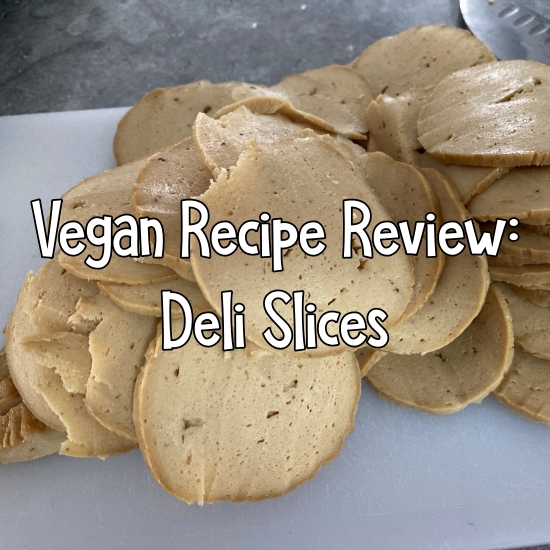
VEGAN RECIPE: Deli Slices (a modified recipe I finally perfected!)


I wasn't really sure what to call this post--it's not a simple review, but rather a recipe where I modified a the method a bit to *finally* make what I was hoping for: perfect seitan "turkey". I'd made several recipes around Thanksgiving and just couldn't get it "right"--the texture was always somehow off (a little or a lot).

The flavor also always had a very subtle underlying yeast-like taste (that sounds gross, but think of it like bread; which makes sense, considering a main ingredient is vital wheat gluten). It didn't taste BAD, and I actually found it pretty good--it just wasn't what I was going for.

I didn't want to give up on seitan, though--it's such a great vegan food! It has a very surprising nutrition profile, similar to meat (only without the saturated fat and cholesterol). Here is the info for this particular recipe (one serving, which is one-eighth of the "loaf"--a pretty large portion!):


The recipe I used for this was called Vegan Deli Slices (Smoked Seitan Turkey) and is meant to resemble the slices of smoked deli turkey--you know, the kind you put on sandwiches. Jerry loves sandwiches, and they are convenient for him to bring to work, so I thought I'd give this recipe a try.

It's from It Doesn't Taste Like Chicken, so I was skeptical; I'd tried her Thanksgiving turkey recipe and it didn't turn out very well. It wasn't terrible, but it was actually my least favorite of the ones I'd tried. The flavor was good but the texture was kind of spongy (and it had that yeasty undertone).

After playing around with more recipes, I learned that certain cooking methods worked better than others--and after putting some tips together with others, I *finally* perfected it! (The way my family likes it, anyway.)

The flavor is perfect: it's subtle, like with deli turkey, but you could certainly add more seasoning to give it a stronger flavor or even change the flavor profile altogether. There is zero yeast-like taste or smell. It's not spongy. And my favorite part is that it develops a slightly chewier outside "skin" on it, just like deli meat--you know, how the edge of each slice has a very thin skin? Yes, this seitan even has that!

We like to slice this and eat it cold (I don't make sandwiches or anything--I just eat slices of it because it's delicious!) Jerry likes it both on sandwiches and just plain. Noah will eat it plain. (Eli won't eat it because it's "weird" vegan food.)

The first time I made this recipe it was way too dry and I had to add a lot of water. I realized that was my fault because I'd pressed the tofu first and the recipe said just to drain it. Anyway, I'm getting ahead of myself. Here is (what I think is) the best seitan yet!

Here are the ingredients:


Firm tofu, white miso paste, apple cider vinegar, liquid smoke, salt, sage, onion powder, garlic powder, water, nutritional yeast, vital wheat gluten, and (which I forgot to picture) vegan bouillon powder or cube or paste. (I use a Not Chick'n cube. Usually when something calls for vegan bouillon, I use the homemade powder that I always rave about. But that gave this "turkey" loaf a yellow-tint, and it wasn't as appealing-looking.)

Note: This uses firm tofu and not the extra firm tofu that I usually buy. Also, I used rubbed sage even though the recipe calls for ground sage. I just use 1/2 tsp instead of a 1/4 tsp to make up the difference.

First, you just drain the tofu straight from the package. I don't freeze the tofu first and then thaw before using, like I usually do; for this, I just buy it refrigerated and from the refrigerator, I drain it--no squeezing or pressing. The liquid it holds is needed.

From here, I'm describing how I make it. Some of it varies from the original recipe in order to make this to my family's preferences.

So, after you drain the tofu, you just measure everything EXCEPT FOR the vital wheat gluten into a food processor or blender. I use this Ninja blender because it also has a dough blade/cycle, which is helpful later. You can use whatever tools you have that will 1) blend all of the ingredients--except the gluten--into a very, very smooth purée; and 2) be able to mix in the gluten.

The gluten thickens the dough very very quickly and it's not as easy to work with as bread dough or pizza dough. It's TOUGH. And that's why I like to use the dough blade on the Ninja. I haven't tried it, but I imagine the dough hook on a stand mixer might work, too. Otherwise, you can use a very sturdy utensil and some serious elbow grease to mix it together by hand.

Okay, so everything is measured into the food processor (except for the gluten). You'll have to break the tofu into pieces to get it to fit.


Then just let it rip. To get it completely smooth, I have to stop every 30 seconds or so and scrape down the sides to make sure everything gets mixed in. This is the part I dislike the most! I just use a small spatula to push it all down to the bottom, then blend again. Finally, I'll be satisfied when it looks like this:


It's basically the consistency of hummus. From there, I switch to the dough blade (it looks like the stacked blades that I use for blending, but the blades are made of plastic instead of steel).


Next, you dump in the vital wheat gluten:


I set it on the dough cycle, which is one minute long. It will come together quickly into a ball and the blender basically kneads it for about 15 seconds in the end. The original recipe says not to knead it, because it will turn the seitan tough and rubbery--but I've found that when you don't knead it, it has a spongey texture. I think kneading it is key for this.

(Or, if you're mixing by hand, scrape all of the wet mixture into a large bowl and add the gluten--then stir it all together until you can't stir anymore, and begin to knead by hand.)

After the dough cycle, it'll look like this:


At that point, it will feel a little sticky, but it will hold together and won't stick to your hands.

I lay out a long piece of foil--about 24 inches!--and put the ball on that.


From there, I knead the dough the best I can to get it to look uniform. It's really hard to make it smooth because the wheat gluten makes it springy. It wants to hold its shape. So I basically pinch closed all of the crevices I can, then try to smooth it all out the best that I can. There will likely be some crevices that you miss on the inside, which you'll see in the photos after it cooks, but it won't affect the taste or texture. There may just be a few holes in the slices.

Try your best to form it into a log shape. You don't want it to be too long because you want the there to be a few inches of foil on each side of the ends of the loaf.


There is no need to grease the foil. The original recipe says to roll it loosely in the foil to allow it to expand, but I've found that the texture is MUCH better when you roll it as tightly as possible. That's why I use such a long piece of foil--it won't come apart or break while it's cooking.

So I place the log at one end of the foil and, as tightly as I can, I roll it into the entire length of the foil so it looks like this:


Then, to make it even tighter and to seal the ends, I twist each end very tightly, while being careful not to rip the foil.


It will feel very tight and you'll be tempted to play with it--toss it around, bounce it, squeeze it--or maybe that's just me, who knows.

Anyway, prep a steamer basket--I use this silicone one that I bought on Amazon, but I don't love it, so I personally wouldn't recommend it; but it works, so I still use it. I put it in a large pan filled with water that stops just underneath the basket (you don't want to submerge the foil--it should be above the water). 


I the foil-rolled log into the basket and put a lid on it; then turn the heat on high until it starts to boil. Then I reduce the heat to medium-low (a "3" on a 1-10 gas stove) and set the timer for 60 minutes.


I *always* keep a large (quart-sized) measuring cup full of water next to the stove to add a little water to the bottom of the pan once in a while. I've made the mistake of forgetting to add water and when it burned dry, the smoke alarm went off for a while before I figured out what the issue was!

After 60 minutes, I turn off the heat and remove the foil wrapped log. It will feel extremely tight and kind of bouncy, like it's going to burst. For some reason, I love the way it feels, haha. But it'll be very hot, obviously--set it on a plate and let it cool off for a while. Don't unwrap it!

Then, when it's cooled down a bit (I give it a couple of hours), put it in the refrigerator--still in the foil--and leave it there all night long. Do not open it until the next day! If you do, the texture will be a bit spongey. But if you're patient, the following day it will be completely chilled and it'll feel a lot looser inside the foil.

Unwrap the foil and it will look like this:


Kinda neat-looking, right?

You can slice it thin for sandwiches (use a very sharp knife, or even a bread knife):


Or, what I like to do, is slice some of it thin for sandwiches and then slice bigger chunks into thick stick-like pieces for snacking:


Beware that this seitan is super addicting! Before becoming vegan, I was never a huge fan of deli meat--I could eat a little of it and then I would be grossed out at the thought of it. And when there were fatty striations in it (like in ham) I couldn't eat it at all. I *love* that there is no risk of biting into a piece of fat or something in this! I could eat this all day long and never get grossed out by it.

I haven't tried warming this up yet--we've always just eaten it cold--but I may start playing around with the recipe now that I've perfected the cooking method and texture.

It may look like a lot of work, but it honestly isn't bad. The prep work is little--just measure and blend everything. The hardest part is kneading in the gluten, but after that, you just let it steam and you don't have to do any more work. I make two loaves at a time (prepping one while the other is steaming) because we go through it pretty quickly.

I store it in an airtight container in the fridge. I don't know how long it keeps, because I think the longest it's lasted in our house is three days! But I've read that seitan freezes really well. You'll have to do your own research on that.

I totally understand that seitan is a "weird" vegan food and why people wouldn't even want to bother with it. Before becoming vegan, I wouldn't have even read this post, let alone consider making the seitan! Haha. But if you're an adventurous eater, I'd give it a try. I'm so glad I didn't give up on it, because it's one of my favorite foods now!

Featured Posts

Blog Archive